DarksNavigation
Nights during which the moon does not shine.
Page 354 of Patterson’s Illustrated Nautical Encyclopedia · 13 entries
Nights during which the moon does not shine.
An old-fashioned navigating instrument for measuring altitudes.
The length of time occupied by a complete revolution of the earth on its axis. Some certain point is chosen to mark the commencement of the day, and, as this is arbitrary, we have several kinds of days and times to consider, owing to various selections.
Astronomical Day. The day commences at noon of the civil day and ends at noon--the hours being counted numerically from oh. to 24h.
Civil Day. The civil day begins at midnight and ends at midnight, the 24 hours being divided into two equal parts--the twelve from midnight to noon being named A. M. (before meridian), and the twelve from noon to midnight named P. M. (after meridian.)
Intercalary Day. A day inserted in the calendar in leap year.
Circumnavigators' Day. The day added to or subtracted from the date shown by the ship's log-book when the vessel crosses the meridian of 180 deg. in sailing easterly and westerly respectively.
Lunar Day. The interval of time between two successive transits of the moon over the same meridian.
Nautical Day. An old-fashioned way of keeping time at sea. The day began at noon, and was 12 hours in advance of the civil day and 24 hours in advance of the astronomical day. Now obsolete.
Sea Day. Same as nautical day.
Sidereal Day. The interval of time between two successive transits of a fixed star over the same meridian. Sometimes called a star day.
Solar Day. The interval of time between two successive transits of the sun's centre over the same meridian.
Calculating the ship's position by dead reckoning.
Finding the true track which the ship has made and the distance thereon by correcting the courses sailed for leeway, variation and deviation, and entering them in a traverse table, and selecting from the nautical tables the difference of latitude and departure for same.
The angular distance of a heavenly body from the equinoctial, either north or south.
A degree is the 360th part of the circumference of a circle. Sixty minutes make one degree.
The pole below the observer's horizon.
The easting or westing made by a vessel. Parallel sailing is all departure. Also, to take departure is to determine the position of the ship after leaving port, and before the first course is set. Cross-bearings are generally employed for this.
(See Dip of the Horizon.)
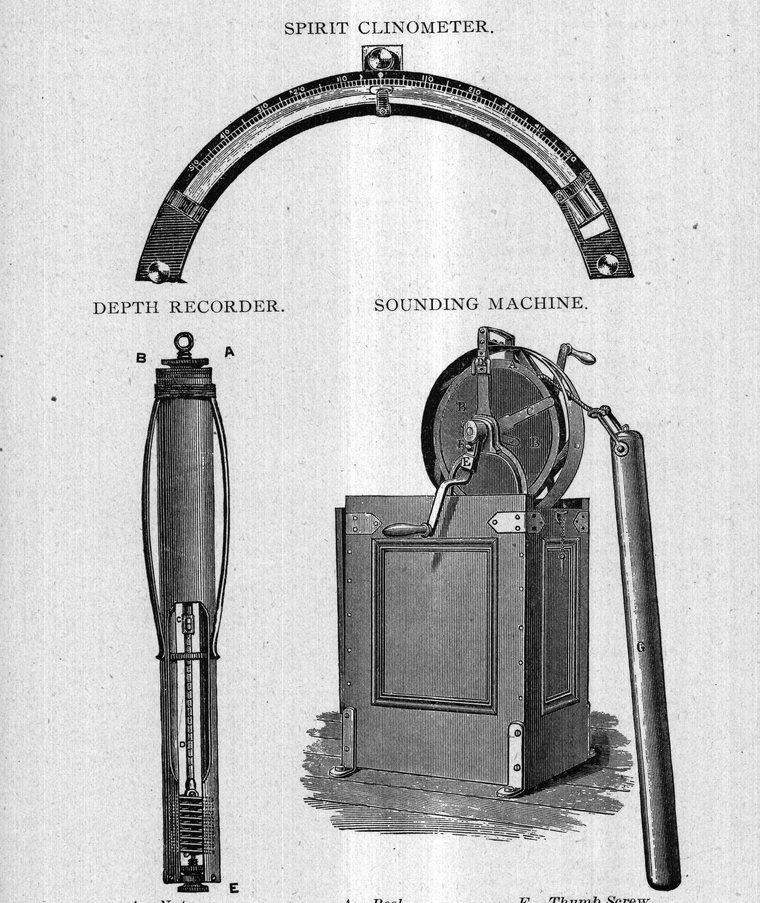
An instrument used for sounding purposes, which registers the depth it descends to.
The deflection of the compass needle from the magnetic meridian owing to the attraction of the ship's iron, or elements of magnetism in the cargo. It is named easterly or westerly deviation, according as the north point of the needle is drawn to the eastward or westward of the magnetic north.
A card showing the 32 points of the compass, and having marked opposite each the error on that particular point, and the compass course necessary to steer in order to make the magnetic course given by the chart.