Dumb TelescopeNavigation
The line telescope of an octant or sextant. This tube has no glasses, and is employed simply for guiding the eye to the horizon glass.
Page 360 of Patterson’s Illustrated Nautical Encyclopedia · 23 entries
The line telescope of an octant or sextant. This tube has no glasses, and is employed simply for guiding the eye to the horizon glass.
A sudden and violent flow of tide; the whole of the flood tide moving up a river in one or several successive waves.
The globe; the terrestrial sphere; in form an oblate spheroid; the third planet in order from the sun; equatorial diameter, 7,926 miles; polar diameter, 7,899 miles; surface, 197,000,000 square miles, of which 51,000,000 is land; moves round the sun in an ellipse in 365 1/4 days; least distance of the earth from the sun, 94,000,000 of miles; greatest distance, 96,000,000 of miles; velocity or the earth in its orbit, 19 miles per second; daily motion on its axis (velocity increasing from the pole), 1,440 feet per second at the equator; circumference at the equator, rather less than 25,000 miles; earth rotates on her axis in 23h. 56m. 4s.; inclination of the plane of the earth's equator to the plane of the ecliptic, about 23 deg. 28 min.
(See Earth.)
The cardinal point in that part of the horizon where the heavenly bodies rise.
A compass has easterly deviation when the north point of the needle is inclined to the right of the magnetic north, owing to the influence of the ship's iron.
A compass has easterly variation when the north point of the needle is inclined to the right of the true north owing to the angle subtended by the true and magnetic meridians.
The reflux of the tide; the running out of the tide towards the sea; the receding of the waters of the sea.
An imaginary great circle of the heavens or of the sphere, which represents the path described by the earth among the fixed stars in its annual revolution around the sun. The ecliptic intersects the equinoctial at an angle of about 23 1/2 deg. The ecliptic is the apparent path of the sun about the earth.
(See Compass.)
The pole above the horizon of the observer-equal to the latitude of the place.
An oval figure; the orbits of planets.
The difference in length between time as measured by the sun and time as measured by the moon.
An astronomical almanac; a tabulated form assigning the place of heavenly bodies for various days and hours.
An abridged work on navigation.
Double altitudes of the sun-one taken before and the other after meridian, when the angular measurements above the horizon equal one another.
To make equal.
The difference between apparent and mean time. Apparent noon sometimes takes place 16 m. 21 sec. before mean noon, and again 14 m. 28 sec. after. It disappears altogether four times in the year-about April 15, June 15, September 1, and December 24.
In measuring equal altitudes of the sun the declination of that body changes in the interval between the two sights, and the time correction for the hour angle is termed the equation of equal altitudes.
That great circle of the earth the plane of which is perpendicular to the axis of the earth; the imaginary line encircling the earth which is equi-distant from the north and south poles; the dividing line between the northern and southern hemispheres.
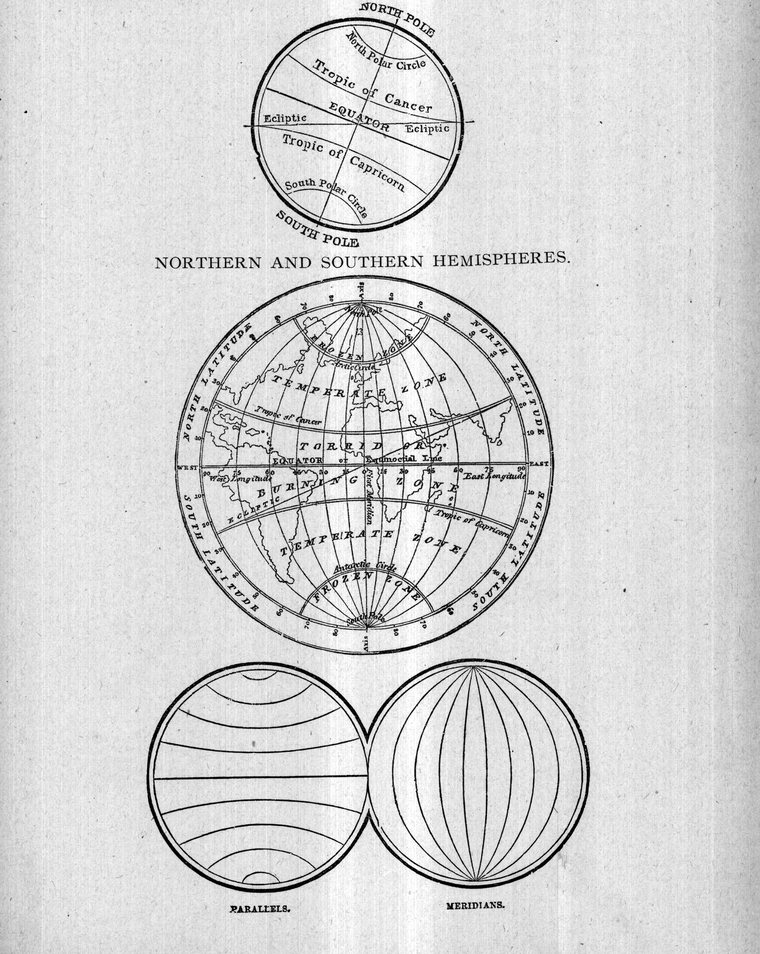
The westerly flow of the sea near the equator.
(See Earth.)
(See Earth.)