Sea HorizonNavigation
The circle at sea which bounds the observer's view; the blending of the waters with the sky.
Page 400 of Patterson’s Illustrated Nautical Encyclopedia · 23 entries
The circle at sea which bounds the observer's view; the blending of the waters with the sky.
The log-book kept at sea, in contradistinction to the harbor-log, which is kept in port.
(See Rate.)
In trigonometry a line drawn from the centre of a circle through one end of an arc, and terminated by a tangent drawn through the other end.
A great circle perpendicular to another great circle-meridians are secondary to the equinoctial.
A great circle of the sphere which passes through the poles of another.
Meridians other than the first or prime meridians.
A plane which revolves around or attends another-in contradistinction to primary.
Division of a minute; the sixtieth part of a minute of angular measure.
Division of minute; the sixtieth part of a minute of time.
An astronomical instrument for determining the zenith distance of stars-sometimes referred to as zenith sector; an instrument for determining the difference in declination and right ascension between two bodies whose distance is to great to be observed through a telescope with the aid of a micrometer.
An apparatus, an adjunct to the box-gauge, so arranged that the rising and falling float carries a pencil with which it describes a curve upon paper wrapped about a cylinder, which revolves by clockwork.
Deviation caused by the magnetism of the ship and the induced magnetism of vertical iron, which changes with time and the latitude of the ship.
Half a diameter; the radius of a circle.
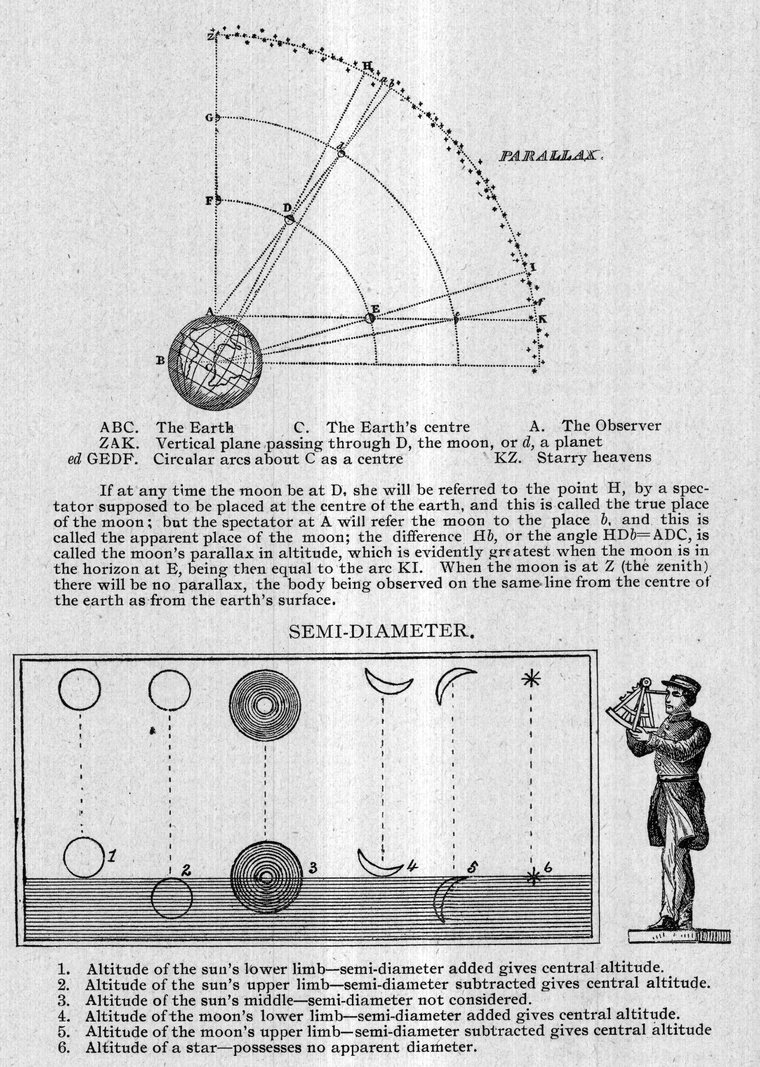
Half the diurnal arc-the part between the meridian and the horizon.
An inequality in the tides.
Half the nocturnal arc.
A plane, tangent to the earth's surface at the placed of the observer, and which extends to all sides until it is bounded by the sky.
A heavenly body is said to set when it dips below the horizon line; the set of a current is the direction of its flow; to set the course is to bring the ship's head to the required direction in sailing.
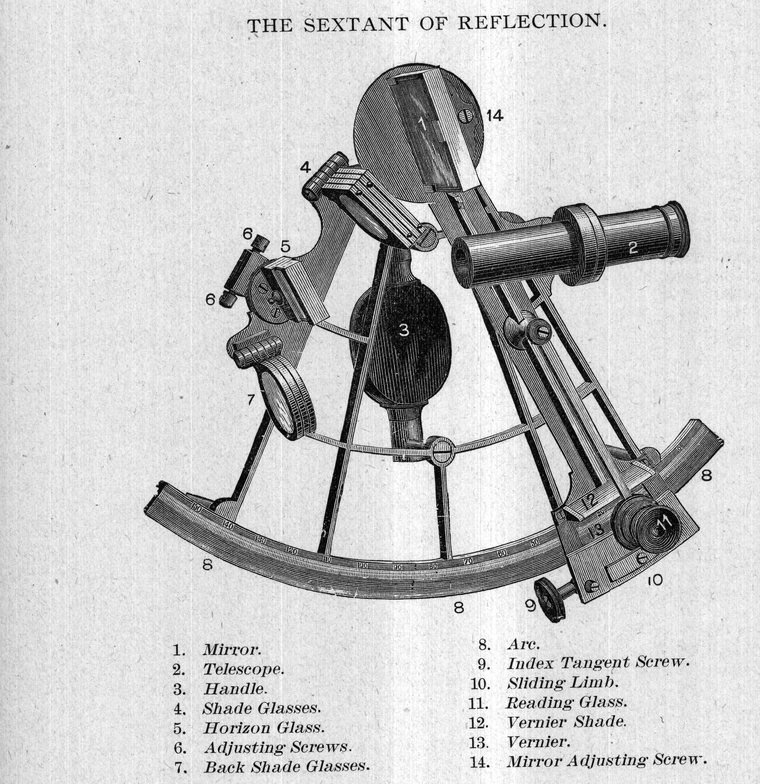
A navigating instrument of reflection used for measuring altitudes of heavenly bodies and vertical and horizontal angles of objects; its graduated are is divided into equal parts, the angles possible to measure on the instrument ranging form 120 degree to 140 degrees. (See engraving.) It is to 10 seconds of arc.
Ascertaining by the employment of the parallel rules ad the chart, or by middle latitude or Mercator's sailings, the bearing of the port of destination from the position of the ship.
A portable, slender pin about 6 inches long, so arranged as to stand vertically on the center of the compass glass. The shadow cast by it determines the sun's bearing.
(See Clinometer.)