Prestel's MethodNavigation
A rule sometimes made use of when working Sumner's method, so as to confine the ship to a limited portion of the line of bearing.
Page 394 of Patterson’s Illustrated Nautical Encyclopedia · 53 entries
A rule sometimes made use of when working Sumner's method, so as to confine the ship to a limited portion of the line of bearing.
(See Planets.)
First meridian; the starting point of longitude; the meridian from which longitude is reckoned east and west as high as 180 deg.; the meridian established by a country from which to reckon longitude in laying out their charts. The French use the meridian of Paris as 0 deg.; the English that of Greenwich; the Russians that of St. Petersburg; the Spaniards that of San Fernando; the Americans that of Washington, etc. The meridian passing through the national observatory of a country is selected as the prime or first meridian of that country. It is to be explained that a chronometer must be regulated to the meridian of the country whose chart is being used for navigating the ship. A ship having a chronometer set to Greenwich time must use English charts; a chronometer set to Paris time must have French charts, etc.
The vertical circle perpendicular to the meridian, and which passes through the east and west points of the horizon.
The plane upon which projection are to be made; the surface to be drawn upon.
In spherical projections the plane upon which the different circles of the sphere are projected.
An azimuth compass fitted with a prism glass, so that the bearing of an object can be read from the graduated card by reflection.
Delineations; maps; plans; representation.
These logarithms are employed in lunar observation for finding the mean time at Greenwich corresponding to the true distance of the moon from the sun or star.
A table for facilitating the process of interpolation in the employment of logarithms.
An instrument employed in plotting for laying off angles.
A navigating instrument of reflection, reading to minutes and graduated so as to measure angles up to 90 deg. (See engraving.)
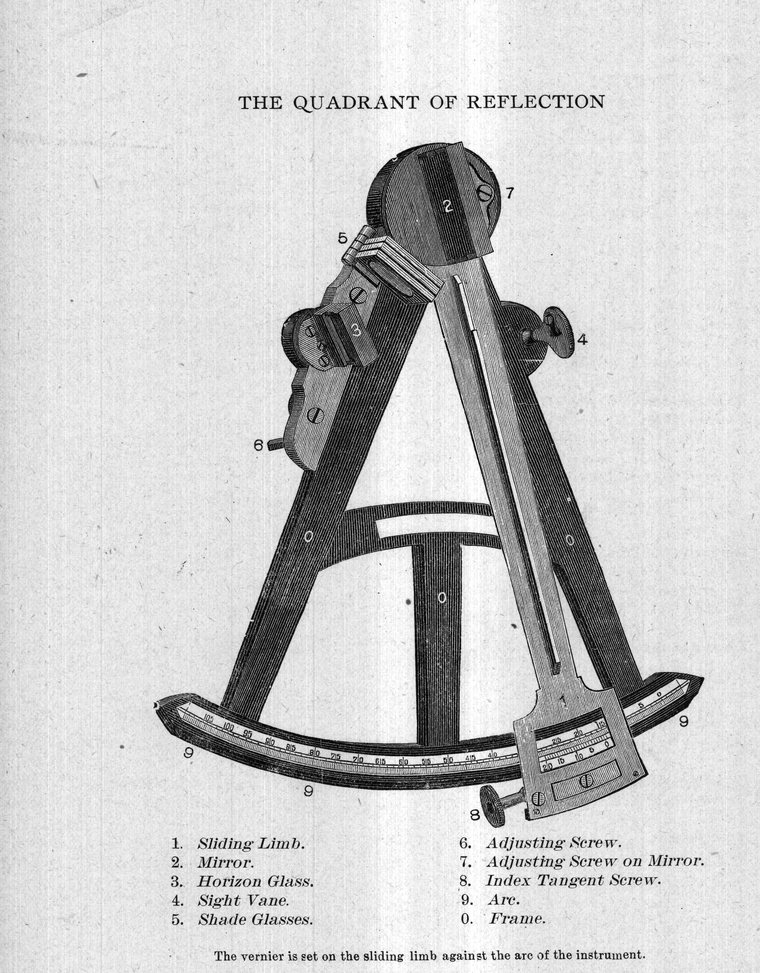
The error caused by the difference of the induced magnetism in thwartships and fore-and-aft horizontal iron in the ship. This error is corrected by two iron balls attached one on each side of the binnacle bowl.

Said of the moon when that luminary is 90 deg. from the sun--at one of the two points in her orbit equally distant from the opposition and conjunction.
A point from which rays of light or heat proceed; a point from which shooting stars diverge.
Half the diameter of a circle; distance from the centre to the circumference; the imaginary line joining the centre of the sun and the centre of a planet.
A bar secured at one end so as to turn around on a pin, and guiding a movable body in an arc.
The distance from the origin to the point. An imaginary line joining the centre of the sun and the centre of a planet.
A base; a root; 10 is the radix of the common system of logarithms.
A method of drawing the great circle so as to find the course from one place to the other, and lay off both courses on the Mercator's chart; next to ascertain the maximum separation in latitude, and to draw through this point a line parallel to the rhumb line between the two places. These three points being determined, the track can be approximately drawn by hand.
The daily variation of a timepiece; to determine the running of a chronometer in respect to a variation from a standard; to ascertain the extent of gain or loss in respect to true time.
Gaining Rate. When the chronometer runs too fast.
Losing Rate. When the chronometer runs too slow.
Sea Rate. On arrival in port after a voyage it will generally be found that the accumulated error of the chronometer, according to the record kept by the navigator, and which is based upon the shore rate furnished by the chronometer-makers, does not represent the correct aggregate amount of the chronometer deviation; thus proving that the daily rate given the navigator before sailing was not maintained by the instrument at sea. Now, in order to ascertain the sea rate, subtract between the error on the day of sailing and the gross error, determined when the vessel reached port, and then divide the remainder by the number of days at sea, and the answer will be the sea rate of the chronometer.
Shore Rate. (See Sea Rate.)
No chronometer will run for any length of time without variation, consequently its deviation from true time is determined, and allowance made for it by the navigator in his calculations. This variation can be determined in a variety of ways--by comparing the chronometer with the clock of an observatory, by time balls, by transit instrument, and by the employment of the sextant and artificial horizon in a time sight. To determine the rate, find the error made on different days, and divide the aggregate by the specified number of days. The answer will be the daily rate of the chronometer.
(See Horizon.)
To learn by observation; to discover by signs or characters.
To observe the angular measure of an object as shown on the are of an instrument of reflection.
Observing the numerals indicated by the log hands, and which figures represent the number of miles sailed by the ship.
Noting the hour, minute and second shown by a chronometer or other timepiece at a given instant.
A process employed in compass adjusting. One observer is stationed on shore with a compass set up in a position free from magnetic disturbances, and from which an unobstructed view can be obtained of the standard compass (over which a conspicuous mark is placed) on board ship. As the ship's head is brought to each one of the 32 points of the compass, mutual bearings are taken simultaneously by the observers on shore and on board.
The ship's latitude and longitude, by determined observations of the heavenly bodies, and by calculating the distances sailed on the various courses made.
A system of co-ordinates in which the axes are at right angles to each other.
Changing the form of an expression without changing its value; to change hours, minutes and seconds into are is called reduction of time; reduction of the elements in the nautical almanac is accomplished by interpolation or by proportional logarithms; reduction to the meridian consist of applying a calculated quantity in arc to the observed altitude, taken either in the A. M. or P. M., when working an ex-meridian sight, in order to ascertain the meridian altitude of the body for the place of observation.
The reflux of the tide has reference to its running out--a state of ebbing.
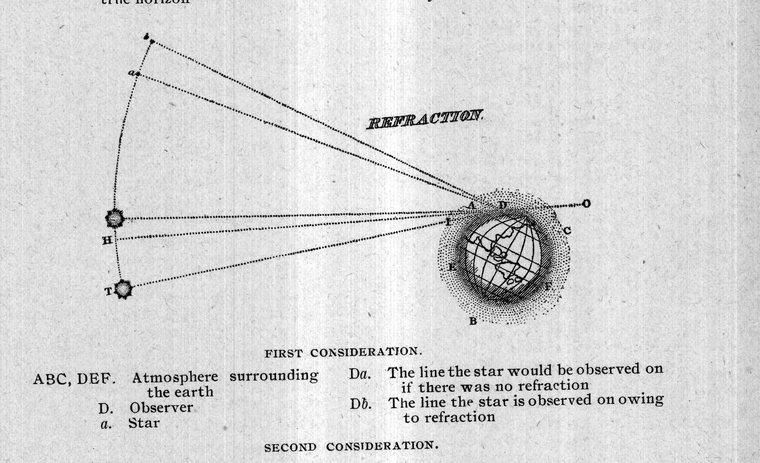
Astronomically considered, refraction is the change of direction assumed by rays of light passing through atmospheric mediums of varying densities. All the visible heavenly bodies, out of the zenith, are apparently elevated above their true place owing to refraction. The refracting power of the atmosphere changes according to the density--its temperature and moisture. As shown in engraving, when a heavenly body is in the zenith there is no refraction, the rays of light passing through the earth's atmosphere in direct lines; but the nearer the body is to the horizon the greater is the refraction. At the horizon refraction amounts to 33 min. of arc; consequently, that being about 1 min. more than the diameter of the sun or moon, those two bodies may actually be entirely below the horizon and yet appear slightly above it. The table of mean refractions considers the barometer to stand at 30 inches, and the temperature to be 50 deg. F. Terrestrial refraction has reference to the apparent change in position assumed by a terrestrial object owing to the difference in density of various portions of the earth's atmosphere--the amount varying from 1-3 to 1-23 of the intercepted arc.
An astronomical instrument for reducing the error of imperfect graduation by repetition of the observation, reading it on different parts of the graduated limb, and striking the mean of the values found.
When a compass is adjusted the deviation is compensated as much as possible by the employment of magnets, but the remaining amounts of error for the respective points are tabulated and given the name of residual errors.
This is also known as the age of the tide, and has reference to the interval between the transit of the moon at which the tide originates and the making (appearance) of the tide.
The motion of the planets among the stars is eastward, but when they arrive in the quarter of the heavens opposite the sun their motion is westward, and this latter motion is termed retrograde--motion contrary to the order of the signs.
The course of a heavenly body round a centre; the interval of time occupied by a heavenly body in its consecutive return to the same meridian.
Sidereal Revolution. The time occupied by a planet in passing round the sun.
Synodic Revolution. When the earth, the planet and the sun come again in the same relative positions.
Also known as hurricanes, typhoons and cyclones. Currents of air within the limits of the storm disc moving in concentric circles around a centre of low pressure.
A vertical circle intersecting the horizon; the track of a ship which sails constantly toward the same point of the compass.
Which cuts all the meridians which it crosses at the same angle, forming a spiral which approaches nearer and nearer to the ole but only reaches it after an infinite number of turns-this is also known as the loxodromic curve; a line prolonged form any point of the compass on a nautical chart.
Angle of the Rhumb. The angle at which the rhumb cuts the meridian.
Complement of the Rhumb. The angle made by the rhumb with the prime vertical.
The courses of the ship, or the line shown on a chart which connects the place of departure with the place of destination.
The distance of a heavenly body from the first point of Aires, considered in time eastward on the equinoctial, from oh. (0 deg.) to 24th. (360 deg.) Right ascension and declination determine positions of the heavenly bodies on the celestial sphere.
The angle at the pole included between the meridian of the observer and the meridian passing through the First Point of Aries. It is reckoned eastward in the order of the Signs.
Sailing on one of the four cardinal points (N. S. E. W.)
Calculations performed according to exact principle; precise; accurate; allowing no abatement.
The coming into view of a heavenly body over the horizon line; the mounting of a body in the heavens. All heavenly bodies continue to rise until they cross the meridian, when they commence to fall.
The deck journal kept by the watch officers, the contents of which are copied daily into the smooth log book.
Taking bearings of various points on the shore line as the ship runs along the coast. The track of the ship is the base line, and the intersection of the bearings fixes the positions of the shore line; the position of the ship is determined by altitudes of the sun measured on the sea horizon. This method is by no means accurate, owing to leeway, currents, deviation is steering, etc., but is profitably employed when landing is impossible from various causes.
Under head are classed rhumb, great circle, plane and spherical sailings.
A secondary planet; the moon of a planet.
A wind blowing from the sea, toward the land.
Until a few years ago navigators followed the absurd practice of commencing their date at one noon and ending it at the next noon, so that the sea day was always 12 hours in advance of he civil day and 24 hours in advance of the astronomical day. That fashion is now obsolete.