Balanced ValveEngineering
A valve arranged so that the pressure tending to force it against its seat is wholly or in part counteracted.
Page 418 of Patterson’s Illustrated Nautical Encyclopedia · 18 entries
A valve arranged so that the pressure tending to force it against its seat is wholly or in part counteracted.
The burning fuel is heaped up in one part of the furnace, leaving the grate partly bare. The heap is then covered with coal or ashes that combustion may be almost entirely checked, while enough heat is furnished to keep the water hot in the boilers.
A term sometimes applied to the frame in which a screw propeller is hung.
A vibrating lever through which power is transmitted from the cylinder to the crank.
The cast iron framework of a built-up beam.
The bearings which support the beam.
The wrought band about the beam centre.
A support for a shaft journal, and in which it revolves or vibrates. Main Bearing. That nearest to the crank.
Spring Bearing. Those supports between the engine and wheel which support the weight of and steady the shaft.
Stern Bearing. The long bearing built into the after-end of a screw vessel, and through which the shaft passes. It is arranged to support the after-end of the shaft, allow it to revolve freely, and prevent water leaking past it into the vessel.
Thrust Bearing. That one about a screw propeller shaft which is arranged to receive the pressure due to the revolving screw and transmit it to the hull of the vessel.
Iron bars across the furnace supporting the ends of the grate bars.
The foundation piece upon which an engine is erected.
The system of pipes and valves through which water from the bilge can be drawn into the condenser if desired.
One connected to draw water (which may collect) from the bottom of the vessel and deliver it overboard.
The cap of a bearing covering the journal.
Pipe and valves for leading steam from boiler or main steam pipe to condenser direct.
Fans for moving air, either for ventilation or to aid furnace draft.
Discharging dirty or super-salted water from a boiler.
These are surface and bottom. Those through which water and sediment are discharged from boiler.
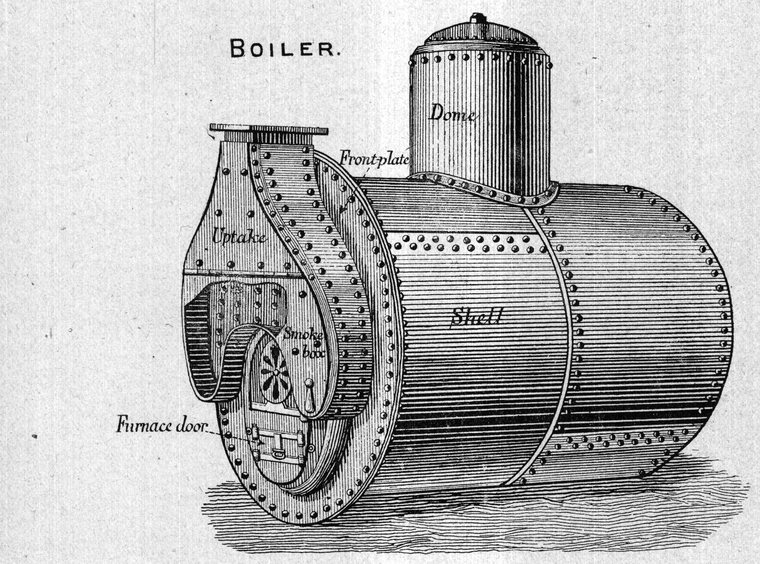
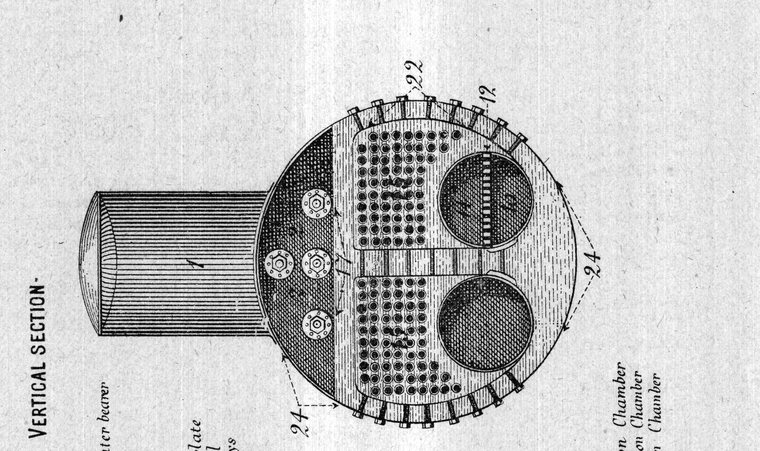
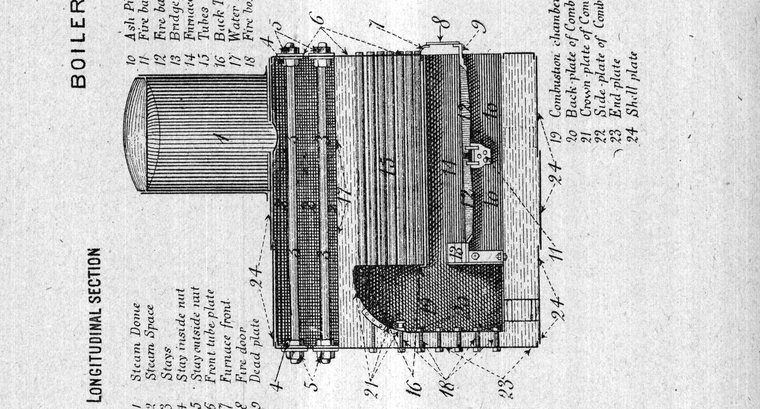
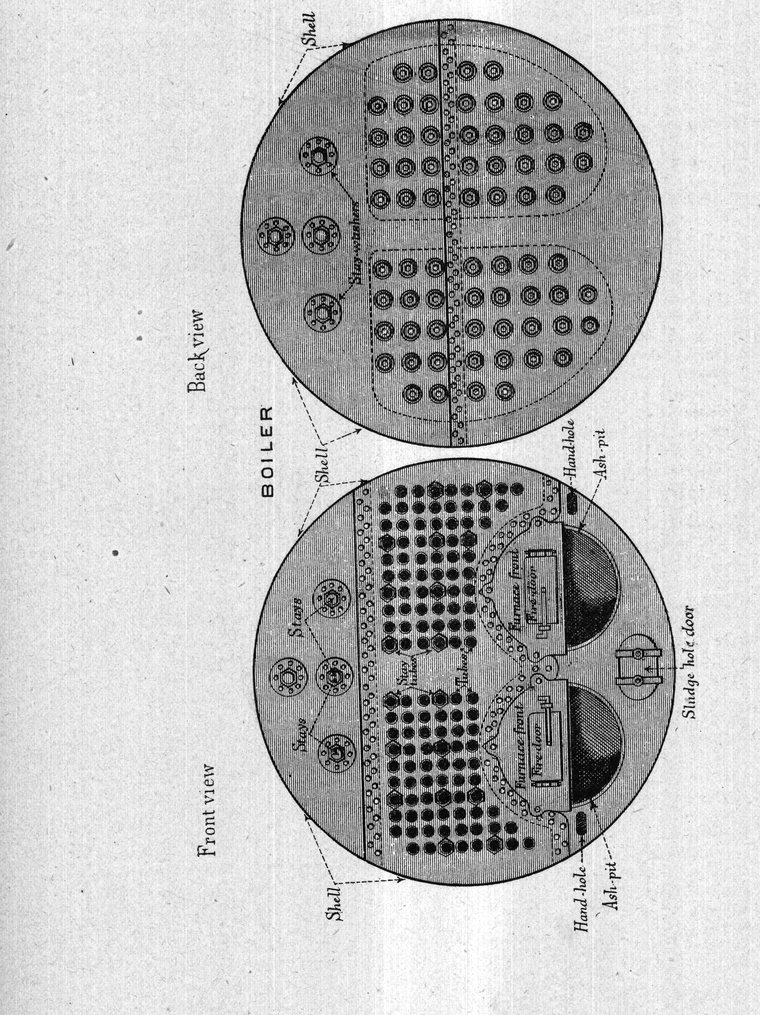
A closed vessel in which steam is generated from water. The various kinds of boilers come under the following heads:
Drop Flue Boiler. One in which the course of the gases is direct from the furnace through flues back to a connection, then down, returning towards the front through flues underneath the first series, thence into another connection and down and through a third series of flues to the smoke-box at the back end of boiler.
Fire Tube Boiler. The water circulates about the tubes and the fire through them.
Horizontal Return Tubular, or Flue, Externally Fired. Cylindrical in shape, containing small tubes reaching from end to end. The furnace is directly under the shell, the products of combustion passing along the bottom of shell to back end, thence returning through tubes or flues to the smoke-box.
Horizontal Return Tubular, Internally Fired-"Scotch." Cylindrical in shape, containing one or more cylindrical furnace flues. From the furnace the gases pass back into a connection, thence return through tubes above the furnace to the smoke box on front end.
Horizontal Return Tubular, Double Ended. The same as two single boilers back to back, but enclosed within the same shell.
Lobster Back. One in which the course of the gases is from the furnace into a low connection, and from thence into flues leading forward to another connection, returning over these flues and the furnace through other flues to a front connection, thence back through tubes to a middle connection and up to chimney.
Locomotive. Has an arched, flat-sided part called "wagon-top," containing one flat-sided furnace with arched crown, and built on to the back of it a cylindrical part called the "barrel." The gases pass from the furnace back through small tubes direct to smoke-box at back end.
Return Tubular; Leg; Flue and Return Tubular. Has an arched, flat-sided part called "wagon-top," containing one or more flat-sided furnaces with arched crowns; built on to the back of this is a cylindrical part called the "barrel." The gases pass out of the furnace through flues at the bottom of "barrel" to back connection, thence returning through small tubes over flues and furnaces to the smoke-box at front end.
Upright Tubular. In shape a cylinder set on end. The furnace is at the lower end and the gases pass upward through tubes to the smoke-box at top.
Water Tube Boiler. The water circulates through the tubes, and the fire circulates about the outside.