Zenith DistanceNavigation
The angular distance of a heavenly body from the zenith--the complement of the altitude, or what an altitude lacks of being 90 deg.
Page 416 of Patterson’s Illustrated Nautical Encyclopedia · 23 entries
The angular distance of a heavenly body from the zenith--the complement of the altitude, or what an altitude lacks of being 90 deg.
An astronomical instrument used for exact observation of stars in or near the zenith.
The point at which the graduation of a sextant, etc., commences.
An imaginary zone in the heavens within which the sun, moon and larger planets appear to perform their annual revolutions. (See Signs.)
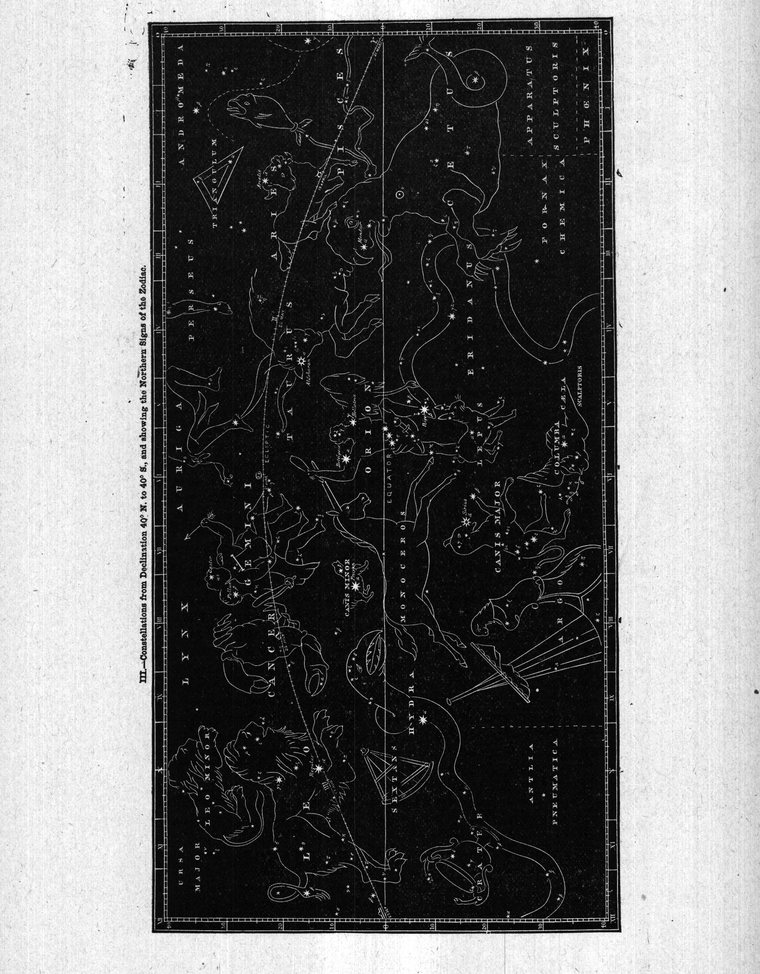

An ill defined light extending from the horizon upward, and following generally the course of the ecliptic. Generally observed in the spring of the year soon after sunset.
A belt; a girdle. There are five zones; the torrid zone, which extends 23 deg. 28 min. on each side of the equator; the two temperate zones, which extend from 23 deg. 28 min. to 66 deg. 32 min., and the two frigid zones, which extend from 66 deg. 32 min. to the poles.
The thin sheet-metal lining of the hole in the deck through which the smoke-pipe passes.
A closed vessel communicating with the discharge side of a pump. Air is confined in it above the liquid, and by its elasticity equalizes the flow of the liquid.
A pipe leading air from the blower to the ash pit.
An instrument attached to an air duct to register the pressure therein.
That pump which removes air and water of condensation from the condenser.
A valve to admit air to the circulating pump to act as a cushion to lessen or soften the shock of the water.
A composition metal frequently used for lining journal boxes to reduce friction.
A tube at the side of a vessel through which to deliver ashes over-board.
Mechanism for lifting ashes out of the fire-room.
A receptacle placed in the bottom of the ash pit in which to collect ashes.
The space in a furnace below the grate bars.
That line on an indicator diagram traced by the pencil point when the indicator piston is exposed to atmospheric pressure only.
Small engines, pumps and boilers that may operate independently of the main plant.
A metal with which a bearing journal is sometimes lined. It is composed of tin, copper and antimony.
A space in a boiler, back of the furnace, bounded on the forward side by the back tube sheet, provided to allow gases from the furnace to combine more thoroughly, and to give room to make repairs.
The pressure in a steam cylinder which resists the movement of the piston during the time of exhaust.
A metal plate used in a boiler to direct the flow of gases. It is usually applied as a lining plate for the fire door.