Bridle PortNaval
The forward port on the gun deck.
Page 460 of Patterson’s Illustrated Nautical Encyclopedia · 17 entries
The forward port on the gun deck.
The prison on board ship.
A brush made of hog bristles and used for cleaning the interior of the gun. It is passed through from the breech after every half-dozen rounds.
A broad piece of bunting cut swallow-tail for a commodore, and rectangular for a rear admiral--the commodore's has one and the rear admiral's has two stars in the flag.
A simultaneous discharge of all the guns on one side.
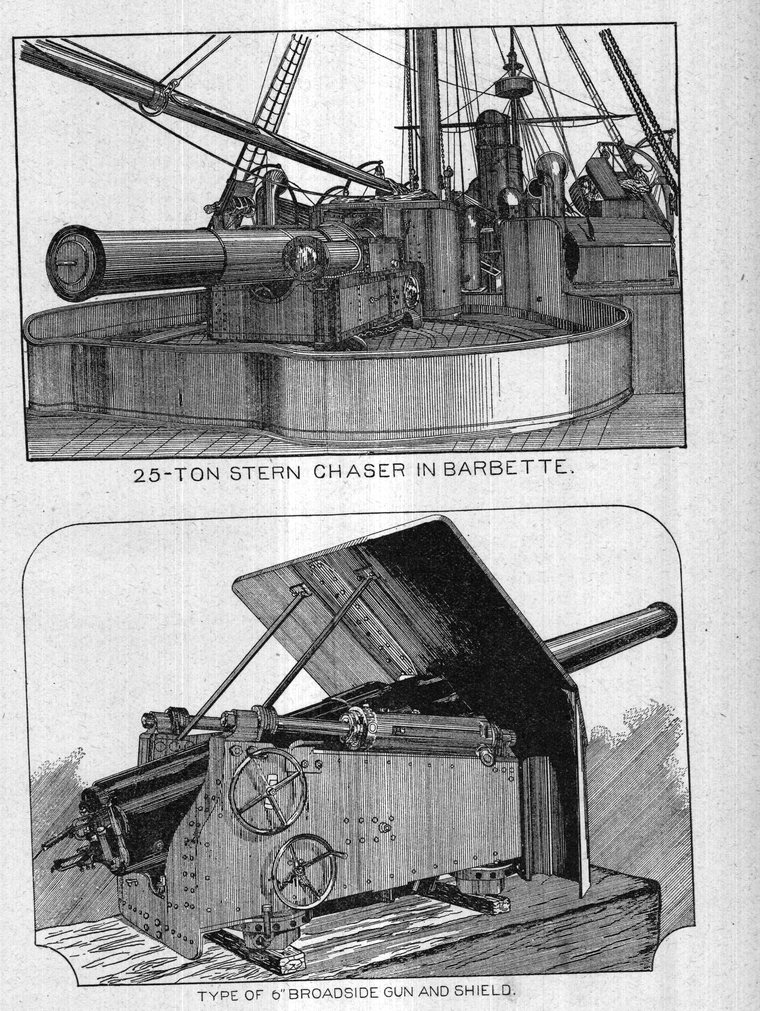
As the name indicates, a gun on the side of a vessel.
A cutlass; a cutting sword with a heavy, broad blade.
A tompion to fit into the circular opening in the half-ports.
The business of the Navy Department is divided under eight heads, called Bureaus, each one being presided over by an officer of the navy, who, if below the rank of rear admiral, is given that rank, or, in the case of a staff officer, the relative rank of rear admiral. The eight bureaus are as follows: Ordnance, Equipment and Recruiting, Navigation, Yards and Docks, Medicine and Surgery, Provisions and Clothing, Steam Engineering, Construction and Repair.
A student in the art of military science.
The lowest grade of staff officer in the navy. A student at the Naval Academy belonging to the steam engineering branch of the service. After graduating he pursues the same course as the cadet midshipman. (See Naval Academy.)
The lowest grade of line officer in the service. After graduating from the Naval Academy, two years must be spent at sea, after which the cadet midshipman returns to the Naval Academy and undergoes a final examination, and if successful in passing same he is promoted to midshipman. (See Naval Academy.)
A rest for a rapid-fire gun, taking its name from the shape of the support.
A thin sheet-iron shell filled with cast-iron shot, and closed at each end by discs of wood. When the piece is fired the mass is scattered.
Under this head belong guns, mortars and howitzers.
A naval captain is the next grade below a rear admiral, and the next grade above a commander. The commanding officer of a man-o'-war is called captain, irrespective of his rank. The leading men among the crew are called respectively: captain of the top, hold, and afterguard. The captain of the head is a jocular title given to the man, generally a negro, whose duty it is to keep the head clean.
This office was abolished by Act of Congress in 1878; previous to which it signified an officer holding the relative rank of midshipman, appointed from civil life by the commanding officer of a man-o'-war, to act as his amanuensis. The appointment was subject to the approval of the Secretary of the Navy, and remained in force until the expiration of the cruise of the vessel, or until the commanding officer was detached. Midshipmen and ensigns are now detailed by the commanding officer to perform such duties.