Mess ClothNaval
A sailor's table-cloth--a tarpaulin spread on the deck and designed to protect the latter from contact with the seamen's tin plates, cups, etc, as well as the spillings from the same.
Page 482 of Patterson’s Illustrated Nautical Encyclopedia · 26 entries
A sailor's table-cloth--a tarpaulin spread on the deck and designed to protect the latter from contact with the seamen's tin plates, cups, etc, as well as the spillings from the same.
Pots, pans, plates, spoons, forks, knives, etc.
A boy who carries message to various parts of the ship from the quarter-deck, being under the personal command of the officer of the deck.
The unity of the French measure in length, being equal to 39-37 English inches.
A measuring instrument used in connection with the crusher gauge.
A line officer one rank lower than an ensign, and one grade higher than a cadet midshipman.
Masts designed to support military tops.
Tops encircled with a barbette of steel, from behind which machine guns are worked when the vessel is in action, and by which a plunging fire is obtained.
In French measure a thousandth part of a metre, or .03937 of an English inch. Hotchkiss guns are often referred to as "37" and "47", meaning that they are respectively 37 millimetre and 47 millimetre in relation to the diameter of the bore.
A Gatling gun. (See Gatling Gun.)
(See Torpedo.)
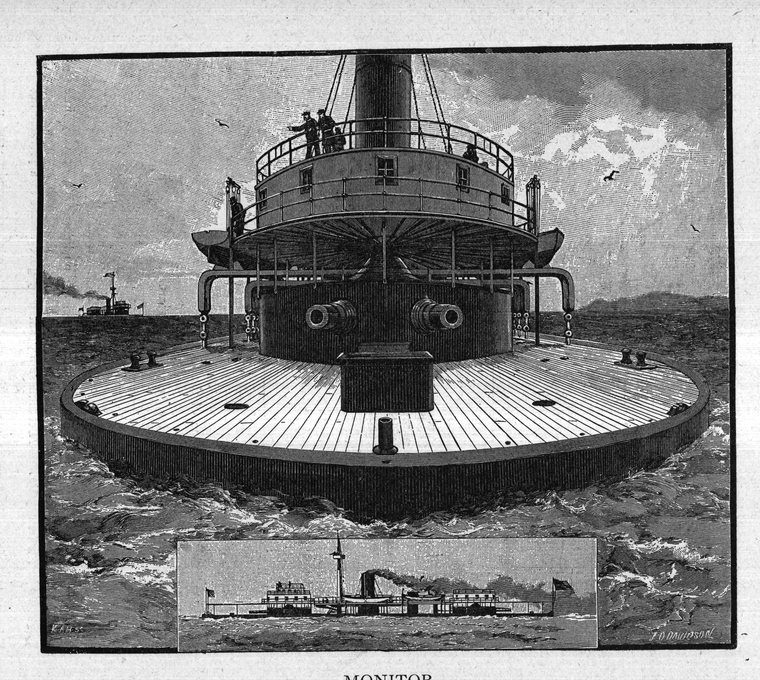
The turreted ironclad vessel designed by Mr. John Ericsson in 1861 was named the Monitor, and that name has become a general designation for all vessels of that type. The Monitor drew about twelve feet of water, the hull was almost immersed, and the cylindrical turret revolved so that an all-round fire could be maintained while the vessel remained stationary. The Confederates called this vessel "cheese-box on the raft."
The gun fired from the flagship announcing daybreak.
A very short piece of ordnance possessing a large bore, and used for throwing shells at an angle of 45 degrees.
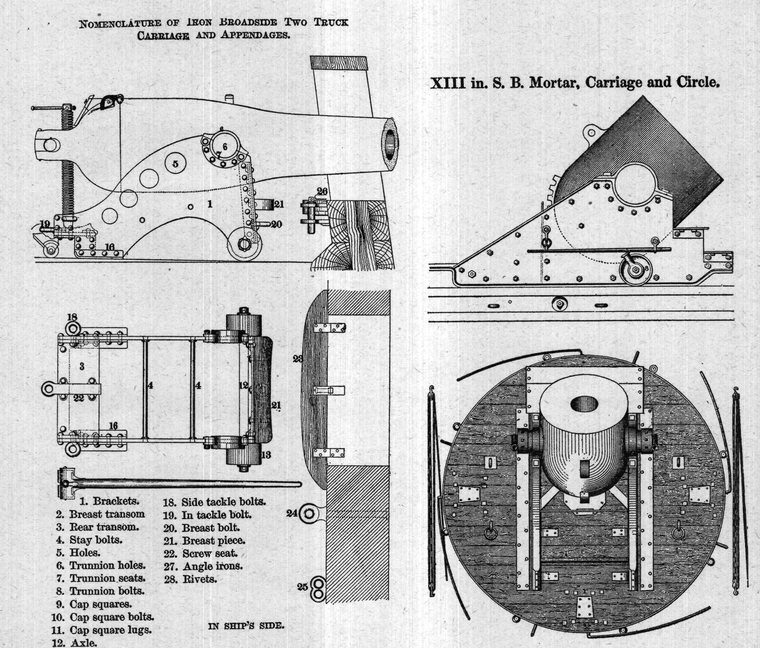
The circular platform on which the mortar rests.
A vessel designed for carrying and working a mortar, and resembling a platform or raft.
A vessel mounts ten guns, i.e., carries ten guns. When a gun is placed on its carriage it is said to be mounted. The term also applies to carriages for Gatling and rapid-fire guns.
A term applied to a line officer who entered the navy from the merchant service instead of graduating from the naval academy.
The peculiar shape resembling a mushroom found attached to the breech plug in all rifled breech-loading cannon. Together with its pads it helps to check the pressure of the gas on the plug when the charge is exploded.
The continuation of the mushroom, which passes through the plug, and to which the firing attachment is secured.
To assemble; to call together for inspection.
A covering placed over the muzzle of a gun to exclude water.
A lashing used to steady the muzzle of a gun.
A gun which is charged at the muzzle instead of the breech.