Store ShipNaval
A government vessel employed in carrying stores of various kinds for the use of men-o'-war.
Page 510 of Patterson’s Illustrated Nautical Encyclopedia · 32 entries
A government vessel employed in carrying stores of various kinds for the use of men-o'-war.
(See Uniform.)
When projectiles are smaller than the bore of the gun they are called sub-calibre projectiles, and are fired from the guns by the aid of contrivances which reduce the diameter of the bore to the size of the projectile.
A gun projecting shell from a point below the surface of the water.
(See Torpedo.)
Explosive shell fired from submarine guns.
Men in excess of the ship's complement, or extra members of a boat's or gun's crew.
(See Medical Corps.)
An ordered examination of government stores. (See Medical Survey.)
To prohibit an officer from performing duty is to suspend him.
A small piece of ordnance turning on a pivot.
The drum-beat previous to 9 p. m., at which time two bells are struck and "pipe down" made.
A new and powerful explosive, the component parts of which is eighty per cent. nitro-glycerine, the secret of its power being in the mode of purification of the nitro-glycerine. It is claimed for this explosive that it cannot be exploded by shock, requiring to be fired by detonation. (See Detonator.)
A ship carrying guns upon three gun decks, besides her spar decks.
An invention of Dr. H. P. Tuttle of Tacoma, State of Washington. Named thorite after Thor, the Norse God of Thunder. It is more powerful, and deadly in its execution than the English lyddite shells or the melenite of the French.
Its power lies in its capacity to rend and tear a ship to pieces after the shell has penetrated through the vessel's armored side.
The danger of most high explosives like dynamite is the risk in handling them. But thorite has stood the most exacting tests at the Sandy Hook proving grounds.
The shock of going through 10 inches of armor did not explode it. Filing, rasping and putting it on a red hot stove did not explode it.
It explodes only by a fuse and a detonating cap, which can be timed to go off when the shell has buried itself in a ship's hull.
When one of these shells was exploded at Sandy Hook, 20,000 fragments of it were picked up afterward. The target at which it was fired consisted of a 12-inch armor plate, backed by ten feet of oak beams and thirty feet of sand. Of this compact pile of metal, wood and earth only a hole in the ground was left to mark where the projectile entered the target and exploded.
Thorite shells are fired with the usual charges of smokeless powder, and so can be used in any regular service gun, either military or naval.
A fuze so constructed as to permit the regulation of the number of seconds between the firing of the piece and the explosion of the projectile.
The wooden plug fitted into the muzzle of a gun for the exclusion of dust and water.
A mount for a small gun in the military top on the mast of a vessel.
A small piece of ordnance once used in the tops of men-o'-war, but which has since been succeeded by rapid-fire guns and Gatlings.
Torpedoes are divided into three classes: Mobile Torpedoes are of the Whitehead or Howell type, which possess their own motive power; Auto-Mobile, or Controllable Torpedoes, in which the motive power is furnished by gases and their movements controlled by electricity; Boat or Spar Torpedoes are carried on the ends of spars projecting from the bows of steam launches, and exploded by electricity from the boat, the idea being to push them below the water-line of an enemy's vessel and explode them while in contact. There is also a kind of torpedo called Submarine Mine, which rests on the bottom and is used to defend channels and entrances to harbors. Gun cotton is the explosive used in all naval torpedoes.
A small, swift vessel with little freeboard, designed for creeping upon an enemy's ship and exploding a torpedo against her side.
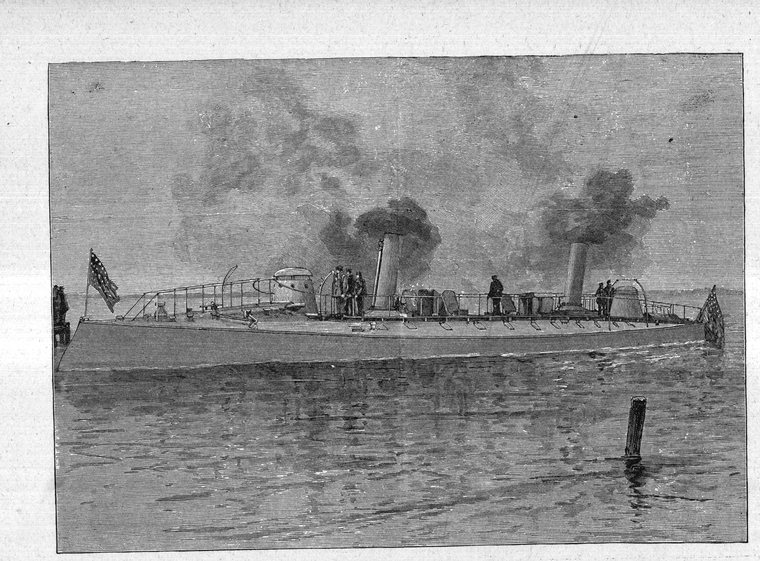
A small, fast boat designed for the double purpose of exploding a torpedo against an enemy's vessel and ramming her also. Such a vessel is the Alarm of our navy.
A place where the science of torpedo practice is taught.
The tongue of a howitzer carriage which rests on the ground.
A wooden bar by which the trail of a howitzer carriage is turned and the piece pointed.
A rope made fast to the trail of a howitzer carriage, and by means of which it is directed while in motion.
An instrument for ascertaining the elevation or depression of a gun, or for sighting the same.
An instrument consisting of a level and pendulum, designed for pointing guns.
A tackle, one block of which is hooked to the rear of a broad-side gun-carriage, the other block being hooked to an eyebolt admidships. By this tackle the gun is run in, and is also prevented from running out while it is being loaded. The tackles which run a gun out are known as side-tackles--old ordnance.
The curve which a projectile describes after leaving the gun.
When officers and men are changed from one vessel to another they are said to be transferred.
A vessel employed in carrying troops from one place to another. The name is sometimes applied to vessels carrying cargoes of war material.