Dragging the AnchorSea Terms
To trail the anchor along the bottom by reason of the vessel having stern way on her. The failure of the anchor to hold the vessel.
Page 100 of Patterson’s Illustrated Nautical Encyclopedia · 20 entries
To trail the anchor along the bottom by reason of the vessel having stern way on her. The failure of the anchor to hold the vessel.
The depth of water contained between the water's edge and the bottom of the keel, expressed in feet and inches, is called the vessel's draught.
When a sail is distended by the wind it is said to draw; a vessel draws so many feet of water; to move away is to draw from; to approach is to draw upon; to draw away or let draw is to allow the weather jib or staysail sheet to be slacked off after tacking ship, so that the sail may be sheeted down to leeward.
The rope which runs along the leach of foresails, mainsails, and jibs, being spliced into the head cringle, and leads down through the space in the tabling between the bolt rope and the sewing of the seam. It then leads out through an eyelet-hole in the clew. It is used to strengthen the leach and prevent that part of the sail from slapping when the leach is too slackly roped, or when the body of the said is shrunken by dampness.
(See Fearnaught.)
A machine belonging to a mud-digger for scooping up in a great hod or tank the bottom of rivers, harbors, etc., for the purpose of deepening the channel.
Displaying flags at the mastheads; also making a span of them from jib-boom end, over the mastheads and down to the outboard end of the spanker boom (this latter is called rainbow dressing). Otherwise having a string of flags from the mastheads down to the deck.
The length of rope over and above that which is utilized. Also the set of a tide or current, and a vessel's leeway.
A hand-lead dropped over the side when at anchor to ascertain if the vessel is dragging by observing the trend of the line.
To hit home a bolt, etc.: a ship drives when scudding before a gale, or drives to leeward when under no control of the rudder or her sails.
A term sometimes applied to the spanker. The name is derived from the large square sail which in olden days was set on a yard on the end of the spanker-boom.
A small craft used as a lighter in the West Indies.
The depth of a square-sail amidships from head to foot: applies to courses which do not hoist, but are dropped.
To let go the anchor. To anchor the vessel.
The retrograde motion of a vessel: when a vessel goes back-wards through the water. (See Fall Astern.)
(See Fall Down.)
Working with an adze.
A small French sailing vessel trading between Channel ports and the Levant, from which latter place it brought back drugs and spices.
The same as Capstan Head: the top of the capstan where the bars are shipped.
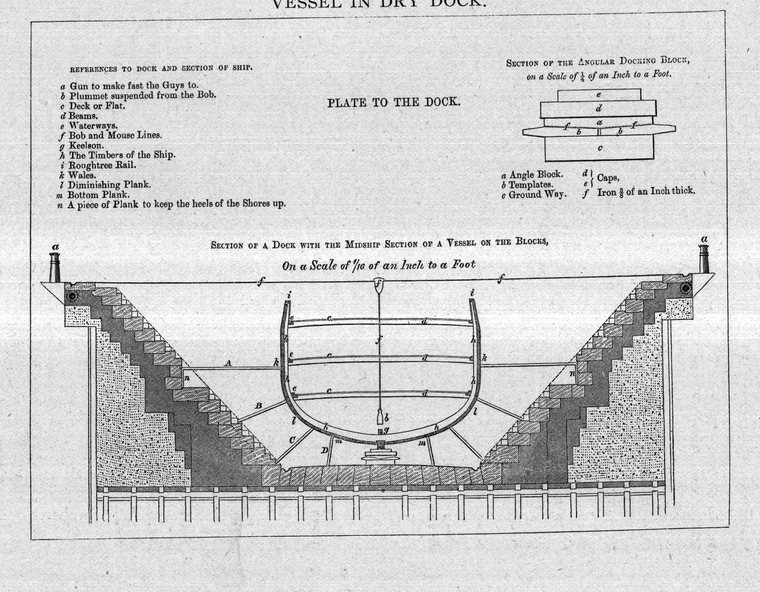
An artificial basin into which ships are floated, then the entrance to the basin closed by a gate and the water pumped out, leaving the vessel resting dry, her keel on keel-blocks, and her sides supported by bilge-shores. Also a huge platform which is sunk so as to allow a vessel to be floated over it, then the dock raised by different appliances, lifting the vessel entirely out of the water, and supported as explained above. Dry docks are described under the following heads:
A Graving Dock, strictly speaking may be either a basin or platform, but the name is employed principally in connection with basin or stationary docks. The word "graving" means the cleaning of a vessel's bottom, and this may be done as well on a floating as on a basin dock.
A Sectional Dock is a platform on which a vessel is raised out of water by a series of air-tight boxes.
A Floating Dock is another name for a sectional dock.
A Balance Dock is a platform so-called owing to the means provided for retaining it perfectly level by pumping water into or out of the side chambers as required.
A Box Dock is the name sometimes given to a basin dock.
A Basin Dock is the name at times applied to a stationary dock.
A Stationary Dock is a basin dock.
A Portable Dock is a floating dock.
A Screw Dock is constructed specially for small vessels, being a platform which is raised and lowered by means of large iron screws connecting the platform and the stationary frame above it.
An Hydraulic dock is a platform which is lifted clear of the water by means of chains pasing over pulleys in the side frames of the dock and connecting with a hydraulic engine. (See Gridiron: Wet Dock.)