EntranceSea Terms
The lower part of the vessel's bow above the water line.
Page 106 of Patterson’s Illustrated Nautical Encyclopedia · 24 entries
The lower part of the vessel's bow above the water line.
The place on the stern of a vessel where the name is either painted or raised.
A length of wood having a number of parallel holes bored in it, and used to spread the legs of the awning crow-foot.
When a vessel has no list, and is resting on the water so that the same proportion of the water line forward and aft is either submerged or elevated, she is said to float on an even keel.
(See Euphroe.)
(See Protest.)
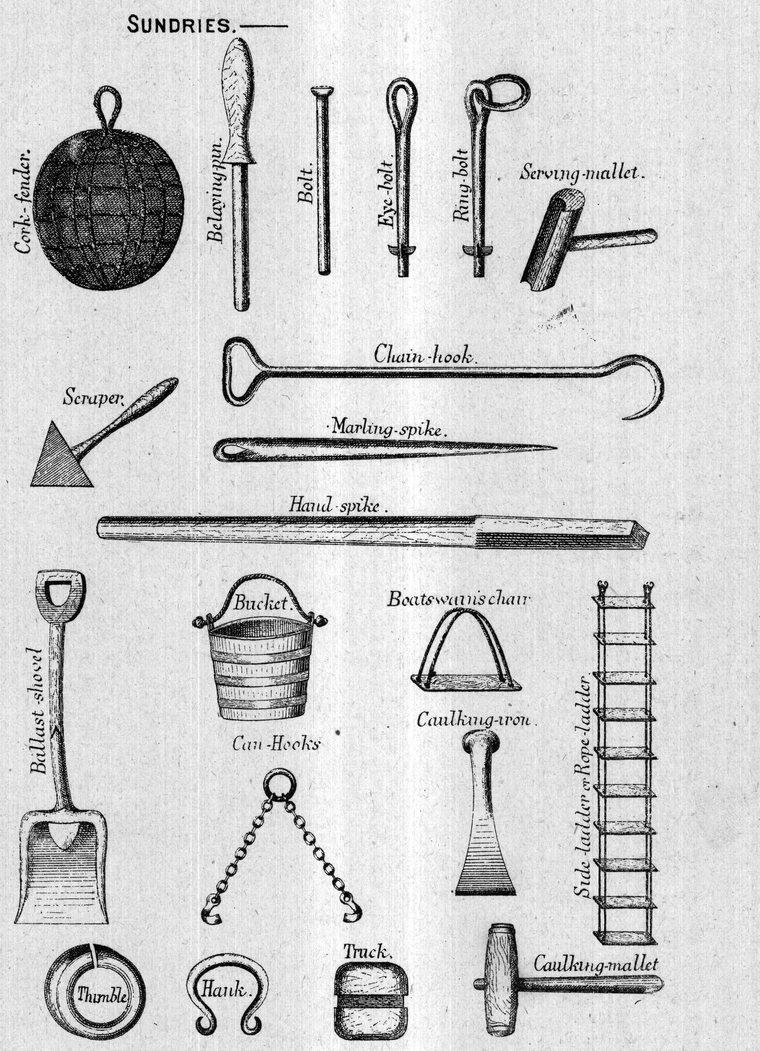
A bolt having an eye in one end driven through a vessel's side or deck until the shoulder around the eye is flush with the wood: it is used for hooking anything to, such, for instance, as a preventer stay, the standing part of a head sheet, etc. When there is a ring through the eye it becomes a ring-bolt.
A seizing which is put on the strop of a block to form the eye and to jam the strop in the score of the block.
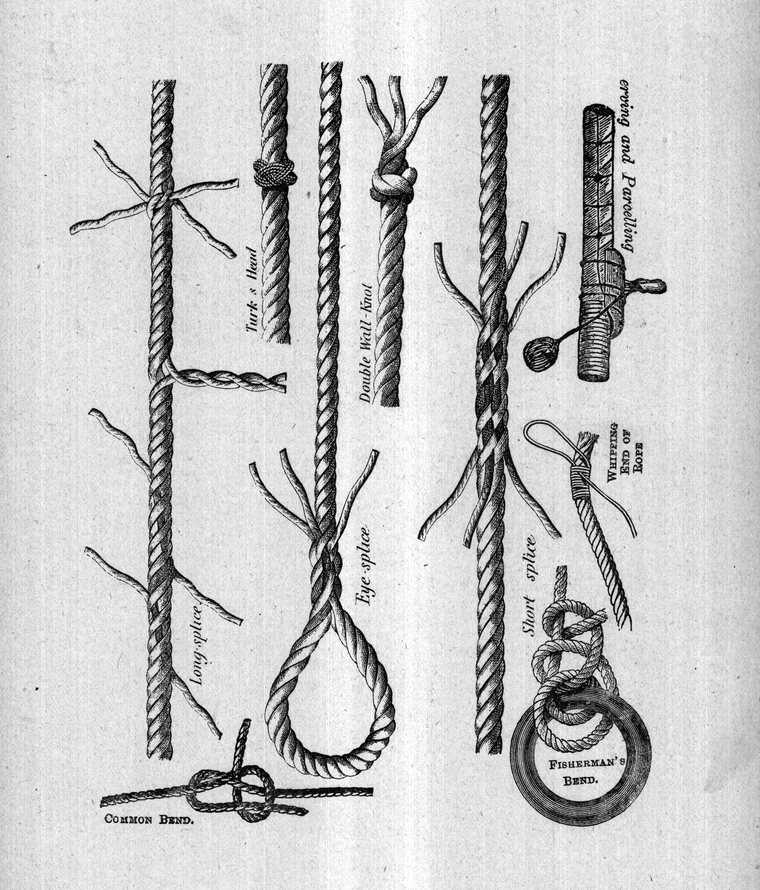
A loop formed in the end of a rope by short-splicing its own end. (See engraving.)
Small holes worked in a sail, and through which the reef points are thrust for half their length, then sewed to the eyelet-hole: also the holes for the robands to go through in bending the sail.
The loop in a shroud or stay that goes over the mast-head: the hole in the top part of the anchor shank that the ring goes through: the eyes of a ship are the hawse-holes: up in the eyes refers to the extreme forward part of the vessel either above or below decks.
To become untwisted; bunting is fagged when it becomes ragged.
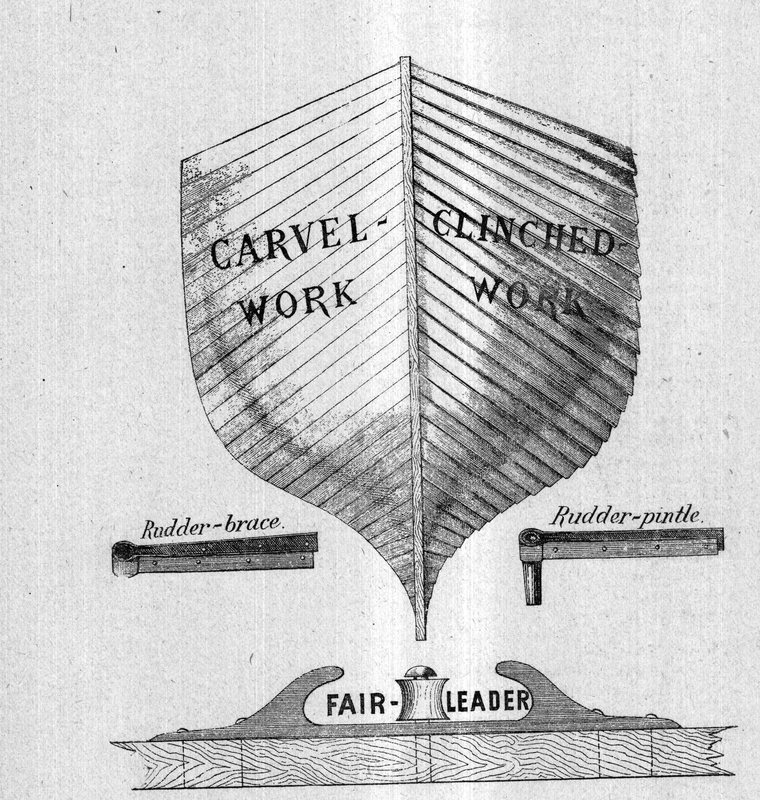
A short length of wood with holes bored in it, or a block or thimble so placed as to give running rigging a fair lead, or to change its direction a little, such, for instance, as to make it parallel to the shrouds by gathering it into them through the fair leader.
The middle of a channel in a harbor or river.
A wind which enables a vessel to lay her course.
A circle of rope in a coil; one of the circles of the lead-line held in the hand in sounding.
The rope of a tackle.
To strike or encounter another ship or object.
The situation of a vessel when she is out-distanced by another. (See Drop Astern.)
To sail or to be towed down a river nearer to its mouth.
Said of a barometer when the mercury descends in the tube.
A vessel's topsides are said to be falling home when they incline inboards from the perpendicular. Also said to be tumbling home or tumbling in. (See Flaring.)
Said of a vessel when her head goes off from the wind.