Fresh BreezeSea Terms
A breeze blowing from thirteen to fifteen miles an hour.
Page 120 of Patterson’s Illustrated Nautical Encyclopedia · 25 entries
A breeze blowing from thirteen to fifteen miles an hour.
Newly-killed, or canned meats and vegetables; any kind of food not salted.
A seaman whose experience is limited to lake and river vessels.
When a vessel increases her velocity she is said to get fresh way, or to gather fresh way.
To freshen anything is to shift or renew it.
To move the ballast about.
To veer out or to heave in a little cable so as to allow another part of it to be brought in contact with the hawse hole.
To renew the service where it has become worn through or chafed.
A day of the week once held in superstitious awe by seamen; but with the advent of steam, which has robbed the ocean of most of its romance, the supernatural character or influences attributed to the day rapidly dissipated. Several American steamship lines have adopted Friday as the regular sailing day for their vessels.
A sailor's name for French people.
A name employed by seamen when speaking of Hollanders, owing to the character of their country, with its canals, dykes, etc.
A license granted to a vessel of the United States by the customs authorities her to engage in trade upon the northern inland frontier of the United States. (See License.)
Said of the sails when they are distended by the wind.
Sailing close to the wind but keeping the sails full. An order given to the helmsman to effect the foregoing.
A vessel having all sail set is said to be under a full spread of canvas.
The smoke-stack of a steam vessel.
Telescopic Funnel. A smoke-stack that telescopes so that all or most of it may disappear below the main deck.
To roll up and secure a sail or awning.
A small line used to bind a fore-and-aft sail to a gaff or boom after it is furled. Short independent lengths of rope used for this purpose are called stops, and when used for square sails, gaskets.
The rigging, spars, anchors, sails, boats, cables, etc., of a vessel are termed collectively her furniture.
(See Corposant.)
The iron band which goes around the lower-mast just under the top, and to which the futtock shrouds secure.
Iron plates secured to the side rims of the tops, with a dead-eye in the upper part for the topmast rigging to set up to, exactly the same as the chain plates of the lower rigging and a hole in the lower end for the futtock shroud to hook in.
Holes in the rim of the top on each side for the futtock chain plates.
Short shrouds extending from the lower ends of the futtock chain plates to the futtock band.
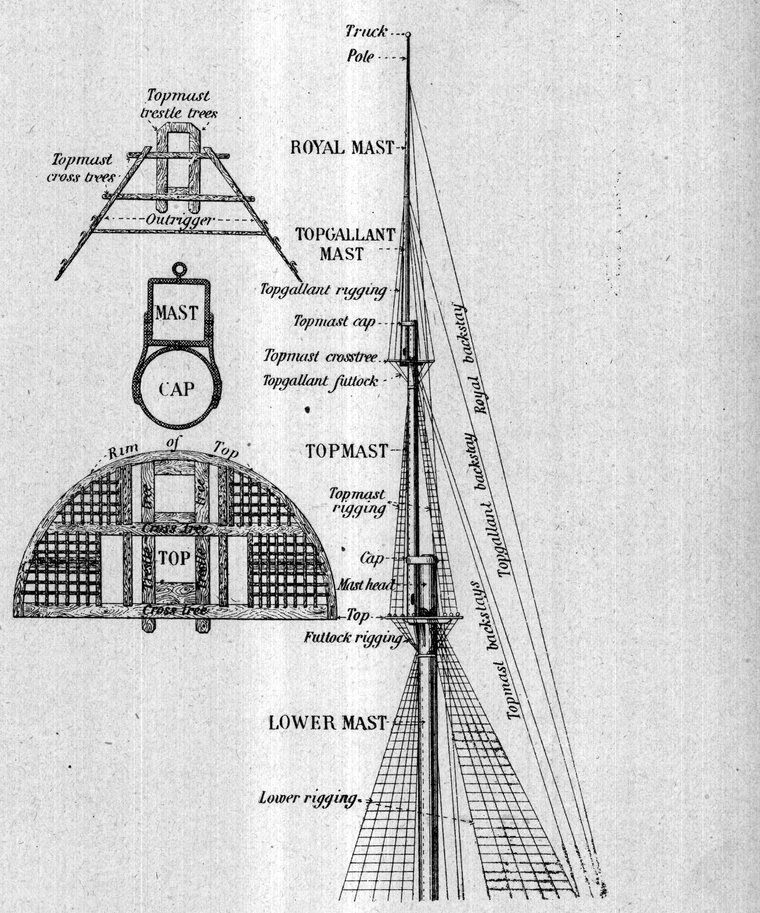
A length of wood or iron covered with canvas or leather seized across the topmast rigging like a shear-pole.