Fore Topmast StaysailSea Terms
A head sail that sets upon the foretopmast stay.
Page 118 of Patterson’s Illustrated Nautical Encyclopedia · 29 entries
A head sail that sets upon the foretopmast stay.
The lowest yard across the foremast on a brig, brigantine, bark, barkentine and ship.
The compartment in the forward part of a vessel, on or under the upper deck, in which the seamen sleep and eat on merchant vessels.
That part of the upper or spar deck which is forward of the after fore shroud. (See Topgallant Forecastle.)
The forward part of the forecastle deck or topgallant forecastle near the knight heads.
The forward mast of all vessels. As sloops and cutters have but one mast, it is always referred to as the mainmast. The term, however, is incongruous, and there is no necessity for its use.
One of the crew not above the rating of a seaman.
A designation for boatswains, carpenters and sailmakers on a merchant vessel.
Same as Head Reach.
Towards the forepart of the vessel.
To stitch oakum over the surface of a sail and draw it under a vessel's bottom for the purpose of stopping a leak.
A rope fouls when it jams in a block; a term used to express the opposite of clear.
When the cable is twisted about the anchor. When the anchor of one vessel locks itself to the anchor of another vessel--both anchors being on the bottom.
When a ship is anchored in the way of another ship or some other obstruction.
When a vessel's bottom is covered with barnacles, grass or slime.
When a vessel has two anchors down, and the cables get a cross or twist in them by the revolution of the vessel round her anchors, she is said to have a foul hawse.
When the vessel sails so close to the bottom that the mud is disturbed and rises to the surface of the water.
When a vessel fills with water and sinks she is said to founder.
The amount charged a vessel for furnishing her with water while in harbor and filling her water tanks for sea. (See Water Dues.)
A block containing four sheaves.
A purchase having two blocks, each containing four sheaves.
Two or more rope yarns twisted together. (See Spanish Fox.)
After a vessel's bottom has been fothered, the sail is frapped by passing ropes under the sail and keel, and hauling them taut so as to keep the sail in place; to pass a rope around a sail to keep it from blowing away.
To free a vessel of water is to pump her dry; a vessel sails free when she has a fair wind.
The distance from the plank shear, or covering board, to the water line.
(See Pirate.)
The amount paid for transportation of cargo.
(See Flemish Coil.)
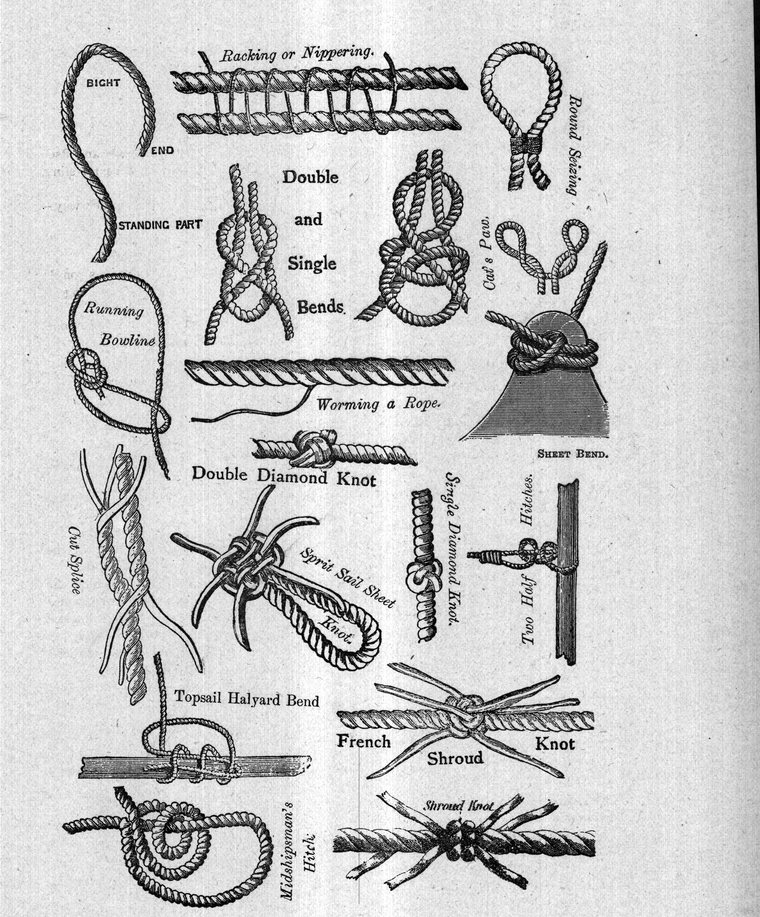
A knot used for rejoining a shroud or a stay that has been carried away.