Jack TarSea Terms
A universal name for a seaman.
Page 150 of Patterson’s Illustrated Nautical Encyclopedia · 28 entries
A universal name for a seaman.
A cornucopia-shaped canvas bag stuffed with oakum, and thrust into the hawse pipes when at sea to prevent the seas as they break against the vessel's bows from flowing inboard.
A brigantine-rigged vessel that carries the fore-topmast and the fore-topgallant mast in one spar.
The forecastle deck.
A ladder with rope sides and wooden rungs, used for getting into the lower rigging on vessels with very high bulwarks, and for getting up to the jack cross-trees--the ladder hanging abaft the mast.
A vessel is said to be jammed on the wind when she is sailing close-hauled.
To enclose anything between two bodies so that it is immovable.
A fishing float used in some of the countries of South America.
The span attached to the jaws of a gaff, and sometimes to a boom, on which little hard wooden wheels called rollers are strung like beads. (See Gaff.)
The inner ends of a gaff, also of some booms, being pieces bolted on to the sides of the spar. Also known by the name of horns.
The power of speech. To clap a stopper on one's jaw tackle is to cease talking.
The bitts to which the jeers are belayed.
Double or treble blocks belonging to the jeer falls.
The capstan placed midships and between the fore and main-masts for general use.
The ropes rove through the jeer blocks, which together form the jeers.
A heavy purchase for hoisting and lowering the lower yards.
A Red Sea coasting boat.
An Egyptian trading vessel.
Goods thrown from a vessel and found floating upon the sea or cast up on the shore. (See Jettison.)
The act of heaying overboard the cargo of a vessel in order to save the ship.
A kind of dyke constructed of timber, earth, stone, etc., at the entrance to river harbors, for the purpose of concentrating the water, and thereby deepening the channel. The largest system of jetties in the United States is at the mouth of the Mississippi River in the Gulf of Mexico.
Small blocks at the yard-arms for the studding-sail halliards to reeve through.
The peculiar-shaped shackle which connects the cable with the anchor ring.
A triangular sail which sets on a stay forward the foremast.
A spar supported on and rigged out beyond the bowsprit through the bowsprit cap. (See Jib-boom Guys.)
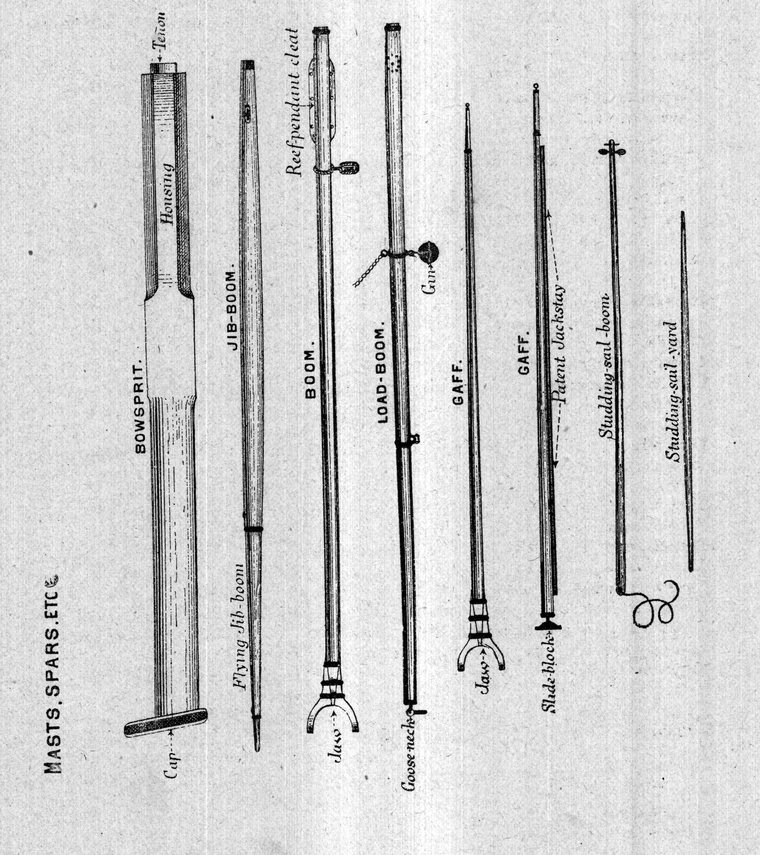
Ropes for steadying the jib-boom sideways, leading from the end of the spar through the whiskers on the end of the bowsprit, and thence to the bows of the vessel where they are set up.
Flying jib-boom guys act in the same way for the flying jib-boom. (See Martingale Stays.)
The term applies to the cut of the sail, and means that the head of it is shaped like that of a jib.
A safety netting under the jib-boom, which is seized to the jib-boom guys and the whiskers.
The flying jib-boom netting is rigged under the flying jib-boom, being seized to the flying jib guys. These nettings are seldom met with outside of naval vessels.