Ordinary SeamanSea Terms
A sailor inferior in knowledge to a seaman; the next lower grade to ordinary seaman is landsman, then boy.
Page 188 of Patterson’s Illustrated Nautical Encyclopedia · 24 entries
A sailor inferior in knowledge to a seaman; the next lower grade to ordinary seaman is landsman, then boy.
Appointing the petty officers and placing the vessel under efficient discipline, drilling the crew, etc.
The lowest deck of a line of battle ship. It is laid over the beams in the hold.
To sail faster than another vessel is to out foot her.
The rope that hauls out the clew of some boom sails, the tack of a lower studding sail, and the head of a sail that brails in to the mast.
An order given in boat service where trailing oars are used, signifying that the crew are to ship their oars, prepared for pulling. To ship them the men reach over the side of the boat, grasp the oars by the handle, throw them into the rowlocks, and lift the blades out of the water, holding them horizontal and at right angles to the keel of the boat, the blades feathered. In this position they await the coxswain's next order.
Said of a vessel when she does not sit properly on the water.
For one vessel to sail closer to the wind than another is to out-point. Also known as sailing higher.
Attached to but outside the vessel.
The head sail next forward of the inner jib on some merchant sailing vessels. (See engravings of various rigs of merchant vessels.)
A spar (sometimes of iron) projecting from the cross-trees to give spread to the backstays, or any spar rigged out to give spread to rigging, like the whiskers or whisker-booms on the bowsprit, the spreaders on each bow for the jib sheets, etc.
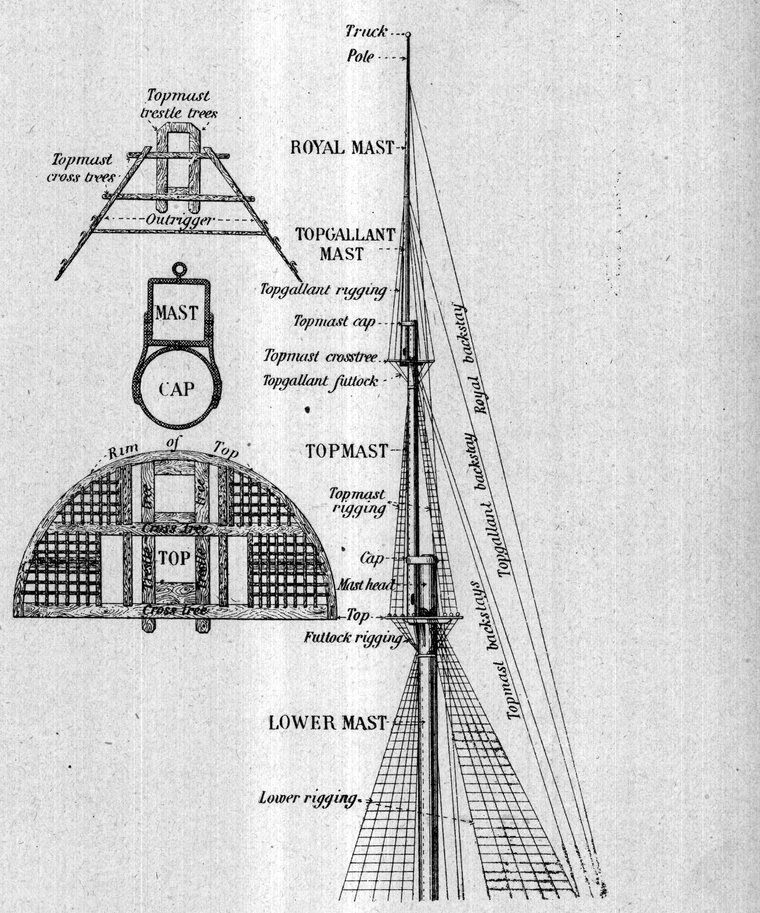
A reef or cluster of rocks are outlying when some distance from the shore.
An open or ocean course.
Outward pilotage, towing out of the harbor, and any other expense that may be incurred in leaving port.
The extreme length of the hull of a vessel from end to end on deck.
One vessel overbears another when from her stability she is able to carry a greater press of sail.
Over the side; out of the ship.
The projection of a vessel's stern from the stern post, or of a vessel's head from the stem.
To examine; to separate the blocks of a tackle by coming up with the hauling part and pulling one block away from the other.
An overlap is established when an overtaking vessel has no longer a choice on which side she will pass, and continues to exist as long as the leeward vessel by luffing, or the weather vessel by bearing away, is in danger of fouling. An overtaking vessel shall, as long as an overlap exists, keep clear of the vessel being overtaken.
When a vessel is at anchor in a heavy seaway and the waves break over her head they are said to over-rake her.
When a vessel has heavier gear than necessary.
A vessel showing such a high side out of water as to be out of all proportion for her length and breadth is said to be over-risen.
When a vessel has heavier masts and yards, or booms and gaffs, than necessary.