Ox-eyeSea Terms
A small cloud peculiar to the African coast, and which derives its name from its form resemblance to the eye of an ox. It presages a speedy and violent storm.
Page 190 of Patterson’s Illustrated Nautical Encyclopedia · 26 entries
A small cloud peculiar to the African coast, and which derives its name from its form resemblance to the eye of an ox. It presages a speedy and violent storm.
Stun'-sail-boom irons are known sometimes as Pacific Irons.
A short oar having a broad blade, and used in propelling canoes. It does not set in a rowlock, but is held perpendicularly when dipped in the water.
(See Paddle Wheels.)
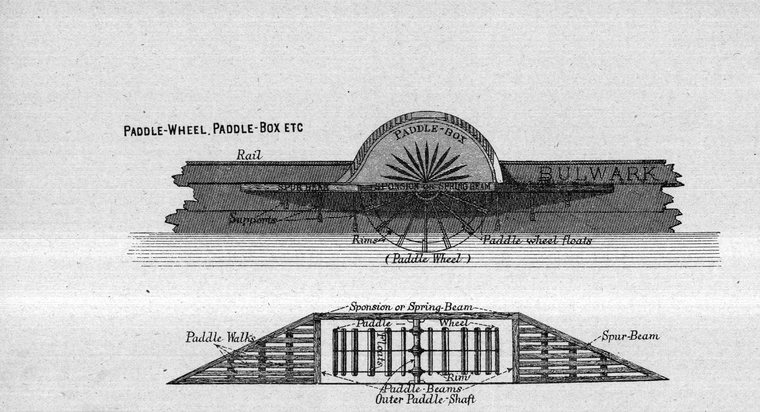
The large wheels in the sides of some steam vessels, such as ferry boats and river craft, and by the revolutions of which the vessel is forced ahead or astern. These wheels are partly encased in what is known as paddle boxes.
A peculiar shaped boat of Ceylon.
When there is little or no wind, so that the pennant hangs down alongside the mast. Hence it is said that the wind in a Paddy's Hurricane is "up and down the mast."
The skipper of a small coasting vessel of the Mediterranean.
A small vessel armed and used for piratical purposes by the Malays.
A war canoe of the Society Islands.
A length of rope made fast to the inner side of the stem of boats, and used for making fast to anything in order to hold the boat.
The inner side of the fluke of an anchor, also called the pea. A piece of stout leather which fits across the hand and is used when sewing upon canvas, marrying a rope, etc. A small round iron shield on the outboard face of the leather is employed to drive the needle through the substance.
An East African canoe having one mast, and a sail made of cocoa leaves.
A passenger boat propelled by oars, and used on the Hooghly.
A boat made of papier-mache. Also a boat made by applying lengths of linen to a form and coating them with shellac. The frame of the boat is inserted after the shell is complete.
A small, pink-sterned vessel of the Mediterranean, rigged with a lateen mainsail and mizzen, and carrying a large jib.
To hoist or lower a spar or cask on its bilge by the bight of two separate ropes passed round it. One end of the ropes is secured an the other ends are used for slacking away or for gathering in the bight.
Long strips of canvas used in parceling.
To lay a narrow strip of canvas over a seam that has been caulked to prevent it filling up with dust, etc., before it is payed (filled with pitch, etc.)
To wind long strips of canvas around a rope preparatory to serving it.
Said of a vessel when she is careened in order to get at her bottom.
The rope or iron ring which confines a yard to the mast, but permits of a vertical movement; in other words which acts as a traveler for the yard when being hoisted or lowered in setting or furling the sail.
To break a rope or cable is to part it.
(See General Average.)
(See Part II.)
To pass the word is to repeat the order to the crew. To pass an earing, gasket, seizing, etc., is to secure the same.