OarSea Terms
A wooden instrument used to propel a boat. It consists of the blade, loom and handle. The loom is the part from where the flat part (the blade) ends, to the small length of round wood at the extreme inboard end, which is the handle.
Page 186 of Patterson’s Illustrated Nautical Encyclopedia · 26 entries
A wooden instrument used to propel a boat. It consists of the blade, loom and handle. The loom is the part from where the flat part (the blade) ends, to the small length of round wood at the extreme inboard end, which is the handle.
The square, open hole cut in the wash streak of a boat, also known as row-lock. Where iron shapes are used rising above the gunwale they are called thole-pins.
An order given to a boat's crew by the coxswain signifying that the crew are to cease rowing temporarily, and to feather their oars and keep them horizontal in the thole-pins or row-locks.
Old pieces of rope, called junk, untwisted and picked into shreds. It is used for caulking seams. White oakum is made from untarred rope like Manilla.
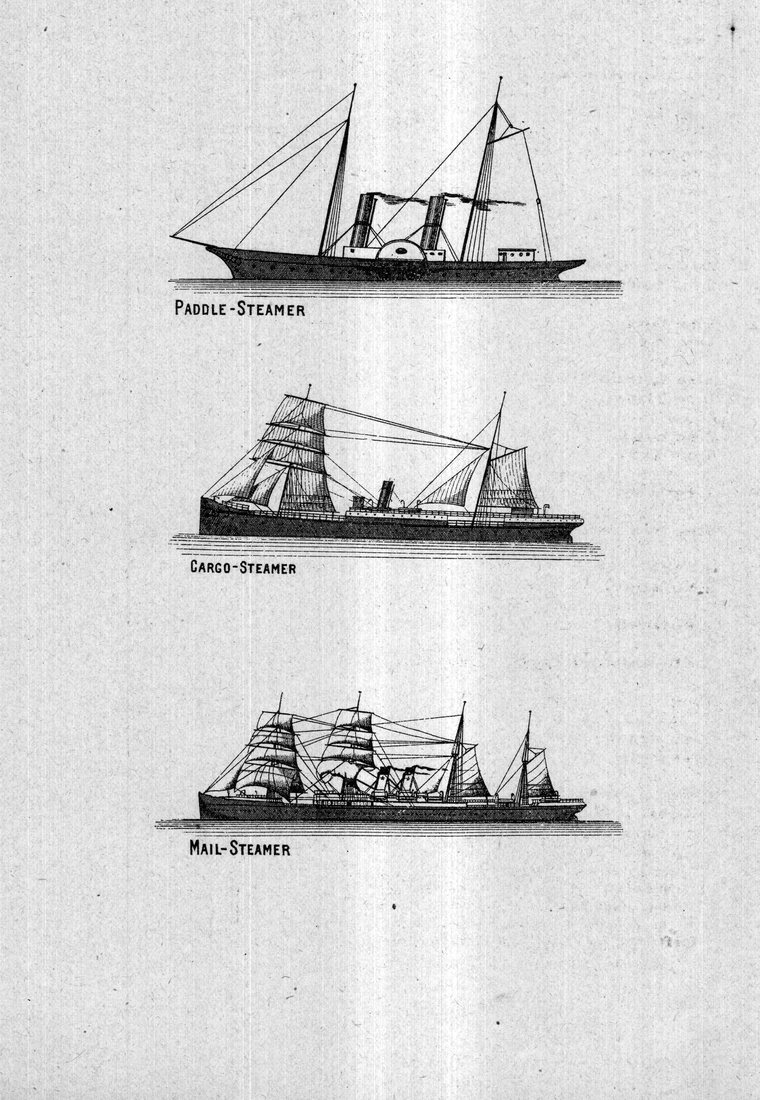
A term applied to fast steamships.
A vessel stands off-and-on when by alternate tacks she approaches the land and again recedes from it.
(See Cautionary Signals.)
A vessel is off the wind when she is sailing two or three points free.
The officer of the watch who has charge of the ship.
(See Officer of the Deck.)
All documented vessels of the United States are required by law to obtain from the Bureau of Navigation certain identifying numbers, which are to be marked on the main beam in the same manner as the tonnage.
A distance to seaward. Beyond anchoring ground, but within sight of the land.
(See Quelling Oil.)
A name applied to ice made in a previous winter.
A ship is on a bowline or on the wind when she is close-hauled; one is on board a vessel when on her deck.
(See Aboard.)
When the ship is sailing over a depth of water that can be measured with the lead and a line marked to eighty fathoms (within eighty fathoms.)
Any object bearing so as to be at right angles with the line of the vessel's keel.
The bearing of an object contained between the ship's head and inclusive of four points (45 deg.) to right and left. Thus we say, a ship bears one, two, three, and four points on the starboard or port bow.
The bearing of any object contained in an arc of 45 deg. measured from right-aft to four points (45 deg.) forward on either side. (See On the Bow.)
A preparatory flag signal is made, and usually about ten minutes later a single gun is fired, and the time of commencing the race is calculated from the time of firing.
A seal-skin boat of Greenland.
A harbor is said to be open when it is exposed to the sea. A distant object not intercepted in any way to an observer is said to be open.
A boat not decked over.
When with two anchors down the cables lead straight ahead to their respective bowers the ship is said to have an open hawse. Same as Clear Hawse.
A vessel is in ordinary when she is laid up--out of commission.