Storm CanvasSea Terms
Small sails of heavy material used in place of the regular working sails during storms.
Page 245 of Patterson’s Illustrated Nautical Encyclopedia · 34 entries
Small sails of heavy material used in place of the regular working sails during storms.
A small jib of heavy canvas used in bad weather.
(See Storm Canvas.)
(See Cautionary Signals.)
(See Mother Carey's Chickens.)
A boat is stove when her hull is broken in.
To fix anything in place, as to stow the fenders away; stow the cargo, stow the anchor, etc.
Straining at her Cables. (See Tugging at her Anchors.)
A plank running fore-and-aft.
Any number of rope yarns twisted together. A rope is stranded when one of the strands forming it is broken. A vessel is stranded when she is resting on the shore. A beach is also called strand.
A vessel whose nationality is in doubt.
A length of rope spliced together so as to form a ring, and used for various purposes, such as for slinging bales, for attaching a tackle to any object, etc. (See Strop.)
(See Strake.)
To attach a buoy to an anchor by a length of rope and to drop it overboard previous to letting go the anchor.
An anchor about one-third the size of the bowers, and used for warping, club-hauling, etc.
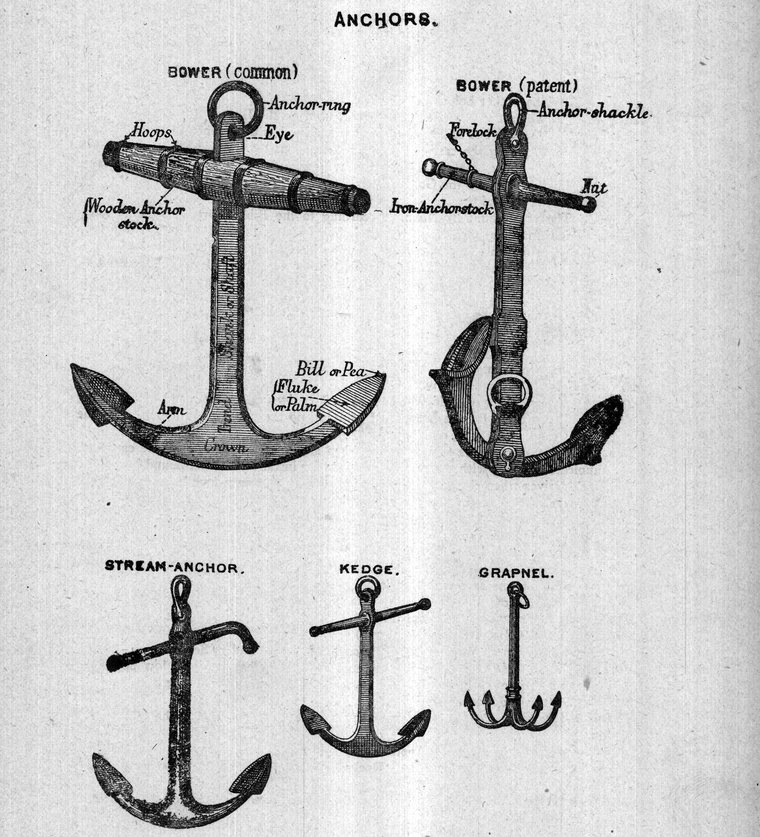
A cable belonging to a stream anchor, and which is of comparatively light weight.
Extra pieces of canvas sewed on the corners of sails, also at the reef cringles and along the luff.
An order given to a boat's crew to bend to their oars with increased power.
Pieces of wood placed thwartships in a boat's bottom for the rowers to brace their feet against; pieces of wood placed thwartships in a boat to prevent the sides from being crushed in by ice, or from other causes.
To lower a yard, mast, sail, or colors; for a vessel to touch bottom.
To take the rigging off of a mast is to strip it.
The sweep of an oar. The stroke oarsman pulls the after starboard oar.
The after oarsman who sets the stroke for the rest of the crew.
(See Davit Guy.)
A binding of rope encircling and fitted into the score of a block, in one part of which an eye is formed by seizing a thimble in the drift, or spare part. Some blocks are iron bound. (See Strap.)
(See Strike.)
(Pronounced stun' sails.) Light sails carried in moderate weather with a fair wind, and which are set outside of the square sails on booms rigged out through rings on the yards. There are lower, topmast, topgallant and royal studding sails.
The horizontal bar on which the stun' sail sets.
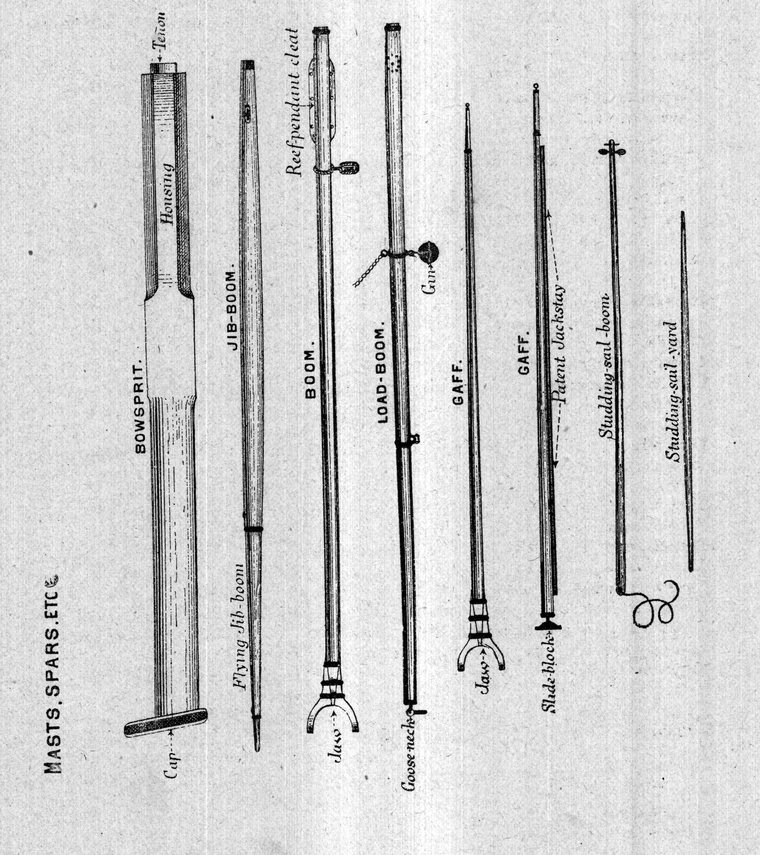
The rope leading from the outboard end of the studding sail boom to the side of the vessel.
The ropes which hoist the stun' sails to the stun' sail booms. There are two sets, named respectively inner and outer stun' sail halliards.
The bend which secures the stun' sail halliards to the stun' sail yard.
The tack line of the lower stun' sail, which leads through a block on the end of the swinging boom.
The line which secures the inner lower corner of a stun' sail.
The rope secured to the outer lower corner of a stun' sail. (See Studding Sail Outhaul.)
The light spar to which the head of the stun' sail is lashed before the sail is sent aloft.