SwivelSea Terms
A metal link turning upon an axis, and used on cables to keep turns out. Also used on iron-bound blocks.
Page 248 of Patterson’s Illustrated Nautical Encyclopedia · 30 entries
A metal link turning upon an axis, and used on cables to keep turns out. Also used on iron-bound blocks.
The hem on the borders of sails to which the bolt rope is sewed. (See Part II.)
To go about; a vessel is on the starboard tack when the wind blows on the starboard side, and on the port tack when the wind blows on the port side; the tackle by which the clew of a course is hauled forward and down; the tack line or tack pennant of a fore-and-aft or gaff topsail is the rope that keeps down the tack of the sail, or the lower forward corner; the rope that keeps down the lower outer corner of a studding sail.
The iron ring spliced into a fore-and-aft sail at the junction of the luff and foot, but the iron shapes spliced into the lower corners of square sails.
The length of rope passed through the tack cringles on a fore-and-aft sail, and used to keep the slack luff of the sail down to the boom after it has been reefed.
The line by which the tack of loose-footed fore-and-aft sails is triced up.
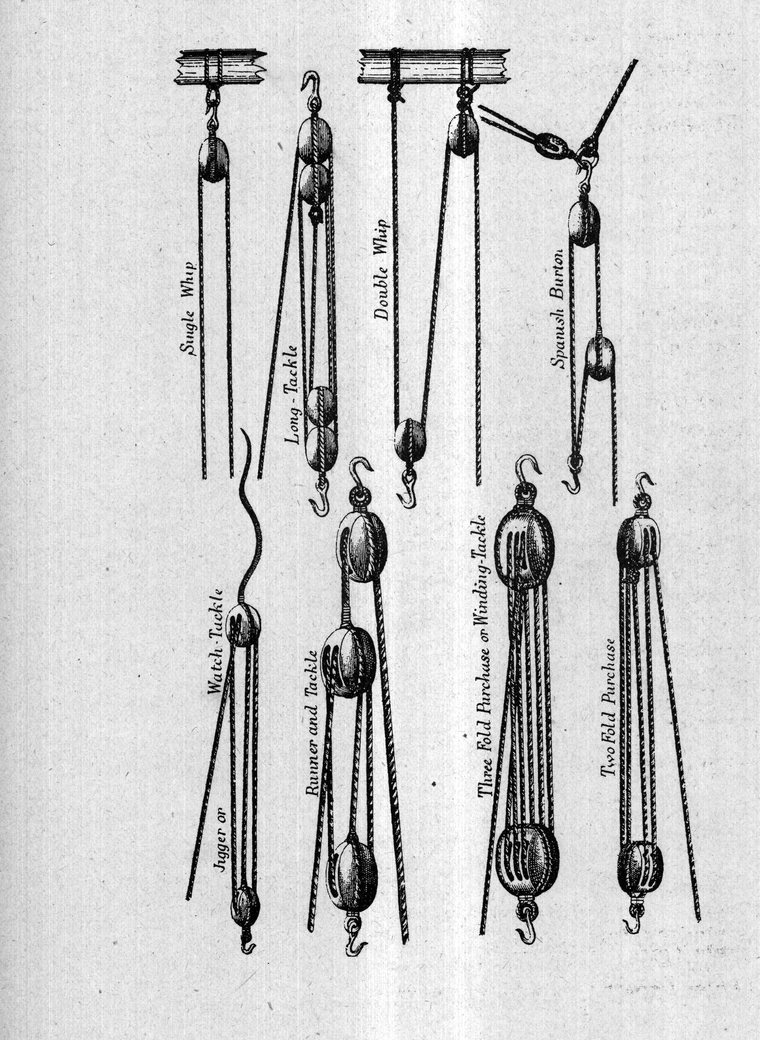
(Pronounced tay-cle.) A purchase of ropes and blocks.
The rail around the stern of a vessel.
A tail block has a short length of rope hanging from the spiicing around the block, and which takes the place of a hook; a vessel when at anchor tails up or down stream according as her stern tends--in opposition to heading.
An order to lay hold of a rope and pull.
A watch tackle purchase having a tail to one of the blocks.
To furl the sails; to take in cargo; to take in water, etc.
(See Aback.)
A lofty vessel.
A Chinese row boat with a cover extending over the after part, and used for carrying passengers between the shore and ships in harbor.
An iron receptacle for containing fresh water.
A vessel whose space between decks is occupied with iron tanks designed for the transportation of oil in bulk.
A short, heavy piece of wood placed inside of a heavy tank across the man-hole, and to which a strap is fixed and a block hooked when it is desired to lift the tank.
Sails that have been soaked in oak bark as a preventive against mildew.
The gum of pine trees. Stockholm and North Carolina tars are the best obtainable. Tar is used on standing rigging to protect it from the elements. A name given to a sailor.
Painted canvas used as a covering for hatches, etc. An old name for a sailor's headgear.
(See Shiver-my-Timbers.)
A small coasting vessel of the Mediterranean, having one mast and a lateen sail.
A term applied to the examination of a vessel's timbers for ascertaining her soundness.
Tall, high masts are sometimes referred to as taunt masts. A vessel is said to be all-a-taunt-o when she has all her masts and yards aloft, sail bent, and rigging in order.
Tight.
A ferry-boat propelled by paddles, the motive force being horses or mules.
A name for the old East Indian tea ships.
A term used in reference to a vessel's guns.
(See Engine Room Telegraph.)