Telegraph BlocksSea Terms
These are formed of a number of small sheaves in a narrow, lengthy shell, and used for the purpose of making signals.
Page 249 of Patterson’s Illustrated Nautical Encyclopedia · 25 entries
These are formed of a number of small sheaves in a narrow, lengthy shell, and used for the purpose of making signals.
(See Funnel.)
An inverted dry card compass hung below deck from one of the beams so that the heading of the vessel may be known at any time without going on deck. (See
Tiller Tell-Tale.)
(See Tending.)
A vessel which accompanies another for the purpose of lending assistance, if necessary, to carry extra stores, coals, etc. (See Crank.)
Watching a vessel when at anchor so as to cast her by the helm, also some sail if required, when the tide changes--this to prevent turns getting in the chain and the probable fouling of the anchor.
The shoulder on the heel of a mast which fits into the step on the main keelson.
The small hand holy-stones used by seamen for cleaning the surface of unpainted woodwork. The wood is first wet, next sand sprinkled over it, then the stone is rubbed across the surface.
A block having two sheaves, one thicker than the other, so as to accommodate different sizes of rope passing over them.
An iron ring with a groove around its outer rim for a rope to fit in, so that it may be held in place when it is spliced either in the corner of a sail as a cringle or in the end of the pendant. A thimble prevents chafing.
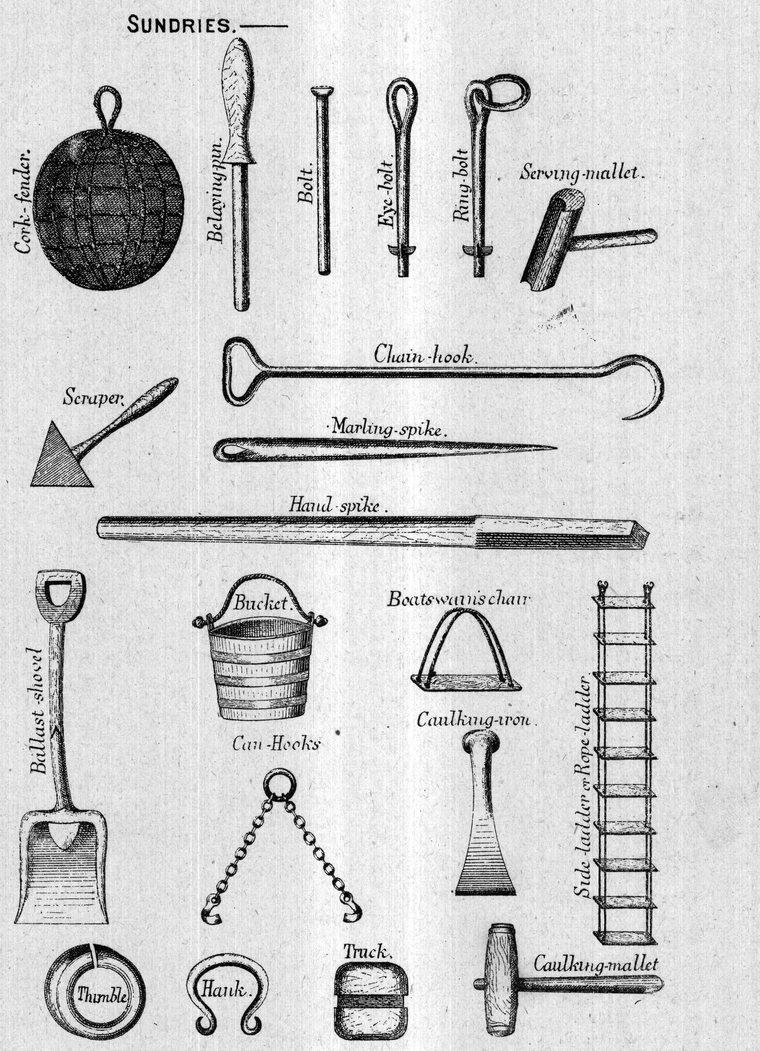
Wooden pins, or metal sockets, fitting in holes bored in the gunwale of boats between which the oar rests when pulling. Thole pins form a rowlock for the oar. (See Rowlock.)
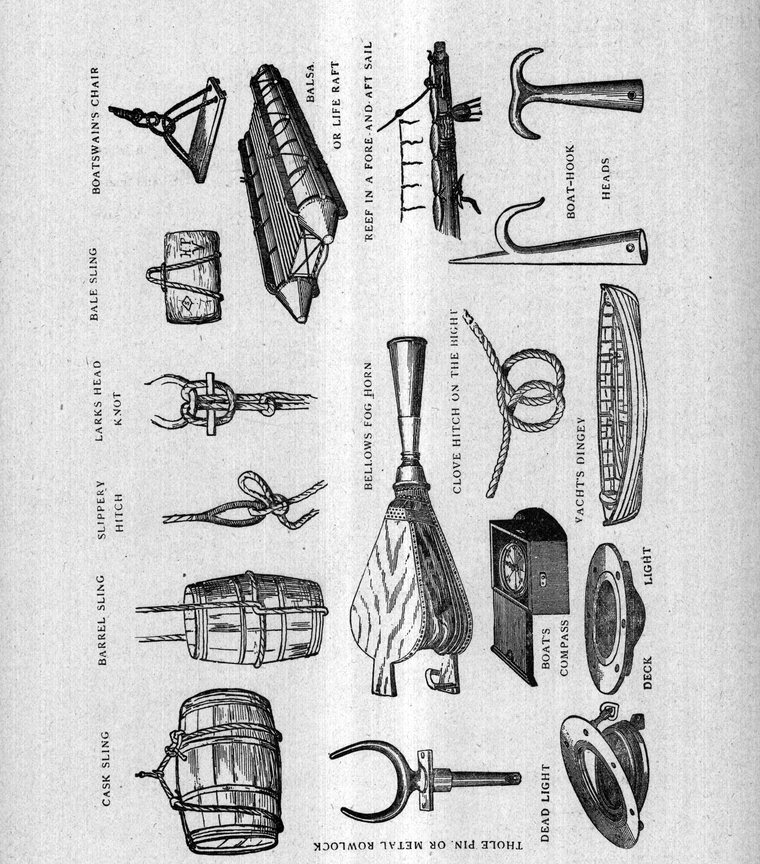
Said of a fall when one of the blocks is capsized through the parts; or the parts of the fall twisted by the turning round of one of the blocks.
A block of three sheaves.
A purchase made of two blocks, each containing three sheaves.
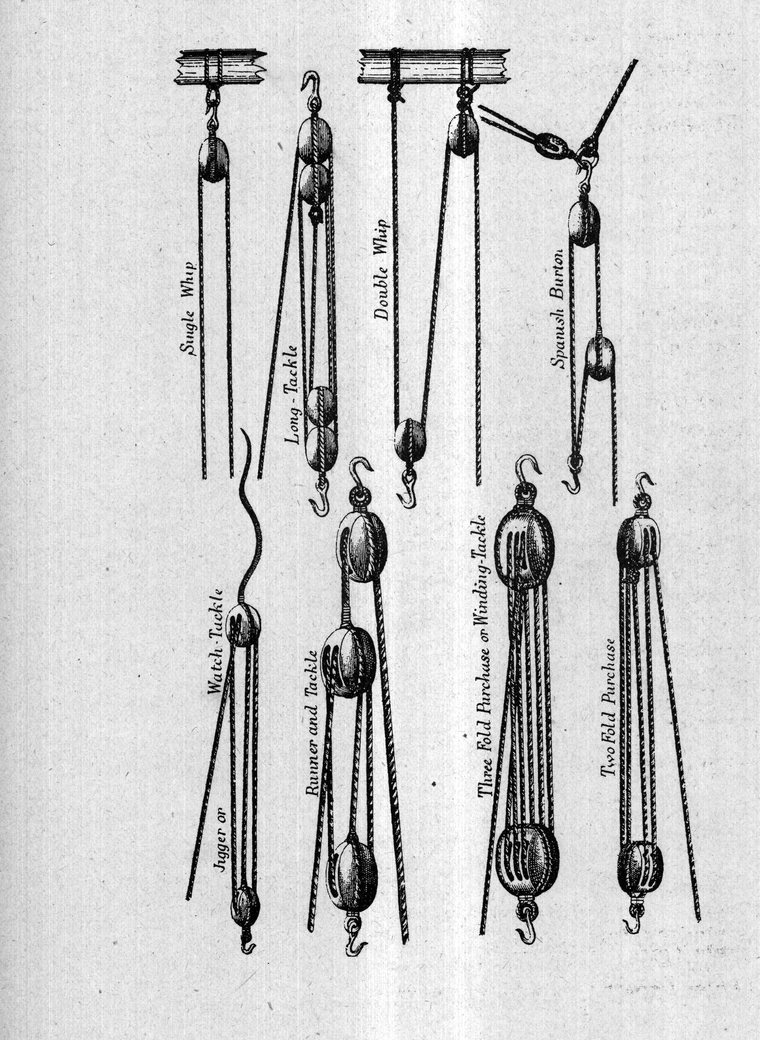
The inner end of a gaff where the throat block is hooked. (See Jaws.)
The metal eye-bolt in the throat of the gaff to which the lower throat halliard block is hooked.
The rope which gathers a brailing sail up and into the throat of the gaff.
The halliards which hoist the inner end of the gaff, and the luff of a fore-and-aft sail, or that part of the sail which is against the mast.
A seizing which secures the end of a shroud or stay around a dead-eye, by making the end fast to its own standing part after it has been fitted around the score.
A bolt which goes through the side or deck of a vessel, and is riveted inside.
A bolt which passes through both planking and timber and is riveted inside.
To sew the bight of thrums to a piece of canvas, the same being used to protect sails and rigging from chafe.
Short strands of rope obtained by cutting old gear into lengths of several inches, then unlaying the strands.
A small cleat on a yard arm to prevent the turns of the reef earing from slipping along the yard. Also the little metal crook on the martingale under which the stays lead and are held in place.