A1Sea Terms
The highest that a vessel is classed in reference to her construction. (See Class).
Page 41 of Patterson’s Illustrated Nautical Encyclopedia · 50 entries
The highest that a vessel is classed in reference to her construction. (See Class).
Signifying Able Seaman.
When the wind presses the surface of the sails against the mast with a tendency to drive the vessel astern.
In the direction of the stern.
The bearing of any object contained between the ship's beam and the stern of the vessel.
The bearing of any object at right angles to the keel.
On board; upon the vessel; within the vessel.
To go about is to tack ship; to go off on the opposite tack.
(See Ready About.)
When the head-yards are braced aback and the after-sails are full.
To brace abox is to lay the head-yards abox.
To box off is to box the vessel's head away from the wind after she has missed stays in tacking. When the vessel is in the latter position she is said to be in irons.
Side by side.
The small, square, blue flag hoisted at the starboard-spreader on a yacht to signify that the owner is not on board.
(See Gangway Ladder.)
When the yards are topped up at an angle with the deck. Said of an anchor when it hangs up and down at the cat-head.
The origin of the figure-head, being a symbolical ornament on the prows of ancient vessels.
Broken away from moorings.
A dispatch vessel, first used in the year 1692.
Resting on, or buoyed up by the water.
Forward.
In the direction of the stern.
A tower erected aft on the upper deck. (See forecastle.)
After peak. (See Run.)
The sails on the masts abaft the foremast.
The yards on the masts abaft the foremast.
A rope laid up from left to right is said to be laid up against the sun. when the wind shifts around the compass contrary to the way in which the hands of a watch revolve (from north to south by the way of the west), it is said to back against the sun. A rope coiled down from left to right is coiled against the sun. The sun is supposed to move from right to left.
On the bottom.
Before the vessel. When we say that the wind is ahead we mean that it is from the direction toward which we wish to sail the ship.
The term used in hailing a vessel.
Said of a vessel when she lies with all her sails furled, and the helm lashed to leeward, or a-lee.
A large, web-footed aquatic bird, belonging to the gull family, and peculiar to the southern ocean. Sailors entertain superstitious veneration for this bird, and will not harm it, believing that to do so would entail all kinds of calamities in the shape of gales, stagnant calms, and personal ill fortune.
When the helm is put over to leeward it is said to be a-lee.
When all the sails are pressed against the masts.
The call by which all the ship's company are summoned. The crew collectively.
All the sails shaking from being too close to the wind.
An African war canoe.
Above the vessel's deck.
Along the coast.
Side by side.
At a distance.
A step of a dry dock.
At once; suddenly.
An incorporated American society for the survey and classification of American and foreign merchant vessels, and which is approved by the Underwriters of New York, Boston and San Francisco. This society also issues certificates of competency to masters and mates provided they pass the required professional examination. (See License)
A term applied to any place on or below decks that is in the centre of the vessel, whether in reference to the length or to the breadth. Strictly speaking it refers to the axis, or the fore-and-aft line of the vessel--a line drawn over the keel.
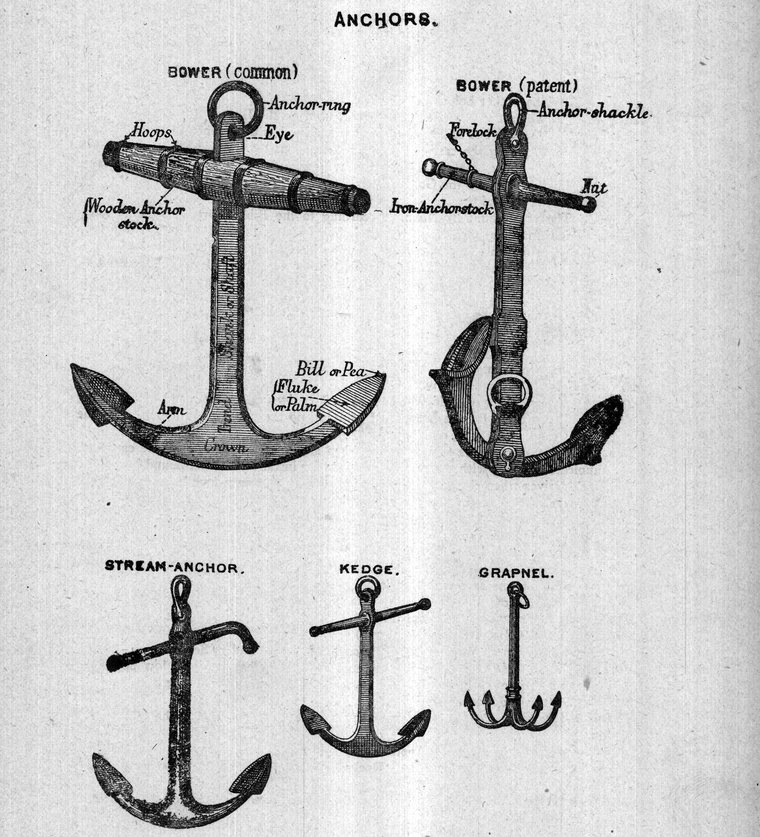
The iron shape used to drop overboard, and, being connected with the vessel by a cable of iron or rope, it holds her riding near the place below which the anchor is resting on the bottom.
The report made by the mate from the forecastle when the anchor leaves the bottom in getting under way.
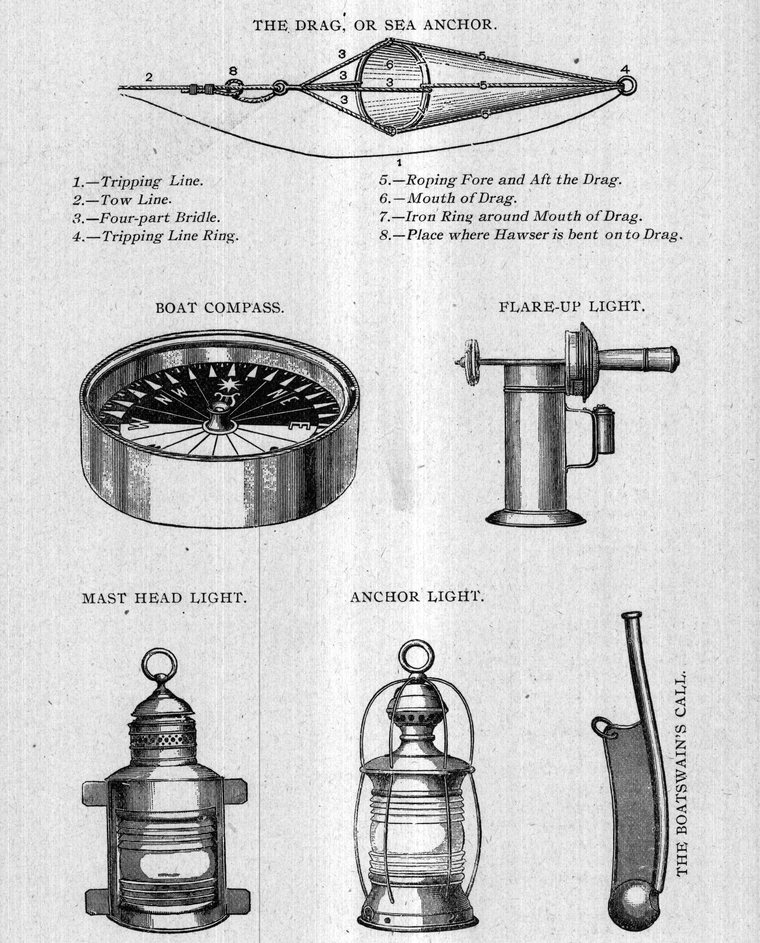
The globular lantern light hoisted after sundown by all vessels when at anchor.
A watch kept at night when the vessel is at anchor to guard the ship against dragging, fire, thieves etc.
Said of a mast when it is perpendicular to the deck.
The angle reckoned in degrees, which marks the safety limit in a vessel's rolling. Should she roll beyond the limit she would upset. This angle varies according to the vessel. An instrument called the clinometer records the angles made in the rolling of a ship.
A western river name for the pilot house.
An electric tell-tale or recorder. When an electric button is pressed in any part of the vessel its wire connection transmits a current from the battery to the annuciator, in which a bell is rung, and at the same time a hinged card drops on which is painted the station at which the button was pressed.