ElevationShipbuilding
The orthographic draught, or perpendicular plan of a ship, whereon the heights and lengths are expressed. It is called by shipwrights the sheer-draught.
Page 296 of Patterson’s Illustrated Nautical Encyclopedia · 18 entries
The orthographic draught, or perpendicular plan of a ship, whereon the heights and lengths are expressed. It is called by shipwrights the sheer-draught.
An oval-shaped, overhanging stern.
A term applied to the forepart of the ship under the load-water line--as "She has a fine entrance," Etc.
A ship is said to be on an even keel when she draws the quantity of water abaft as forwards; also when she has no list, and is not inclined by the head or stern.
Pieces of wood wrought on the fore-part of the knee of the head.
Rabbeting one piece of timber into another in order to strengthen it.
A term to denote the evenness or regularity of a curve or line.
The inclination which the topside has within from a perpendicular.
A second keel, composed of elm plank or thick stuff, fastened in a slight manner under the main keel to prevent it from being rubbed. Its advantages also are that if the ship should strike the ground the false keel will give way, and thus the main keel will be saved; and it will be the means of causing the ship to hold the wind better.
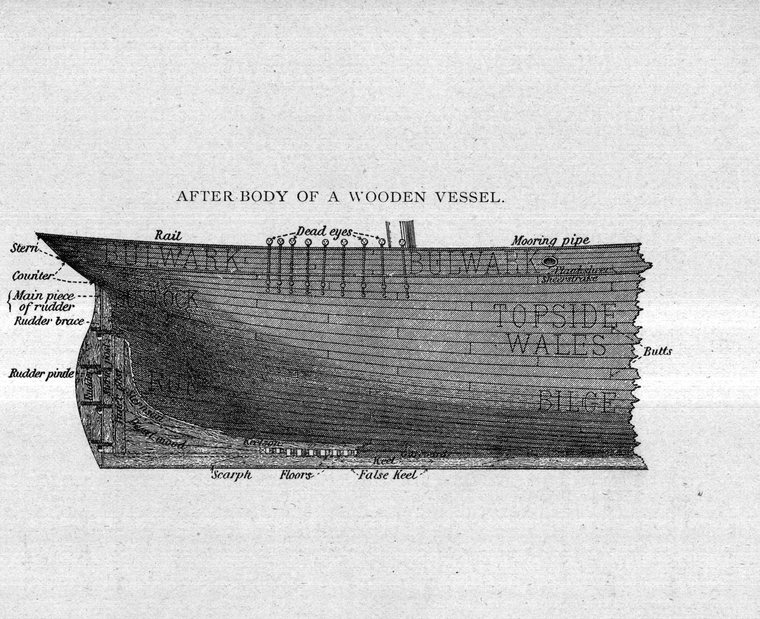
A piece tabled on to the after-part of the heel of the main part of the stern-post. It is to assist the conversion and preserve the main-post should the ship tail aground.
A rail fayed down upon the upper side of the main or upper rail of the head. It is to strengthen the head-rail, and forms the seat of ease at the after end next the bow.
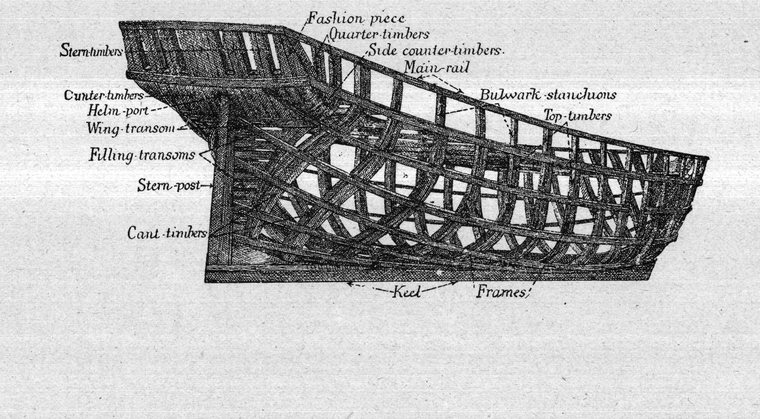
The timbers so-called from their fashioning the after-part of the ship in the plane of projection by terminating the breadth and forming the shape of the stern. They are united to the transoms and to the dead-wood.
To join one piece so close to another that there shall be no perceptible space between them.
The intermediate timbers between the frames that are gotten up into their places singly after the frames are ribbanded and shored.
Carved ornaments of the quarter galley below the second counter and above the upper lights.
The reverse of falling or tumbling home. As this can be only in the fore-part of the ship, it is said that the ship has a flaring bow when the topside falls outward from a perpendicular. Its uses are to shorten the cathead and yet keep the anchor clear of the bow. It also prevents the sea from breaking in upon the forecastle.
A name given to the timbers amidships that have no beveling, and are similar to dead-flat, which is distinguished by this character X. (See Dead-Flat.)
The bottom of a ship, or all that part on each side of the keel which approaches nearer to a horizontal than a perpendicular direction, and whereon the ship rests when aground.