The Nautical Encyclopedia
Patterson’s Illustrated Nautical Encyclopedia — Howard Patterson, 1891

Floors, or Floor Timbers to Frames

Page 298 of Patterson’s Illustrated Nautical Encyclopedia · 9 entries

Floors, or Floor TimbersShipbuilding

The timbers that are fixed athwart the keel, and upon which the whole frame is erected. They generally extend as far forward as the foremast, and as far aft as the after square timber, and sometimes one or two cant-floors are added.

FlushShipbuilding

With a continued even surface; as a flush deck, which is a deck upon one continued line, without interruption, from fore-to-aft.

Foot WailingShipbuilding

The inside planks or lining of a vessel over the floor timbers.

Fore BodyShipbuilding

That part of the ship's body afore the midships or dead-flat. (See Bodies.) This term is more particularly used in expressing the figure or snape of that part of the ship.

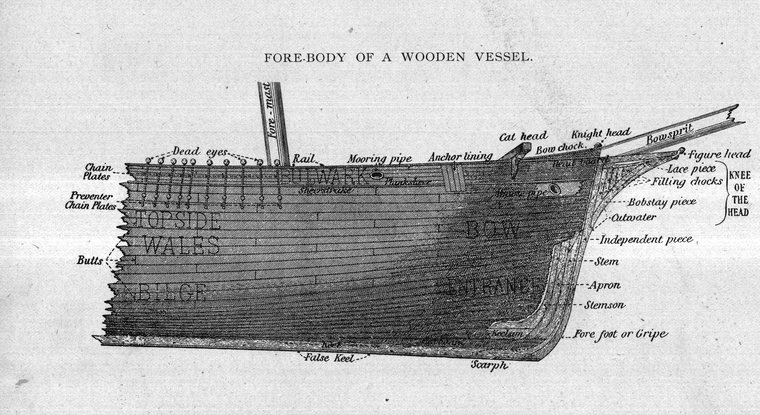
Fore-body of a wooden vessel — cut-water, figure-head, apron, stem and gripe

ForecastleShipbuilding

That portion of the spar deck which is forward of the after fore shroud.

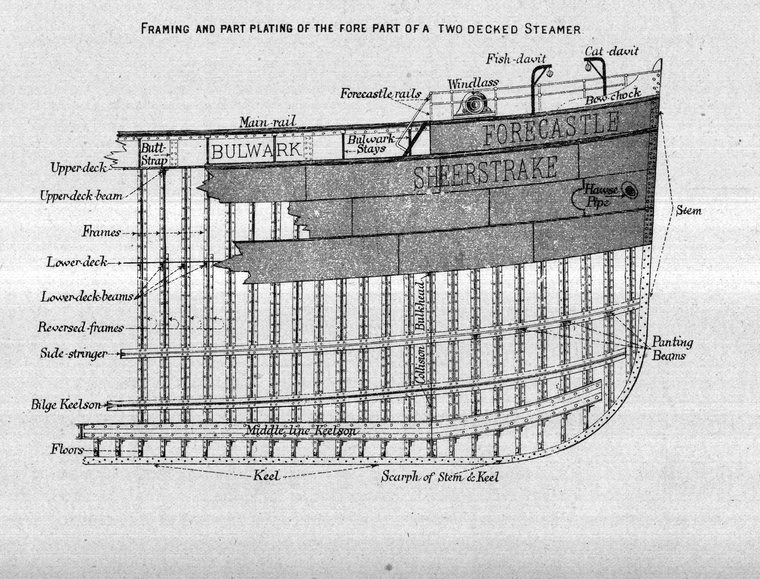
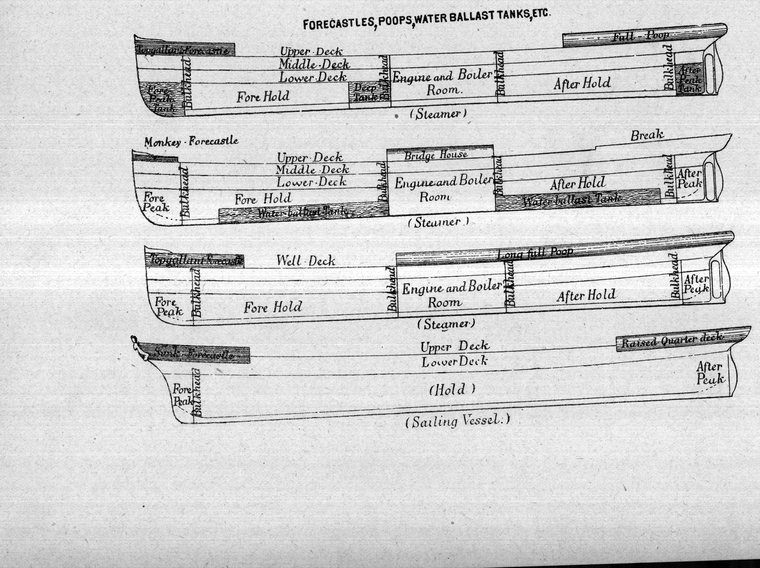
Forecastles, poops, water ballast tanks, etc. — hull profiles of steamers and a sailing vessel
Framing and part plating of the fore part of a two-decked steamer

Fore-footShipbuilding

The foremost piece of the keel.

Fore-lockShipbuilding

A thin circular wedge of iron used to retain a bolt in Its place by being thrust through a mortise hole at the point of the bolt. It is sometimes turned or twisted round the bolt to prevent its drawing.

Fore PeekShipbuilding

Close forward under the lower deck.

FramesShipbuilding

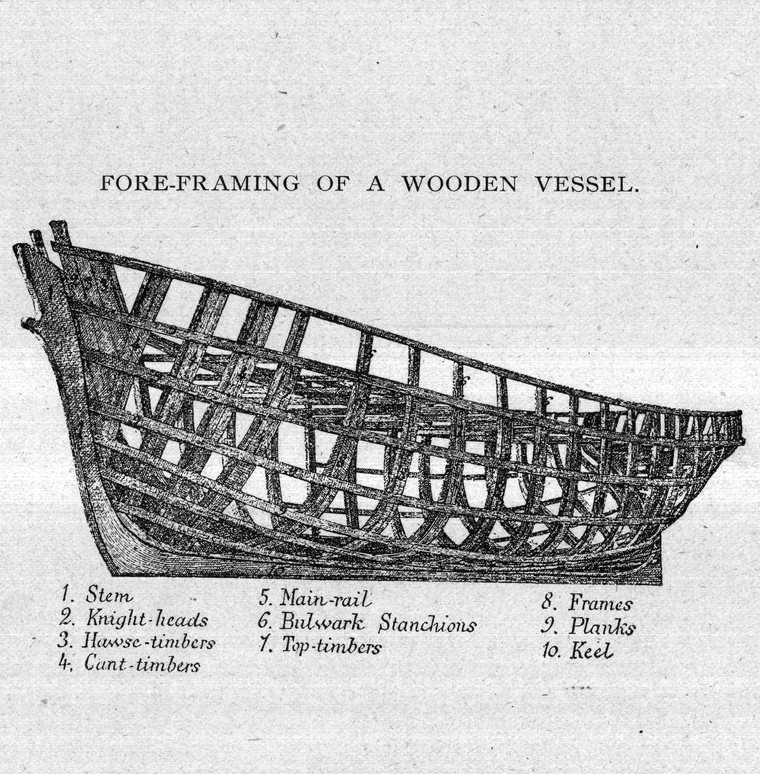
The bends of timber which form the body of the ship, each of which is composed of one floor-timber, two or three futtocks, and a top-timber on each side; which, being united together, form the frame. Of these frames, or bends, that which encloses the greatest space is called the midship or main frame or bend. The arms of the floor-timber form a very obtuse angle; and in the other frames this angle decreases or gradually becomes sharper fore-and-aft with the middle line of the ship. Those floors which form the acute angles afore and abaft are called the rising floors. A frame of timbers is commonly formed by arches of circles called sweeps, of which there are generally five. 1st. The floor sweep, which is limited by a line in the body plan perpendicular to the plane of elevation, a little above the keel; and the height of this line above the keel is called the dead rising. The upper part of this arch forms the head of the floor-timber. 2d. The lower breadth sweep, the centre of which is in the line representing the lower height of breadth. 3d. The reconciling sweep. This sweep joins the two former without intersecting either, and makes a fair curve from the lower height of breadth to the rising line. If a straight line be drawn from the upper edge of the keel to touch the back of the floor sweep, the form of the midship frame below the lower height of breadth will be obtained. 4th. The upper breadth sweep, the centre of which is in the line representing the upper height of breadth of the timber. This sweep described upwards forms the lower part of the top-timber. 5th. The top-timber sweep, or back sweep, is that which forms the hollow of the top-timber. This hollow is, however, very often formed by a mould, so placed as to touch the upper breadth sweep and pass through the point limiting the half-breadth of the top-timber.
Fore-framing of a wooden vessel — stem, knight-heads, hawse-timbers, cant-timbers, frames and keel
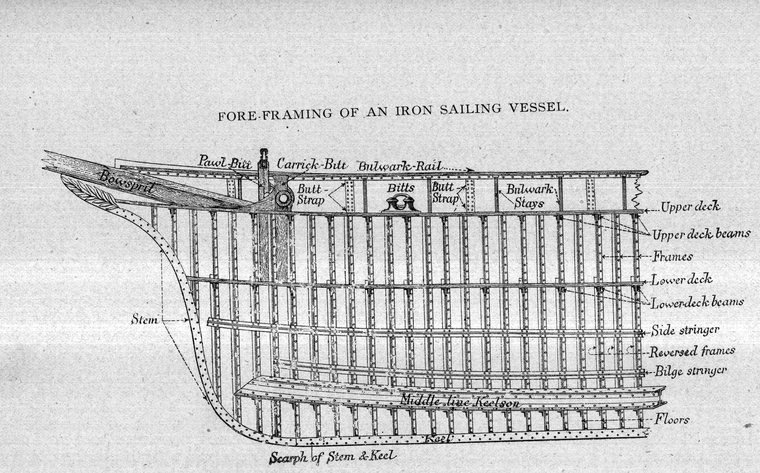
Fore-framing of an iron sailing vessel
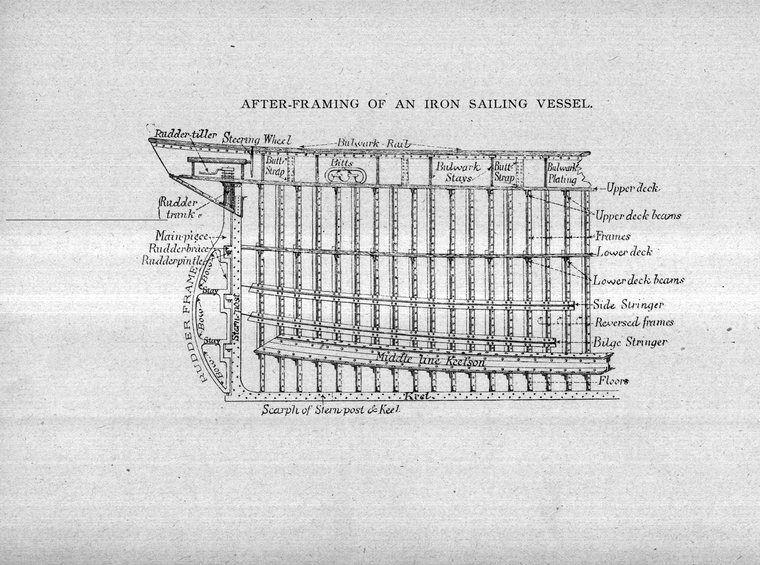
After-framing of an iron sailing vessel
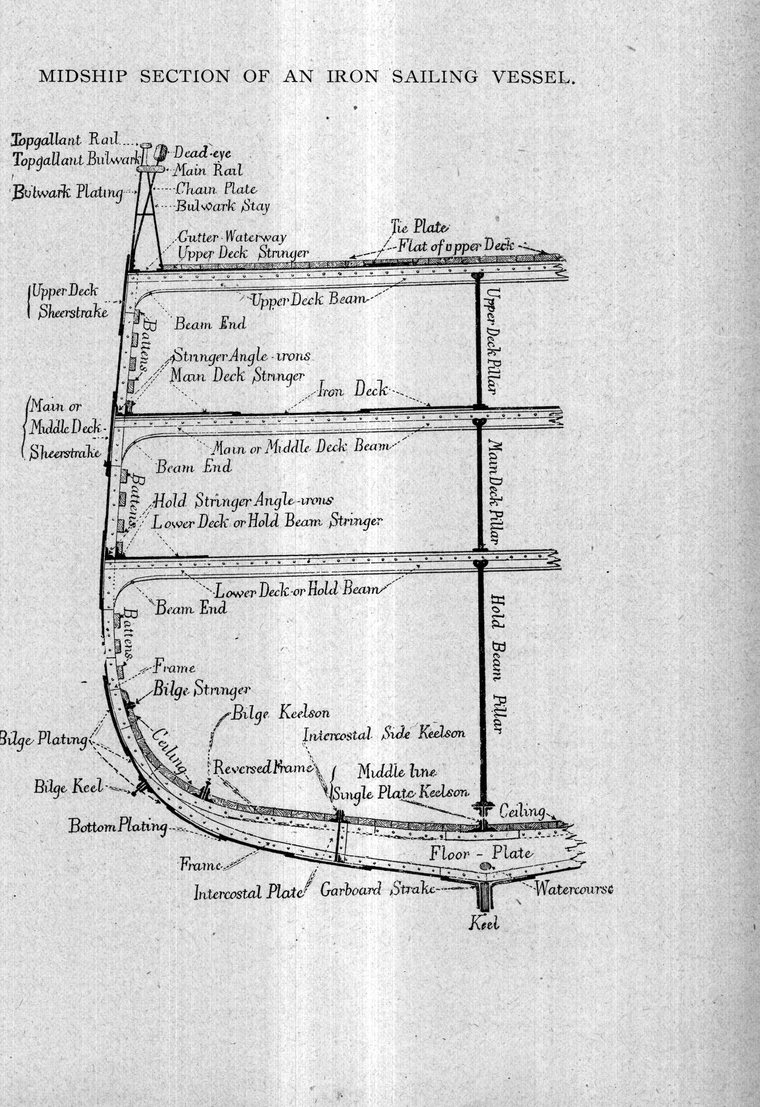
Midship section of an iron sailing vessel
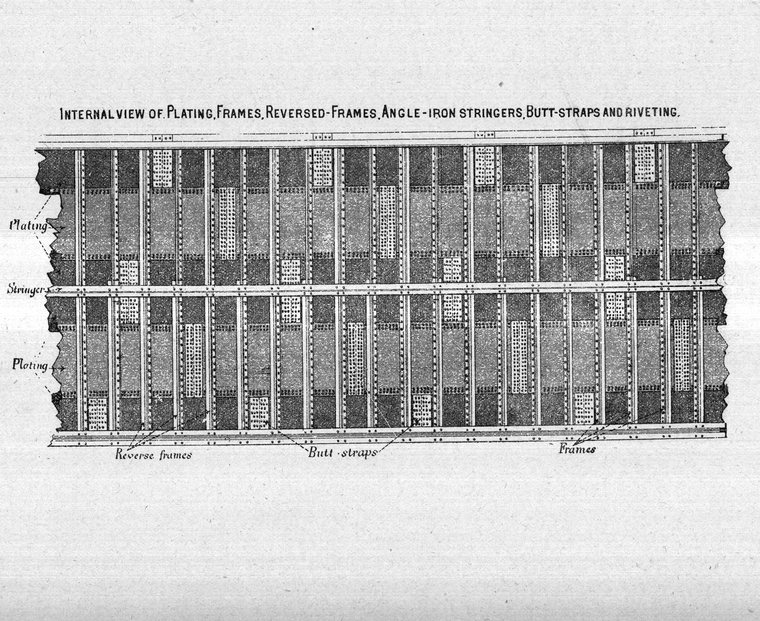
Internal view of plating, frames, reversed frames, angle-iron stringers, butt-straps and riveting
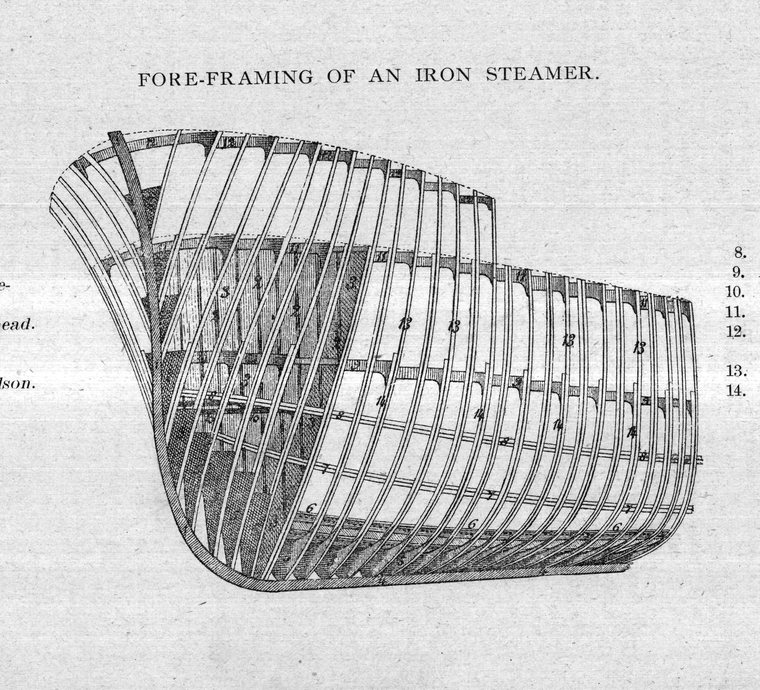
Fore-framing of an iron steamer
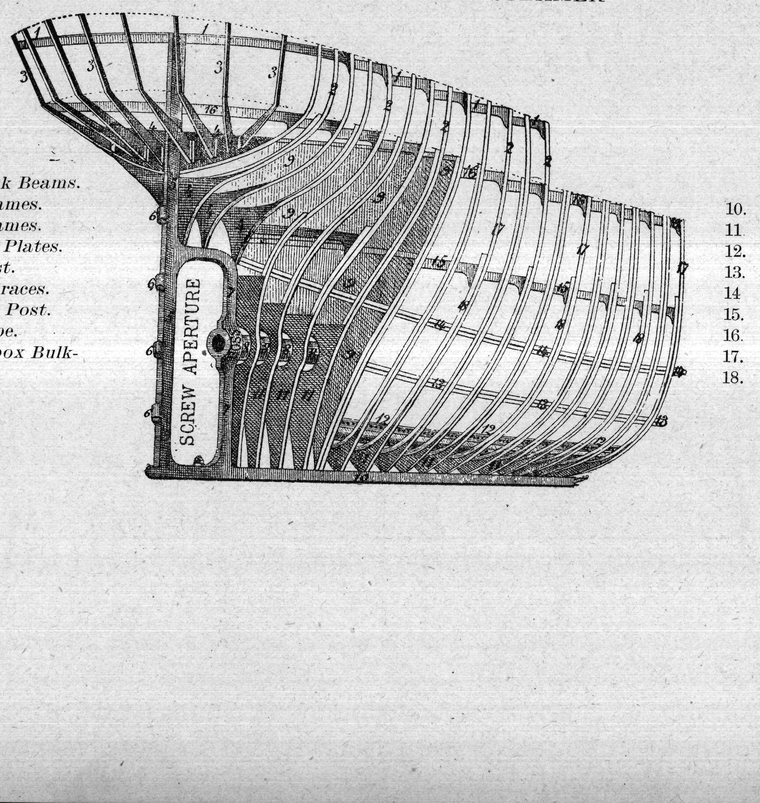
After-framing of an iron steamer, showing the screw aperture
← page 296The A–Z indexpage 300 →