WhalebackShipbuilding
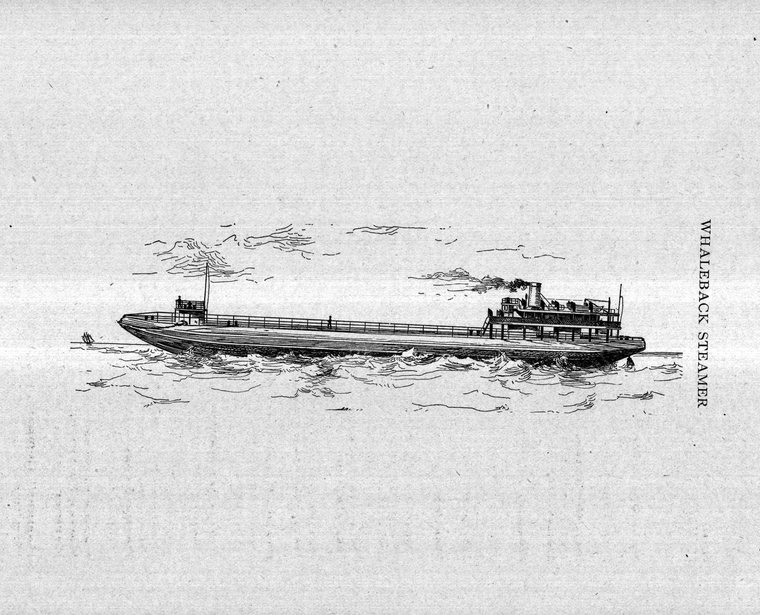
A peculiar construction of vessel built originally on the Great Lakes, and designed for superior stowage capacity. Several of these vessels have made extended ocean voyages. (See Engraving, Part 1.)
Page 334 of Patterson’s Illustrated Nautical Encyclopedia · 46 entries
A peculiar construction of vessel built originally on the Great Lakes, and designed for superior stowage capacity. Several of these vessels have made extended ocean voyages. (See Engraving, Part 1.)
A term applied to the bodies of those ships which are so constructed that one mould made in the midship bend, with the addition of a floor hollow, will mould all the timbers, below the main breadth, in the square body.
The places next the side upon the orlop, usually parted off in ships of war, that the carpenter and his crew may have access round the ship in time of action, to plug up shot-holes, etc.
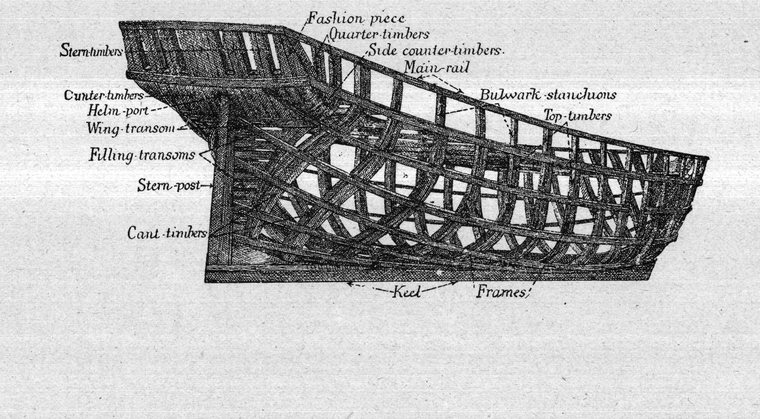
The uppermost transom in the stern frame, upon which the heels of the counter timbers are let in and rest. It is by some called the main transom.
A piece of elm or oak, closely fitted and sheathed with copper, in the throating or score of the pintle, near the load water line; so that when the rudder is hung and the wood-lock nailed in its place it cannot rise, because the latter butts against the under side of the brace and butt of the score.
Ring bolts, used when planking, with two or more forelock holes in the end for taking in the sett, as the plank, etc., works nearer the timbers.
A sort of stout billet of tough wood, tapered at the ends so as to go into the ring of the wrain bolt to make the setts necessary for bringing to the planks or thick-stuff to the timbers.
Owing to the motion of the earth, combined with the motion of light, there is an apparent displacement of the stars, termed aberration.
When the north star is so situated as to be intercepted between the observer and the pole, it is said to be above the pole. This applies to other circumpolar stars.
An abridgement of the contents of the log book.
The increase of velocity in a moving body.
Acceleration of Sidereal on Mean Solar Time. The difference of time between a sidereal and mean solar day, amounting to 4 minutes. It is by this amount that the First Point of Aries anticipates the Sun in a mean revolution.
To regulate a compass with magnets, or to regulate the mirrors of a sextant, etc., for use, is to adjust them.
Bodies revolving about the sun like the planets, and which the earth encounters in the way of fire-balls, and small solid bodies, composed principally of iron.
The elapsed time since the last conjunction.
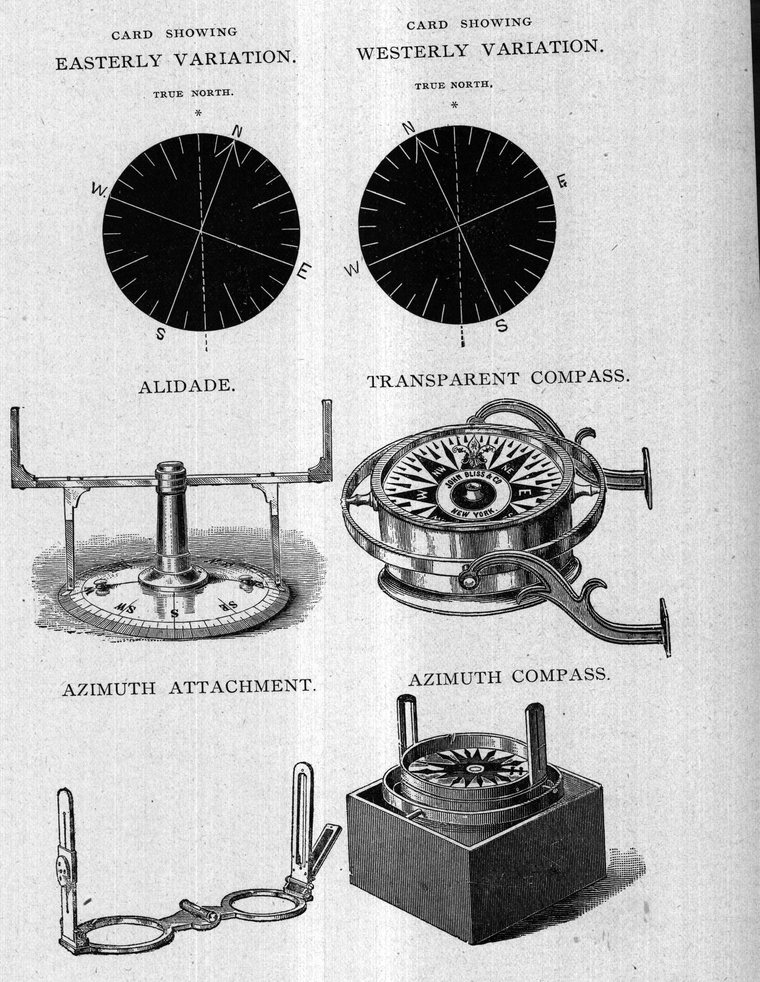
An instrument for taking bearings, composed of two revolving arms around a circular brass plate marked in imitation of a compass card. The alidade is screwed to the top of the binnacle, and set to the ship's course, in conformity to the sensitive compass beneath. (See engraving.)
The nautical almanac is a calendar of the days and months of the year in which is tabulated the declinations of the sun, moon, stars and planets, right ascensions, times of transits, equation of time, etc., etc.
The angular value of a heavenly body above the horizon as measured on a reflecting quadrant, etc.
An instrument is said to "move in altitude" when it turns on a horizontal axis.
Ante Meridian; before meridian; the hours from midnight to noon.
An altitude of the sun measured before noon.
The bearing (never in excess of 90 deg.) of a heavenly body at rising or setting, calculated in degrees from the east or west point. Magnetic Amplitude is the observed bearing of the body by compass. True Amplitude is the geopraphical bearing of the body calculated for its declination and the parallel of observation, and found tabulated in works on navigation.
Tables found in works on navigation giving the true bearing of heavenly bodies at rising and setting, calculated for various declinations and parallels.
An instrument for measuring the velocity of the wind.
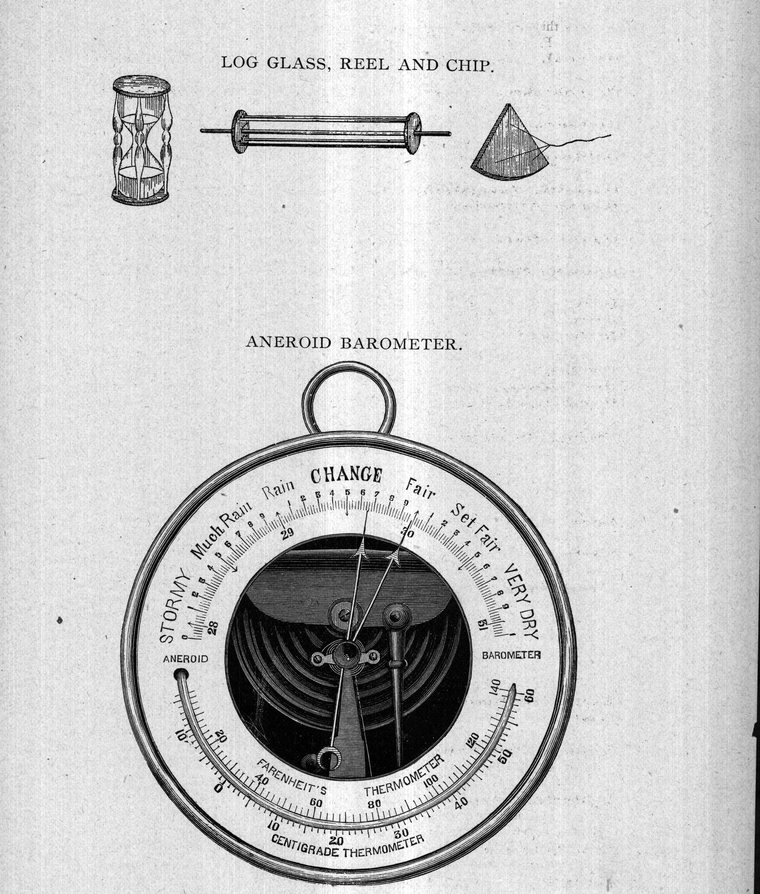
An instrument for registering the variation of atmospheric pressure. In construction it is an air-tight box of thin metallic plates, the compression being resisted by an internal spring. A system of levers connected with the spring causes an index pointer to revolve on the dial face. (See engraving.)
The divergence of two line starting from the same point.
Measured by an angle, as the angular distance of a star from the moon.
The variation of the compass constantly fluctuates, and the aggregate change for a twelve-month is called annual variation.
When the apparent diameter of the moon is less than that of the sun, so that a ring of light surrounds the former while central.
The period of the moon's revolution round the earth with reference to the line of apsides.
The time between two successive passages of the earth through its aphelion or perihelion points, and consists of 365 days, 6 hours, 13 minutes, 46 seconds.
The regions near the South Pole of the earth.
That parallel distant 23 deg. 28 min. from the South Pole.
The South Pole of the earth.
Also known as return trades. Counter currents in the upper regions of the atmosphere, flowing from the equator toward the poles.
That point in the planet's orbit which is furthest from the sun.
The instant of time at which the sun appears on the meridian of a place.
That shown by the sun, estimating the apparent noon to commence at the passage of his centre over the meridian of any place.
That point of the moon's orbit which is at the greatest distance from the earth--opposed to perigee.
A part of a circle.
The regions near the North Pole of the earth.
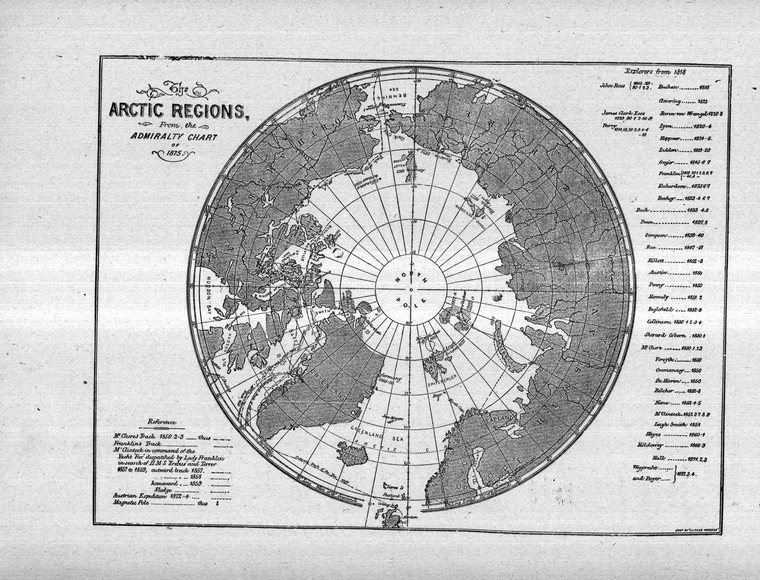
That parallel distant 23 deg. 28 min. from the North Pole.
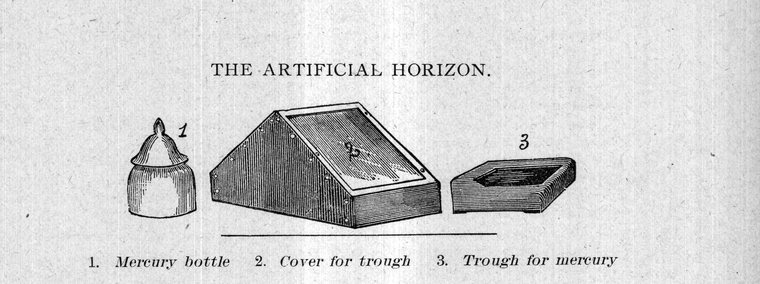
A trough of quicksilver having a roof of glass, and used for measuring altitudes on shore of heavenly bodies. (See engraving.)
An arc of the equinoctial intercepted between the horizon and the hour circle of the object at rising and setting. As related to the sun, it is the time he rises before, or sets, after 6 o'clock.
A small planet--Ceres, Pallas, Juno, Vesta, and others.
A pendulum timepiece of great accuracy regulated to sidereal time. (See Clock.)
This begins at noon of the civil day, and the hours are numbered from one to twenty-four--the letters A. M. and P. M. never being employed.