Land BlinkNavigation
A brightness in the atmosphere in the vicinity of land covered with snow.
Page 374 of Patterson’s Illustrated Nautical Encyclopedia · 21 entries
A brightness in the atmosphere in the vicinity of land covered with snow.
(See Part I.)
(See Part I.)
Any shore object which serves as a guide to vessels. equator; the angular distance from the equator measured on a meridian.
Celestial Latitude. The declination of a heavenly body; the angular distance of a heavenly body from the equinoctial, either north or south.
Difference of Latitude. The difference in degrees, minutes and seconds of arc between two parallels.
Geocentric Latitude. The distance of a heavenly body from the ecliptic, as viewed from the centre of the earth.
Heliocentric Latitude. The distance of a heavenly body from the ecliptic as seen from the centre of the sun.
Terrestrial Latitude. Latitude measured from the equator, north and south, on the earth's surface.
The parallel of the vessel determined by dead reckoning.
The parallel of the vessel determined by the employment of a traverse table. (See Dead Reckoning.)
The parallel of a vessel determined by an observation of a heavenly body. (See Co-Latitude; Co-Middle Latitude; Meridional
Difference of Latitude; Middle Latitude.)
(See Part I.)
A measure of distance, varying in different countries, as follows; United States, France, England and Italy, 6,075 yards; Germany and Holland, 8,100 yards; Spain, 7,416 yards; Russia, 8,468 yards.
(See Part I.)
The magnifying glasses used in telescopes.
The error of a transit instrument owing to the deviation of the axis from the horizontal.
Those northern and southern parallels outside of which occultations of the stars or planets with the moon is not possible.
A term used in relation to the equator.
The imaginary line joining the Aphelion and Perihelion points of the orbit, also the line joining the Apogee and Perigee.
The line of chords upon the sector is used for protracting any angle when the limited size of the paper will not admit of an arc being drawn upon it with the radius of a common line of chords.
The line passing through the centre of the telescope of an astronomical instrument--the intersection of the cross-wires in the focus.
Found upon Gunter's rule, and used to divide a given line into any number of equal parts.
That line which passes through the nodes of an orbit.
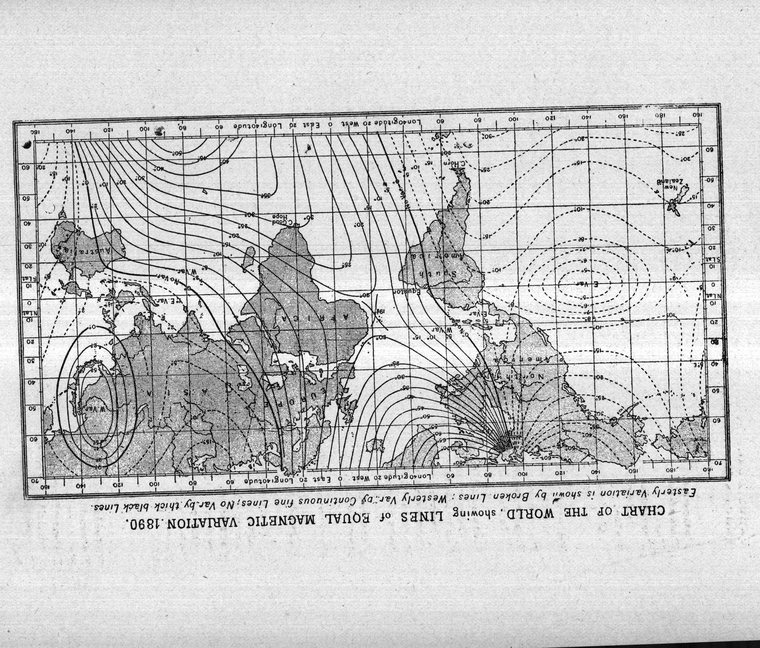
Two lines on the earth's surface extending from the magnetic north to the magnetic south pole; all places on which the magnetic and true meridians coincide. (See chart.)
Used to inscribe a regular polygon in a circle.