Morning StarNavigation
The planet Venus when it rises before the sun; when it appears in the west just after sunset it is called the evening star.
Page 386 of Patterson’s Illustrated Nautical Encyclopedia · 24 entries
The planet Venus when it rises before the sun; when it appears in the west just after sunset it is called the evening star.
The Pampero, which blows chiefly in the summer season from the Andes across the pampas of Buenos Ayres to the sea-coast. It is a dry, northwest wind, conveying large quantities of sand and dust, and extending at times to considerable distance seawards.
Several stars appearing in close proximity to each other so as to form a cluster.
That point in the invisible heavens diametrically opposite to the zenith. The Nadir and Zenith are the two poles of the horizon.
A diagram of a compass card exhibiting a combination of a curved line and a straight line, the deviation between which shows at once the amount of compass deviation for each point.
An instrument used for ascertaining the ship's heel.
Astronomical stations situated in the capital cities of the different nations.
When the term natural is used in navigation it has reference to natural sines, tangents, etc., and natural numbers. Natural sines, tangents, etc., are sines, tangents, etc., taken in arc, whose radii are I. Natural logarithms are those taken in a system whose modulus is I.
Marine; maritime; pertaining to ships; navigation, etc.
(See Almanac.)
That part of astronomy which is made use of in navigation.
(See Mile.)
Certain bright stars employed by navigators for determining the ship's position.
Tables computed for the solution of various navigation problems.
The lowest tides in the month, occurring four or five days before the new and full moons--when the attractions of the sun and moon on the waters do not act in the same line.
The magnetized steel bar of the compass.
In relation to the compass, the points of no semi-circular deviation.
The moon is said to be new immediately after her conjunction with the sun--when she commences to increase.
A combination of cumulo-cirro-stratus; a system of clouds discharging rain, hail or snow; also known as the rain cloud.
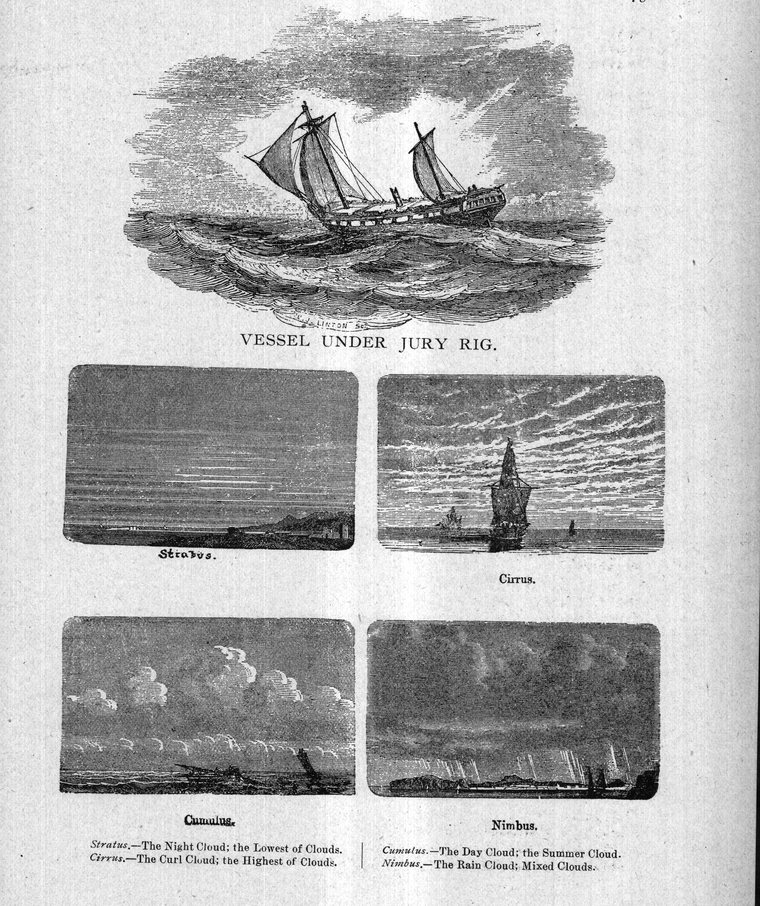
Elliptically-parted clouds seen after a storm, and considered by seamen as a promise of fine weather to come.
Pertaining to the night.
That part of a circle described by a heavenly body between its setting and rising.
In geometry an oval figure formed by the intersection of one branch of a curve with another; in astronomy one of the two opposite points at which the orbit of a planet or comet intersects the plane of the ecliptic.
Ascending Node. The node which a planet, etc., crosses from south to north.
Descending Node. The node which a planet, etc., crosses from north to south.
Line of the Nodes. A straight line joining the two nodes.