The Nautical Encyclopedia
Patterson’s Illustrated Nautical Encyclopedia — Howard Patterson, 1891

Noon to Parallel Rulers

Page 388 of Patterson’s Illustrated Nautical Encyclopedia · 17 entries

NoonNavigation

Midday; 12 hours from midnight; when the sun is in the observer's meridian.

Apparent Noon. When the sun's centre is in the meridian.

Mean Noon. When the mean sun is in the meridian.

Sidereal Noon. When the first point of Aries comes to the meridian.

Northern HemisphereNavigation

That part of the globe on the north side of the equator.

NutationNavigation

A small and slow giratory motion of the earth's axis, producing a periodical fluctuation of the apparent obliquity of the ecliptic, and of the velocity of the regression of the equinoctial points.

Object GlassNavigation

The lens in the large end of a telescope; the lens which is the first to receive the rays of light.

ObservationNavigation

The act of measuring an altitude of a heavenly body.

Working an Observation. The process of calculating the latitude or longitude of the ship from the observed altitude.

Observed AltitudeNavigation

The angular distance of a body measured on an instrument of reflection, such as a quadrant, etc.

OccultationNavigation

The eclipse of one heavenly body by another. The commencement of the occultation is known as the immersion, and the termination as the emersion.

OctantNavigation

A navigating instrument of reflection. An octant is really a metal-frame quadrant, and is divided so as to read to 15 seconds of arc.

Off Shore TideNavigation

A tide setting from the shore.

Off Shore WindNavigation

A wind blowing from the land.

Off SoundingsNavigation

Water so deep that soundings cannot be obtained with the deep-sea lead and line, which is marked from 80 to 100 fathoms.

On SoundingsNavigation

A depth of water capable of being measured with the deep-sea lead and line.

OppositionNavigation

When the longtitude of a heavenly body is 180 degrees from the sun it is said to be in opposition.

OrbitNavigation

The imaginary line described by a planet round the sun, or a satellite round its primary.

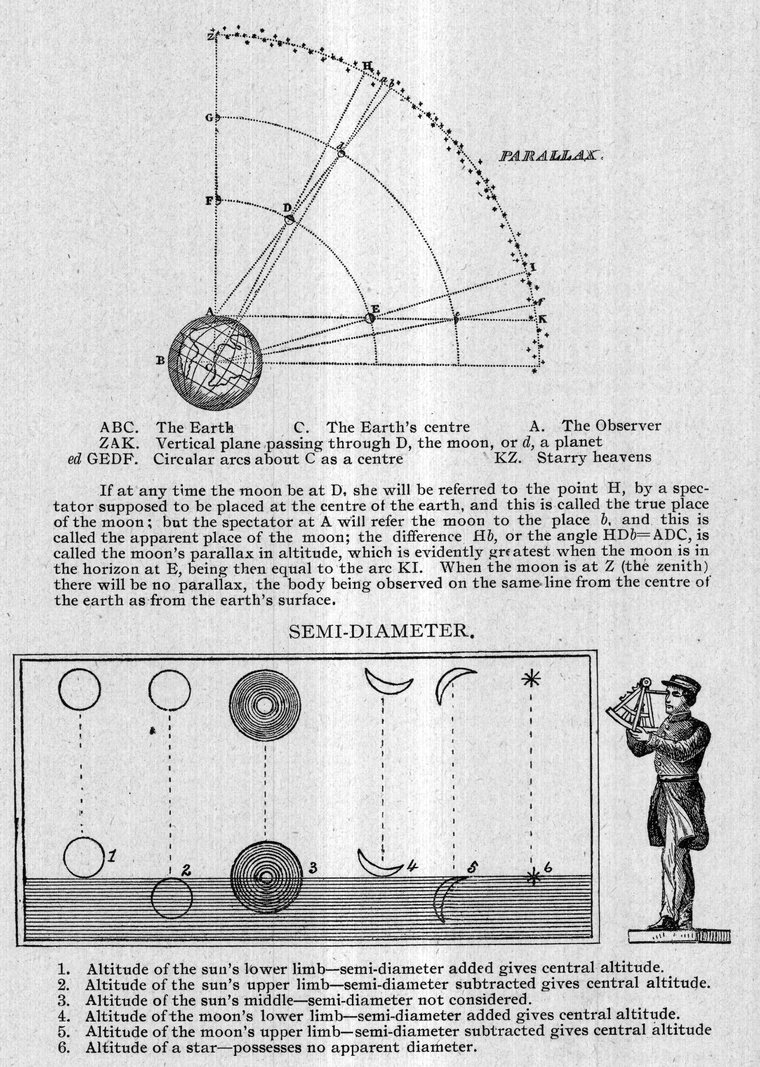
ParallaxNavigation

The apparent angular variation in the position of a body as seen from two different points of view.

Parallax and semi-diameter

Parallax in AltitudeNavigation

A term made use of in contradistinction to horizontal parallax.

Annular Parallax. The maximum value of the heliocentric parallax.

Binocular Parallax. The angular difference of an object as viewed by the eyes of the observer.

Diurnal or Geocentric Parallax. The difference between the place of a body as viewed at the same instant from the surface and from the centre of the earth. When viewed from the surface of the earth we have the apparent place, but could it be viewed from the centre of the earth we would have its true place. Thus the arc intercepted between the true and apparent places is the diurnal or geocentric parallax, which varies with the altitude of the body observed, being zero when the body is in the zenith, and having the greatest parallax when the body is O degrees, or without altitude.

Heliocentric Parallax. The difference in the place of a body as seen from the earth and from the sun; the angle drawn from the body to the centre of the earth and the centre of the sun.

Horizontal Parallax. The maximum value of the geocentric parallax--when the body observed is in the horizon, hence the term. Horizontal Parallax varies with the latitude of the observer, having its greatest value at the equator.
Parallel RulersNavigation

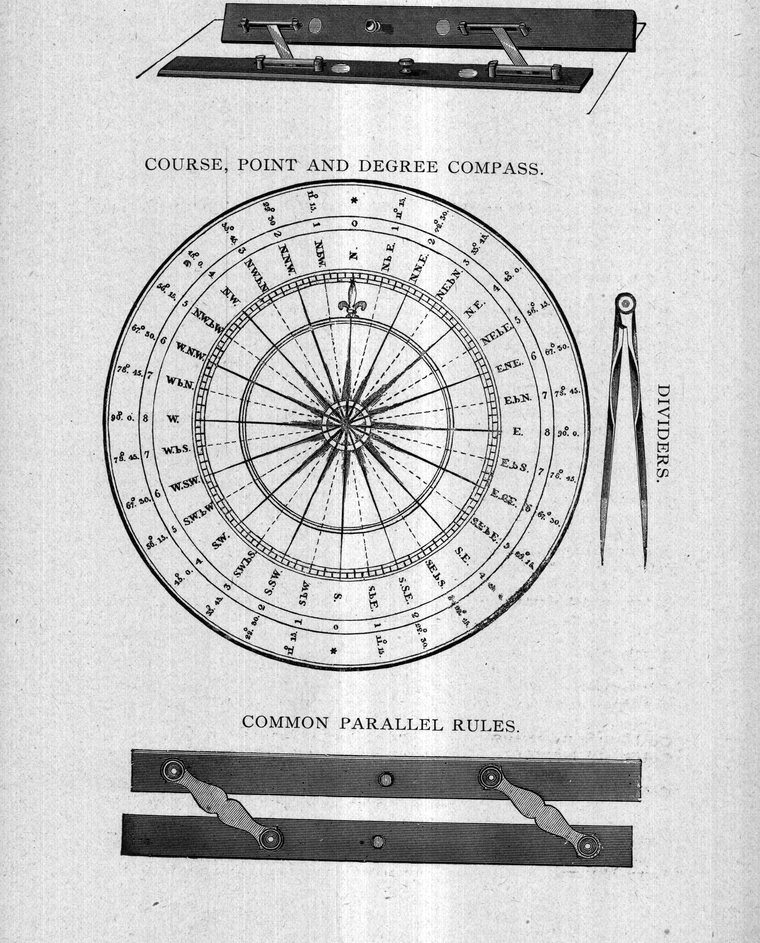
An instrument employed in navigation for shaping the ship's course on the chart. In construction it is two flat rules of ebony or gutta percha, connected by pivoted cross-pieces of brass so that the rules may be spread apart, yet still preserve their parallelism to each other.

Course, point and degree compass; dividers; common parallel rules; spirit level
← page 386The A–Z indexpage 390 →