ParallelsNavigation
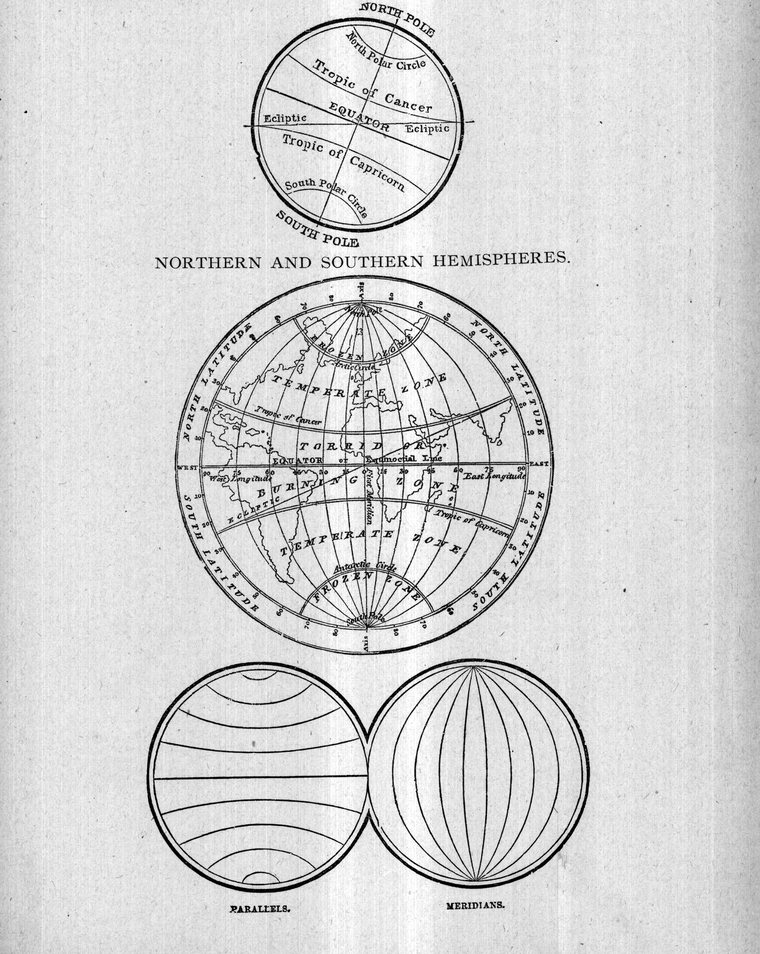
Lying in the same direction; all parts equally distant; small circles of the terrestrial sphere parallel to the equator; small circles of the celestial sphere parallel to the ecliptic.
Page 390 of Patterson’s Illustrated Nautical Encyclopedia · 50 entries
Lying in the same direction; all parts equally distant; small circles of the terrestrial sphere parallel to the equator; small circles of the celestial sphere parallel to the ecliptic.
Small circles parallel with the horizon.
Small circles parallel with the equinoctial.
Sailing true east or west; sailing on a parallel of latitude.
Mock suns appearing at the same height above the horizon as the true sun, and connected with the same by a horizontal halo.
The normal level of the barometer at a given place.
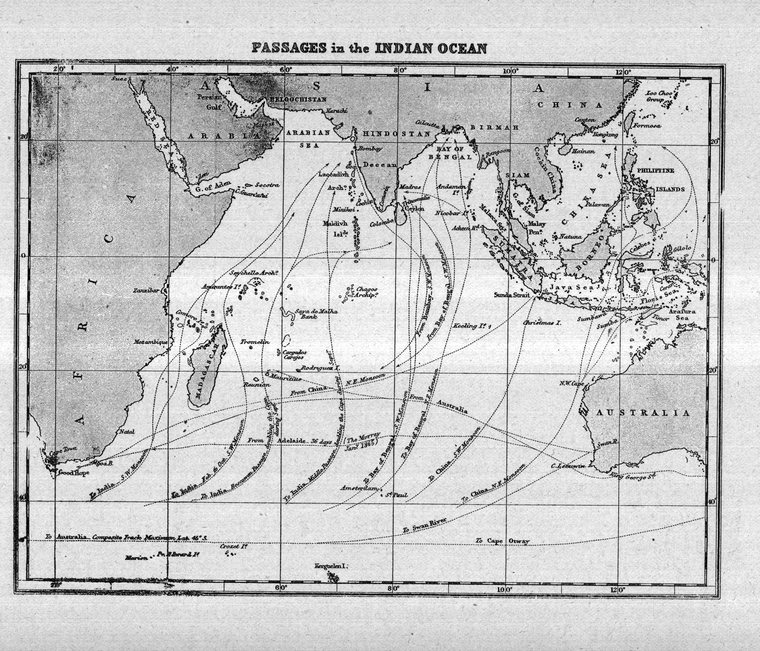
The crossing of a heavenly body over the meridian is also known as the meridian passage; the journey from one place to another by water.
An instrument employed for measuring the force of currents.
(See Log).
(See Clinometer.)
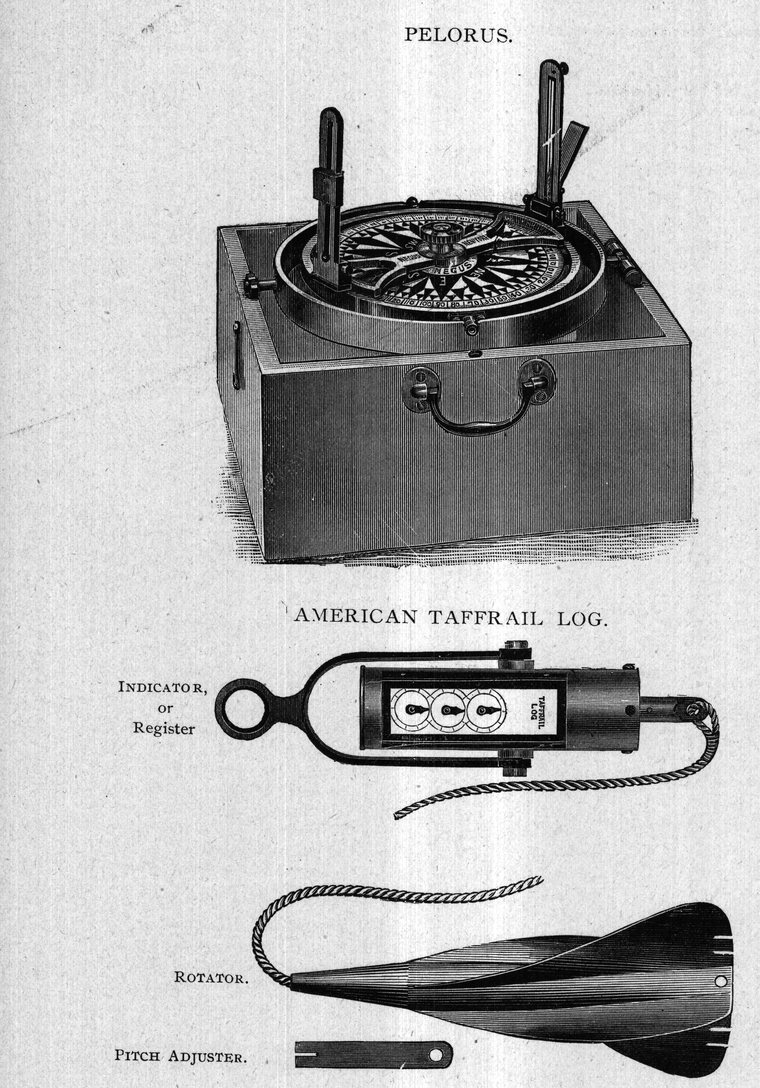
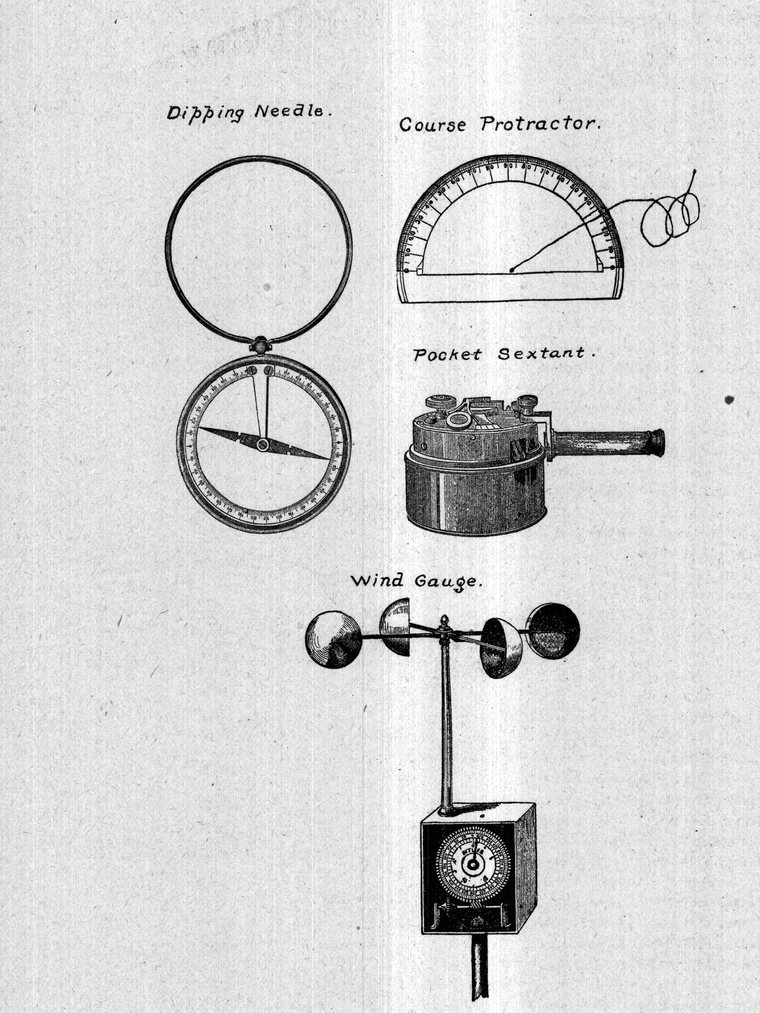
An instrument for taking bearings, on the principles of the alidade. (See engraving.)
In astronomy that portion of the shadow in an eclipse which is not entirely deprived of light.
Near the earth; the point in the orbit of a heavenly body (particularly the moon) which is nearest the earth--opposed to apogee.
Near the sun; the point in the orbit of a heavenly body which is nearest the sun--opposed to aphelion.
A line at right angles to the plane of the horizon.
Difference in judgment, as shown in measuring angles, etc., by different observers.
Same as Personal Equation.
Irregularities in motion of a heavenly body in its orbit.
A name sometimes applied to the quadrant owing to its likeness to the yoke sometimes placed around the neck of a hog.
Certain limits within which the law obliges a vessel to pay pilotage fees.
The point on the celestial sphere to which a heavenly body is referred by the observer.
Apparent Place. The point to which a body is referred by an observer on the earth's surface, viewing it through the earth's atmosphere.
Geocentric Place. The point to which a body would be referred were the observer at the earth's centre.
Heliocentric Place. The point to which a body would be referred were the observer at the sun's centre.
True Place. The point to which a body would be referred were the observer at the earth's centre viewing it through an atmosphere of uniform density.
A level surface. In astronomy planes are ideal, passing through certain points of the heavens--as, for instance, the planes of the horizon, ecliptic, equator, etc.
A chart so constructed that the parallels and meridians are represented by straight lines parallel to each other, and preserving the same distance from one another, employed only for limited areas.
Calculating the position of the ship on the supposition that the surface of the earth is a plane.
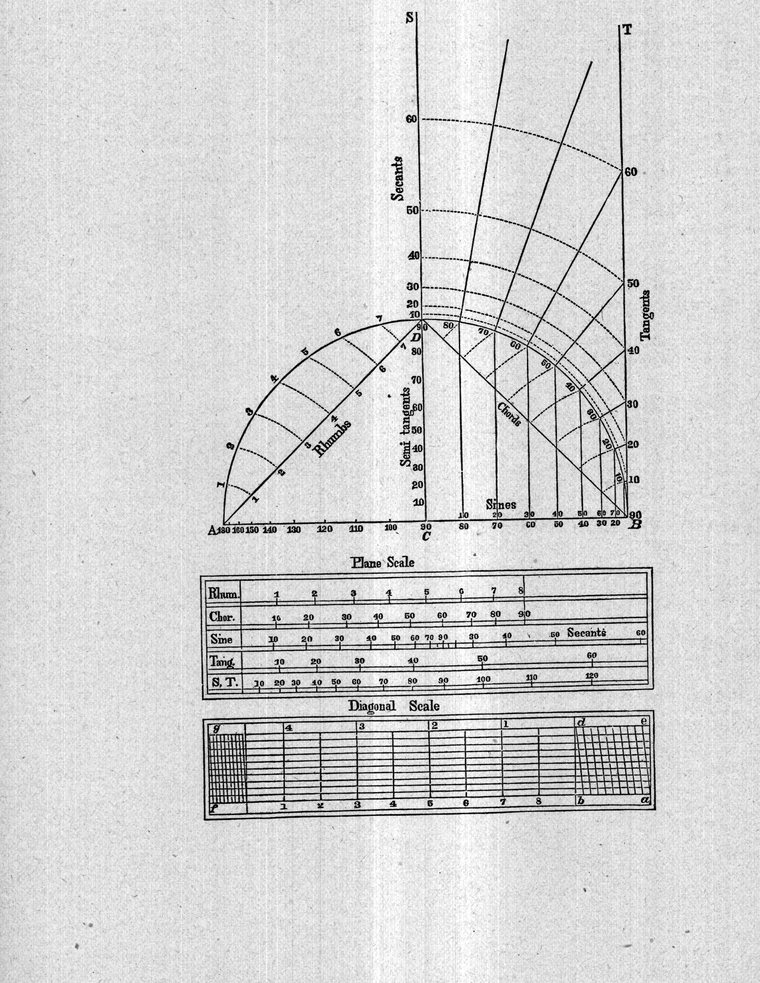
A rule used in navigation, on which are graduated chords, sines, tangents, secants, rhombs, etc.
An opaque celestial body which receives its light from the sun, and around which it revolves. The eight principal planets are the following, which are named in the order of their distances from the sun: Mercury (nearest to the sun), Venus, Earth, Mars, Jupiter, Saturn, Uranus and Neptune. Near the sun is a small planet named Vulcan.
Inferior Planets. The planets whose orbits are within that of the earth--Vulcan, Mercury and Venus.
Minor Planets. A name given to the small planets collectively.
Primary Planets. Planets which revolve only about the sun.
Secondary Planets. Satellites which revolve also about their primaries.
Superior Planets. The planets whose orbits are without that of the earth--Mars, Jupiter, Saturn, Uranus and Neptune.
An astronomical machine which exhibits the relative motion and position of the planets.
netoid. One of the minor planets between Mars and Jupiter--an asteroid.
A small planet.
A map of the stars.
A full tide.
Delineating; marking down; to trace on a chart the courses sailed by a ship, in order to ascertain the position of the vessel--the simplest kind of dead reckoning.
Post meridian; after meridian; the 12 hours from noon to midnight.
An altitude of a heavenly body measured in the P. M.; an afternoon observation.
A bight in the land on a lee shore.
As its name implies, a small sextant; of a peculiar pattern and of a size suitable for carrying in the pocket.
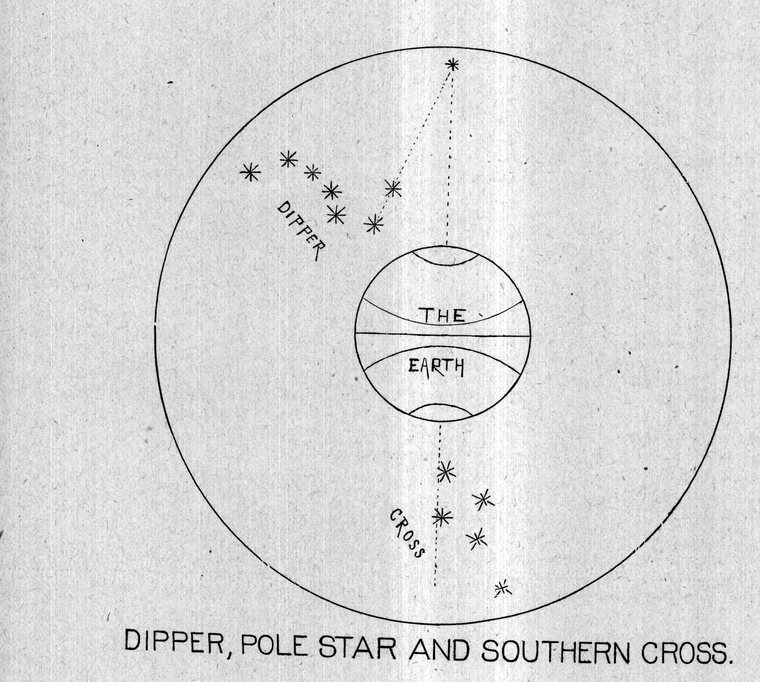
The two stars in the Dipper (Ursae Majoris) pointing to Polaris--the North Star.
A certain place in the heavens; one of the 32 divisions of the compass card.
Autumnal Point. Where the sun descends towards the South Pole.
Equinoctial Points. Where the equator and ecliptic intersect.
Solstial Points. The highest and lowest points of the ecliptic.
Vernal Point. Where the sun ascends towards the North Pole.
Pertaining to the pole.
The angle at the terrestrial pole formed by two meridians, and the angle at the celestial pole formed by two hour circles.
The two parallels of latitude situated 23 deg. 28 min. from the poles of the earth. The northern is called the Arctic and the southern the Antarctic circle.
Rather less than 25,000 miles. (See Earth.)
The earth's polar diameter is 7,899.1 miles--the polar compression being about I-300 of the diameter.
The complement of the declination; the angular distance from the elevated pole.
The Pole Star, so-called on account of its being near the north pole of the heavens. Also known as the North Star.
The extremities of the earth's axis. (See Magnetic Poles.)
(See Polaris.)
The latitude and longitude of a ship calculated by dead reckoning, cross-bearings, etc., or by observations of the heavenly bodies.
An instrument constructed on the divided object-glass principle, and used in marine surveying.
A small telescope instrument used for the purpose of regulating chronometers on shore, for establishing secondary meridians, etc.
The slow shifting of the equinoxes toward the west, the annual rate being 50 sec. This is caused by the earth's rotation on its axis, and the unequal action of the sun and moon on the equator. Precession of the equinoxes is so termed because the place of the equinox among the stars, at every subsequent moment, precedes, with reference to the diurnal motion, that which it occupied the moment before.