Standard CompassNavigation
A compass on board ship situated where it is least subject to deviation; the compass by which bearings are taken and the ship navigated.
Page 404 of Patterson’s Illustrated Nautical Encyclopedia · 30 entries
A compass on board ship situated where it is least subject to deviation; the compass by which bearings are taken and the ship navigated.
Time shown by a clock, which is regulated to mean solar time, which see.
Apparently small luminous bodies visible in the heavens at night, which shine by their own light, and which to the observer maintain their places with reference to one another. About 6,000 may be seen with the naked eye in the whole heavens; and about 3,000 may be seen at one time on a clear night when the moon is not shining. (See Magnitude.)
(See Sidereal Time.)
An instrument used in marine surveying, consisting of a graduated circle of brass having one fixed and two movable arms radiating from its centre, the latter being set to any desired angles.
8 furlongs, 326 rods, 1,760 yards, or 5,280 feet.
Relating to the stars.
The course of a storm; the path of a hurricane in its forward or progressive motion-not its circular or gyratory movement.
The lowest of clouds, sometimes called the night cloud; an extended horizontal formation of clouds, the surface of which sometimes rests on the earth, forming mists and fogs.
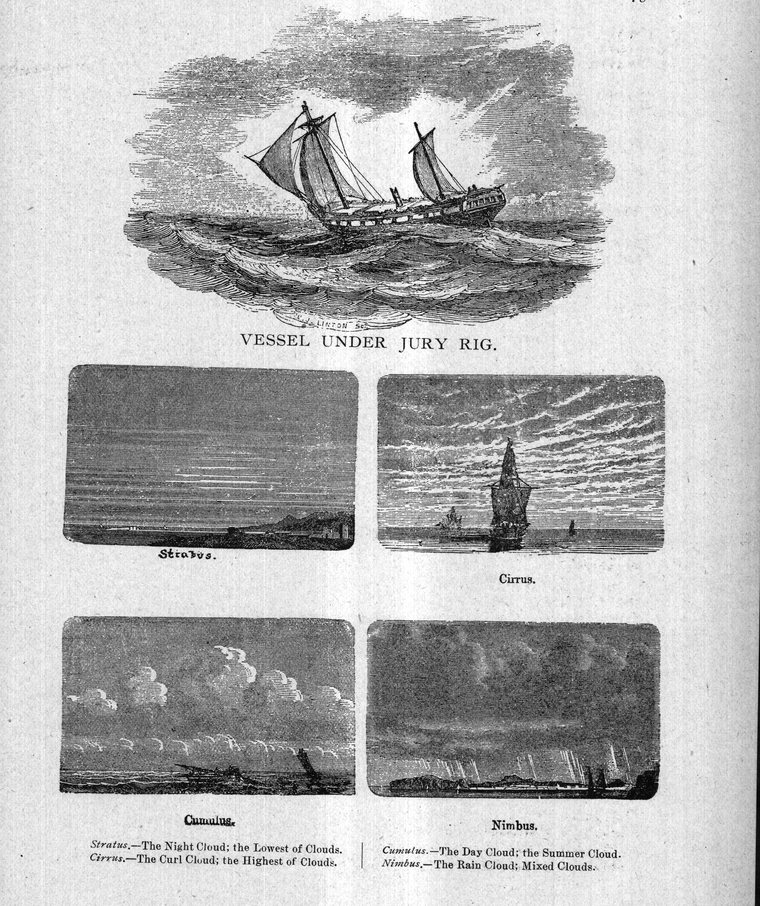
An accumulation of the parts of a drift into a collective mass by the intervention of some obstacle; it then runs off by means of its own gravity, and takes the direction imposed on it.
Currents which do not correspond either in direction of velocity with those of the surface.
A telescope for viewing objects below the surface water, consisting of two united tubes, one of them being thrust into the water, and the other arranged to throw light into it.
A new iron or steel vessel will rid itself to a great extent of the magnetism which it receives in building, but a certain quantity will remain, and this is known as sub-permanent.
A process for finding the ship's longitude and place when the latitude is in doubt, by employing two assumed latitudes, one greater and the other less than the latitude by account; then, after the sun has changed its azimuth, observing another time sight and working it twice again, using the same two assumed latitudes as in the first workings. These four positions are marked on the chart and crossed with lines, the pint of crossing indicating the position of the vessel at the time of the first sight.
The centre of the solar system and the source of light and heat; diameter, 885,000 miles; circumference, 2,780,000 miles; the sun rotates on its axis in 25d. 7h. 48m.; mean distance from the earth, 95,000,000 miles.
A luminous spot sometimes seen near the sun.
(See Solar Time.)
The appearance of the sun above the eastern horizon; the time of the sun's appearance in the morning.
The time of the sun's descent below the western horizon; in the evening.
(See Planet.)
The flowing of the surface water.
Determining boundaries, extent and contour of a portion of the earth's surface, and delineating same on paper.
Turning the ship around to the 32 points of the compass and observing while on each point the bearing of some remote but well-defined object, for the purpose of adjusting the ship's compass.
Characters used as abbreviations to represent the weather. Beaufort's weather notation is as follows:
b. Blue sky.
c. Clouds (detached).
d. Drizzling rain.
f. Foggy.
g. Gloomy.
h. Hail.
l. Lightning.
m. Misty.
o. Overcast.
p. Passing showers.
q. Squally.
r. Rainy.
s. Snow.
t. Thunder.
v. Ugly, threatening.
r. Visibility, clearness.
w. Wet, dew.
A bar (--) under any letter augments its signification, and a bar and a dot (--.) indicates heavy and continuous weather of the kind denoted.
Wind is indicated by the following symbols:
0. Calm.
1. Light air.
2. Light breeze.
3. Gentle breeze.
4. Moderate breeze.
5. Fresh breeze.
6. Strong breeze.
7. Moderate gale.
8. Fresh gale.
9. Strong gale.
10.Whole gale.
11.Storm.
12.Hurricane.
Sea Swell is indicated as follows:
S. Smooth.
M. Moderate.
L. Long.
R. Rough.
C. Cross.
H. Heavy.
V.H. Very heavy.
The period in which the moon goes through every variety of phase.
In astronomy, the position of the moon, or planet, when it is in conjunction with, or in opposition to, the sun.
The tide occurring on the afternoon of the day that the sun and moon are in syzygy.
Meridional Syzygy Tide. When the sun or moon is on the meridian at the taking place of the syzygy.
Line of Syzygies. The line connecting the centre of the earth and the moon when the moon is in conjunction with, or in opposition to, the sun.
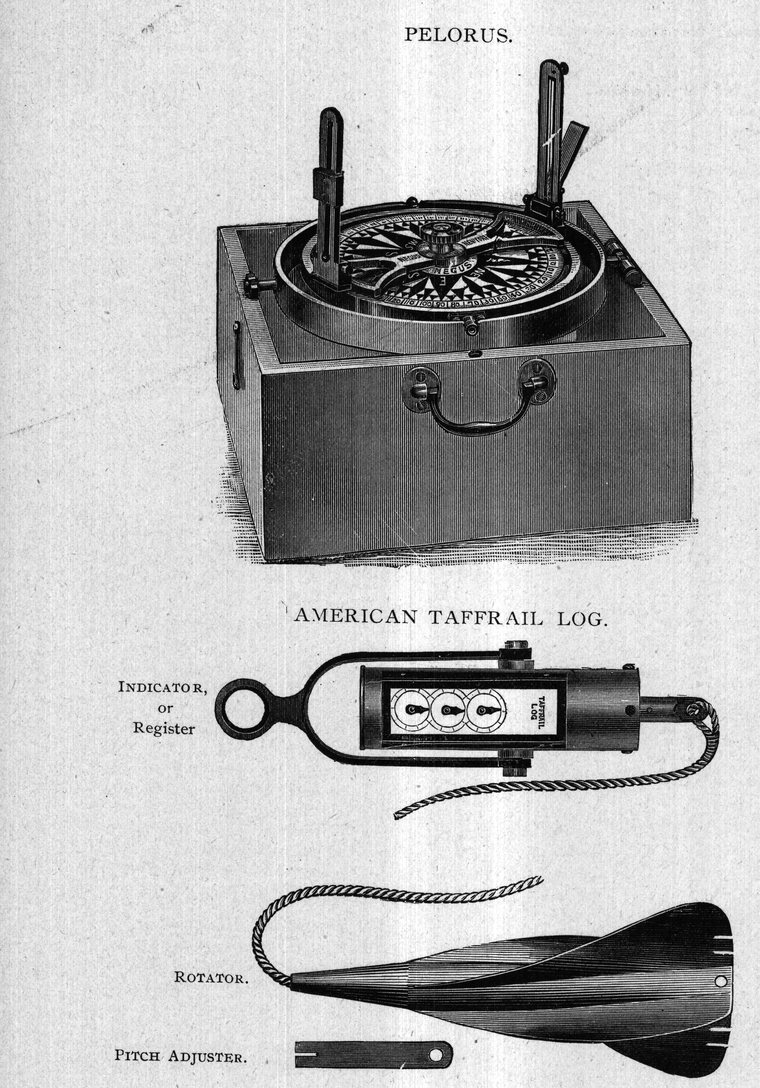
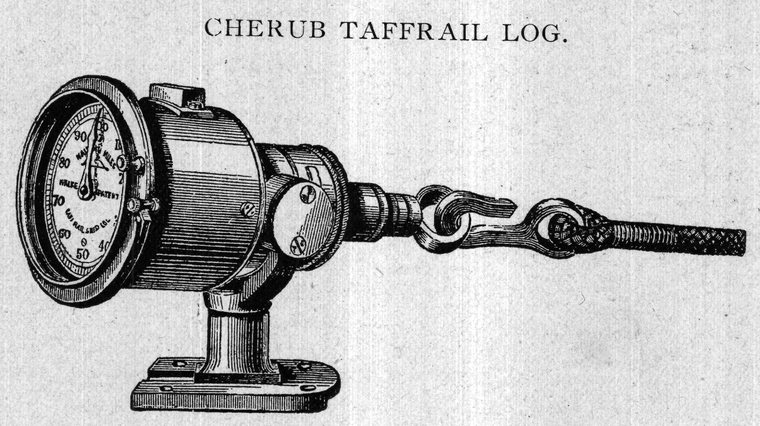
A patent log, the indicator of register of which fastens on the taffrail.
Observing the bearing and distance of a light-house or a point of land (the latitude and longitude of which is known) from which to calculate the position of the vessel. This is done upon the commencement of the voyage, and before losing distinct sight of the land-generally when the first course is set.