TransitNavigation
The passage of a heavenly body over the meridian. (See Lower Transit; Upper Transit.)
Page 412 of Patterson’s Illustrated Nautical Encyclopedia · 30 entries
The passage of a heavenly body over the meridian. (See Lower Transit; Upper Transit.)
A telescope instrument for observing the passage of heavenly bodies over the meridian.
(See Part I.)
(See Part I.)
To solve a problem in traverse sailing is to determine the vessel's latitude and longitude by dead reckoning, and the bearing and distance of the vessel from the point left. This is known as working the traverse.
Tables calculated by natural sines. These tables contain the difference of latitude and departure corresponding to distances up to 300 miles, for every quarter point of the compass, also for degrees, and are employed in the solution of right-angled triangles, which enter into the consideration of dead-reckoning.
A wind blowing directly into the harbor's mouth.
A geometrical figure of three sides.
A term used in surveying, meaning the determination of the triangles into which the country is supposed to be divided.
The science of measuring triangles.
Three stars so close together as to resemble a single star when viewed without the aid of a telescope.
The parallel north of the equator, the latitude of which is equal to the sun's greatest declination--23 deg. 28 min.; the point which the sun reaches on the 21st of June.
The parallel south of the equator, the latitude of which is equal to the sun's greatest declination--23 deg. 28 min.; the point which the sun reaches on the 21st of December.
Those parallels of latitude included between 23 deg. 28 min. north and 23 deg. 28 min. south.
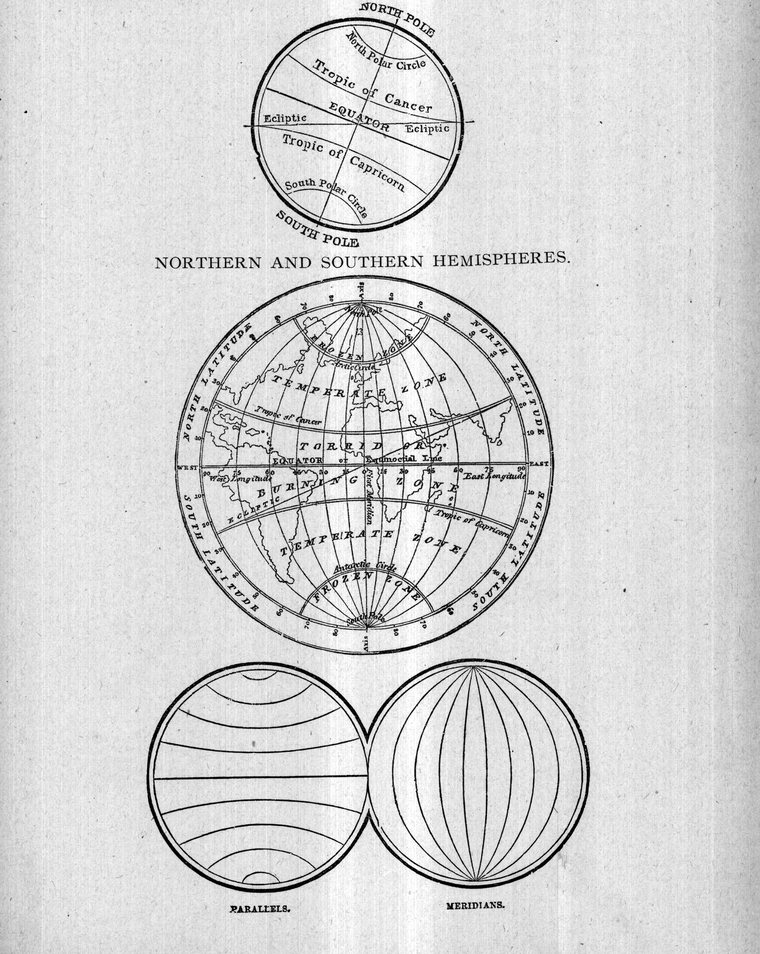
Also called Solar Year, which see.
(See Whirler.)
The geographical bearing of a heavenly body, calculated for its declination and the parallel of the observer--considered from the east and west points.
The geographical bearing of a heavenly body, calculated for its declination, the hour, and the parallel of observation, and found tabulated in special books on navigation--considered from the north and south points.
The angle which the direction of an object makes with the meridian.
The altitude deduced from the observed altitude by correcting it for semi-diameter, dip, parallax, refraction, and instrumental error.
(See Corrected Course.)
The depth of the water as measured from its mean surface.
A violent hurricane peculiar to the China Sea and Indian Ocean at the time of the change of the monsoons.
A rain gauge or measure.
Beyond the tropics.
Beyond the zodiac.
The bright streak often seen under clouds near the horizon.
A current beneath the surface water, flowing in a contrary direction. The supposition is that an undercurrent in the Straits of Gibraltar carries the same amount of water into the Atlantic Ocean from the Mediterranean as the surface current carries from the Atlantic into the Mediterranean.
The passage of a heavenly body across the meridian which is above the horizon--180 deg. from the lower transit.
(See Part I.)