Variable StarsNavigation
Stars which exhibit periodical fluctuations in brightness--stars which change from one brightness to another.
Page 414 of Patterson’s Illustrated Nautical Encyclopedia · 33 entries
Stars which exhibit periodical fluctuations in brightness--stars which change from one brightness to another.
Inconstant winds.
Change; alteration.
In astronomy, a periodic irregularity in the motion of the moon owing to the disturbing action of the sun.
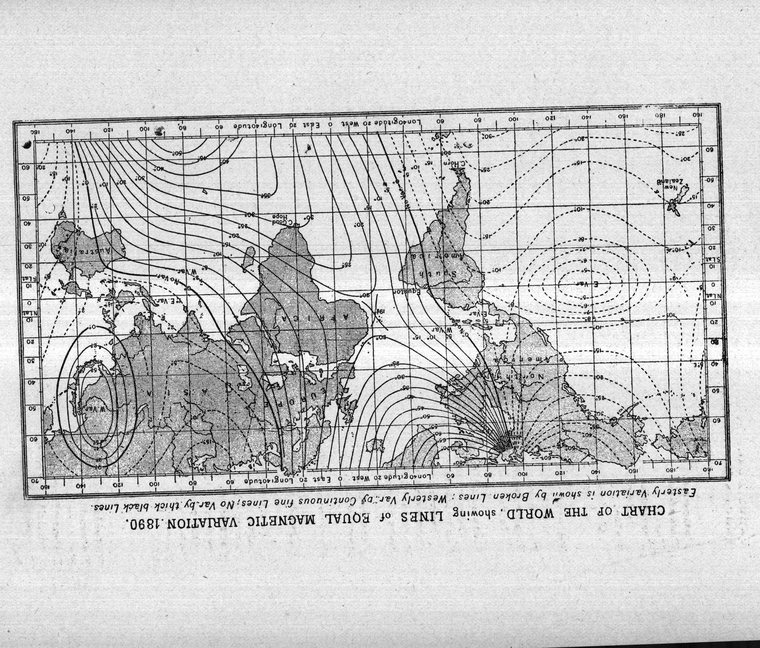
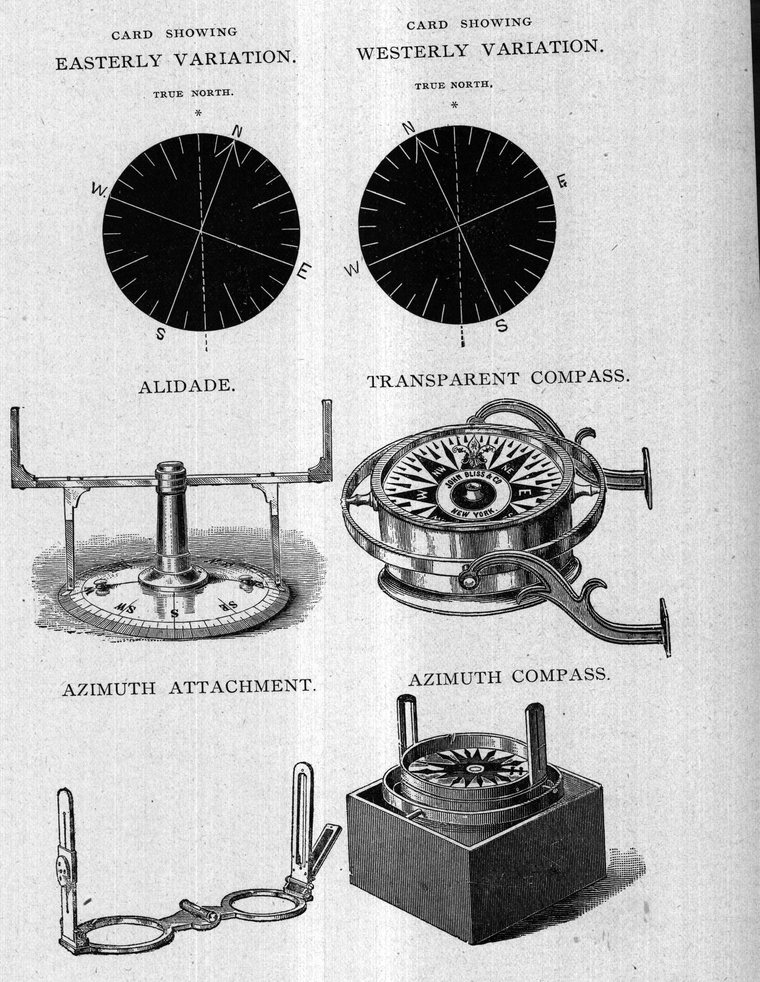
In magnetism, the declination of the magnetic needle from the true or geographical meridian; the angle which the magnetic meridian makes with the geographical meridian.
The variation of the magnetic needle is not constant. In 1663, in Paris, the compass needle pointed true north, previous to which year the variation had been easterly. From 1663 to 1814 the variation in Paris was westerly, increasing steadily until 1814, when it amounted to 22 1/2 deg. W, from which year it has steadily decreased, but is still westerly.
The first point of Aries.
The 21st of March. Same as Spring Equinox.
The small graduated scale on the sliding limb of a sextant, etc., which subdivides the divisions of the arc.
In astronomy, that point of the heavens which is situated perpendicularly above the observer.
Great circles of the sphere passing through the zenith and nadir of a place. (See Circles of Altitude.)
(See Danger Angle.)
A line in any plane which is perpendicular to the horizon.
(See Celestial Sphere.)
(See Horizon.)
(See Tide.)
A dark blue sky seen in the arctic seas, and which is caused by the reflection of deep water.
(See Symbols.)
A halo on the border of a distant cloud which is discharging rain--considered a forerunner of bad weather.
The barometer.
A clear streak in the sky to windward, near the horizon, following stormy weather.
(See Symbols.)
A period of seven days.
The angle between the geographical and magnetic meridians when the latter inclines to the left, or westward of the former, causing the north end of the compass needle to point to the westward of the true north.
(See Thermometer.)
A spinning instrument like a top, used on shipboard as an artificial horizon.
A volent wind having both a circular and a progressive motion.
(See Symbols.)
(See Symbols.)
Trades, Anti-trades, Land-breeze, Sea-breeze, Monsoons, Variable winds, Mountain-winds, Bora, Mistrals, and Puna winds.
(See Weather Gall.)
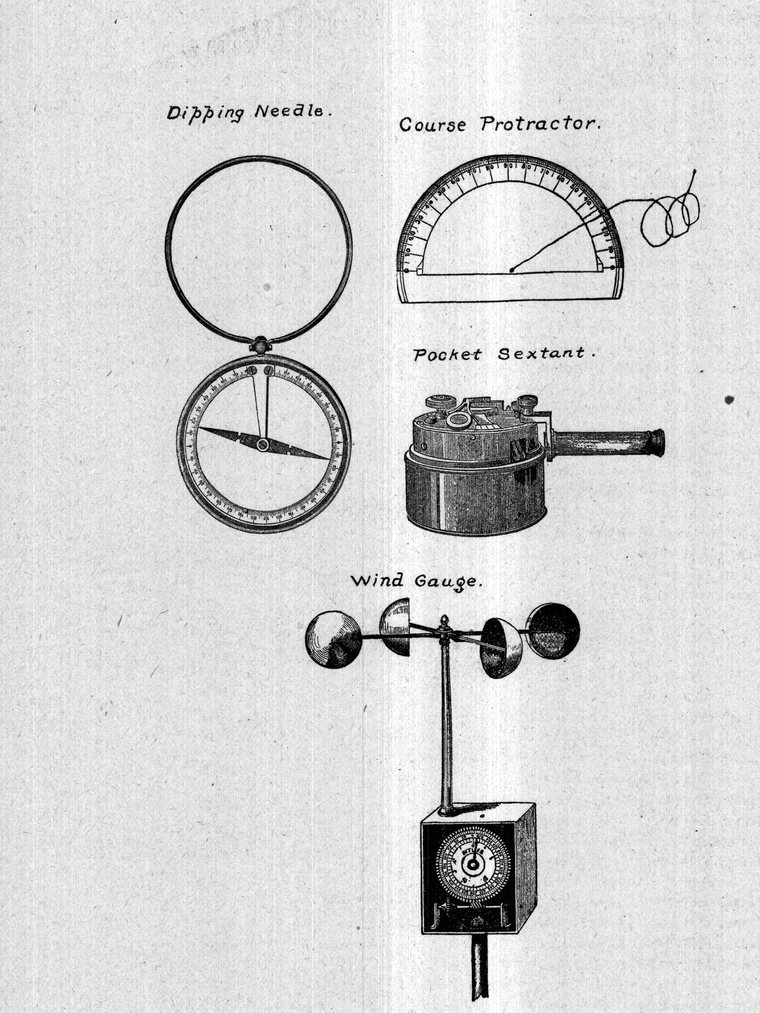
(See Anemometer.)
(See Symbols.)
(See Traverse Sailing.)
(See Common, Solar, Sidereal, Anomolistic, Tropical, Calendar and Bissextile Year.)
That point in the celestial sphere which is situated vertically over the head of the observer, and distant 90 deg. from every point of the horizon--opposed to nadir.