EngineerEngineering
A person responsible for the care and operation of the engine and boilers.
Page 430 of Patterson’s Illustrated Nautical Encyclopedia · 12 entries
A person responsible for the care and operation of the engine and boilers.
The parts connecting the cylinder to the bed-plate.
The fore-and-aft timber or iron framework, made fast to the inside of the bottom of the vessel, on which the engine bed-plate is secured.
The compartment in which the main engine is located.
1 bell, if engines are stopped.....Ahead slow.
Jingle bell additional.....Full speed.
1 bell, if under full speed.....Slow down.
2 bells, if under full speed.....Stop.
2 bells, if engines are stopped.....Astern slow.
Jingle bell additional.....Astern full speed.
Whether going astern slow or at full speed, One Bell always stops the engines.
If, running under full speed, the engineer receives four quick bells it will be understood as a signal of emergency, and the engines will be at once reversed and sent full speed astern, without waiting for the jingle bell.
Ferry boats and tow boats often have a private code of engine-room signals, but the above is employed on all coasting and ocean steamers, not provided with a telegraph.
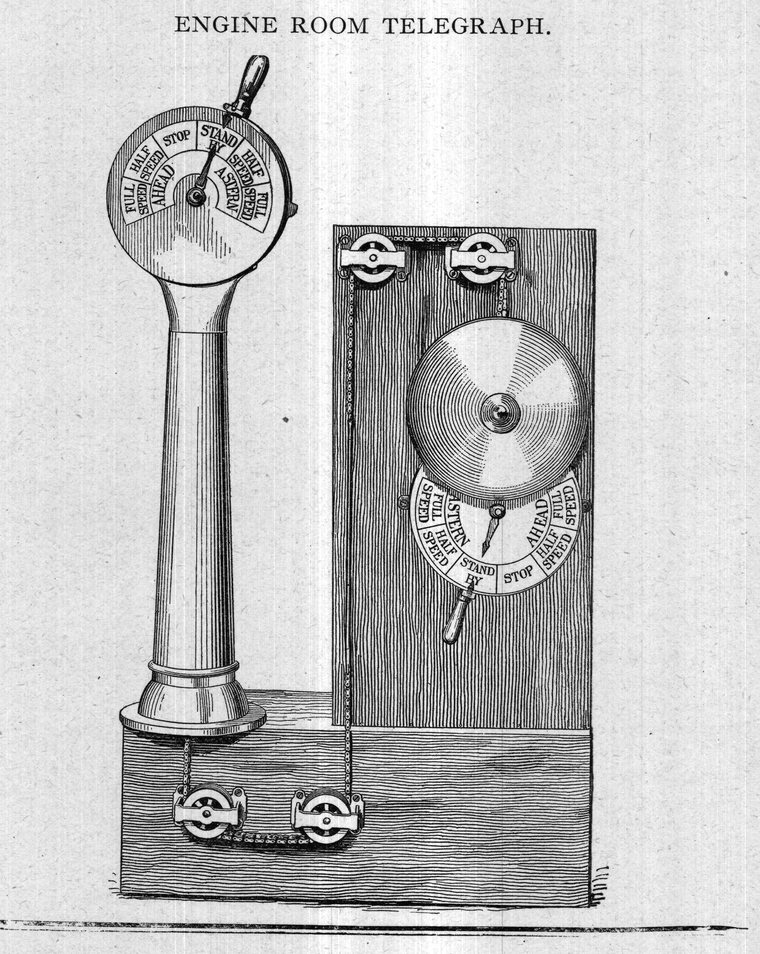
An electrical or mechanical system of wires, indicators, etc., located in and between the pilot house or bridge and the engine room, by means of which the orders for moving the engines are indicated on dials.
(See Balanced Valve.)
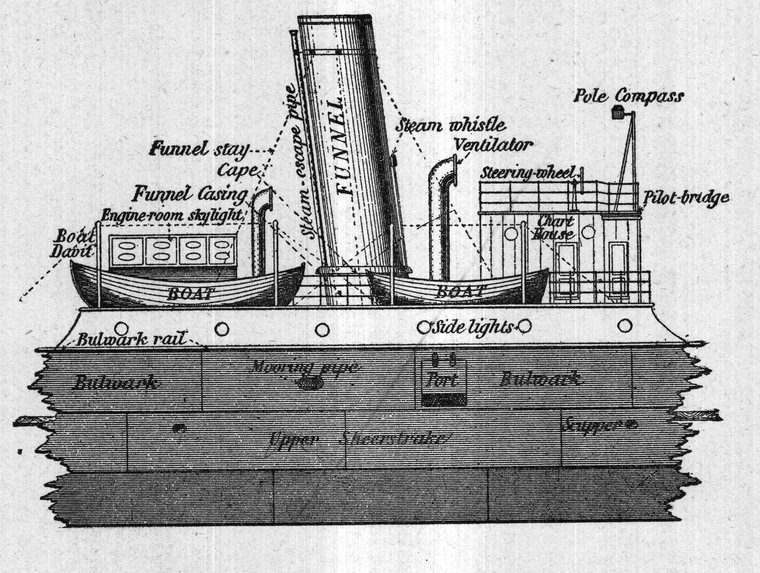
The pipe leading waste steam from the safety valve to the atmosphere.
The steam discharged from the cylinder after having performed its work.
The hook on the end of the eccentric rod which works the exhaust valve gear.
(See Lap.)
(See Lead.)