The Nautical Encyclopedia
Patterson’s Illustrated Nautical Encyclopedia — Howard Patterson, 1891

Lap to Piston Rod

Page 440 of Patterson’s Illustrated Nautical Encyclopedia · 44 entries

LapEngineering

A term applied to that joint in boiler construction in which the edge of one sheet is laid over the edge of the other far enough to be held by rivets. The distance the end of the valve extends beyond the outside edge of steamport when the valve is in mid-position.

Lazy BarEngineering

An iron bar supported horizontally across the furnace or ash pit door opening to take the weight of the fire-tools while they are being used in working the fires.

LeadEngineering

The distance the port is open when the piston is at the end of its stroke.

LeadEngineering

A strip of soft metal laid on top of a journal and squeezed down by the cap, the reduced thickness of which indicates the amount of play which the journal has in the bearing when the edges of the bearing and cap come together.

Left-hand Screw PropellerEngineering

(See Screw Propeller.)

LegEngineering

The water space about the furnace of a flue-and-return tubular boiler.

LeversEngineering

Handles vibrating about a pin, or attached to a shaft, for actuating various parts.

LiftersEngineering

The arms of the lifting rods of a beam engine that receive the impulse from the vibrating toes on the rock shaft.

Lifting RodsEngineering

The four upright rods in a beam engine front that transmit the motion from the steam and exhaust toes to their respective valves.

LiningEngineering

(See Steam Chimney.)

LinkEngineering

The bar which is connected at either end to the eccentric rods from each of two adjoining eccentries on the same shaft.

Link BlockEngineering

The block sliding on the link through which the motion of either eccentric at will is transmitted to the valve.

Link MotionEngineering

The combination of two eccentrics on the same shaft, two rods, and the link and block for operating the steam valve of an engine.

Live SteamEngineering

Steam as it comes from the boiler.

Lock-up Safety ValveEngineering

A safety valve whose adjusting parts are so protected that they cannot be tampered with.

Looking Out of WindEngineering

Sighting three or more objects with the eye to ascertain if they are in alignment--for instance, in the lining up of propeller shafting.

Low PressureEngineering

(See High Pressure.)

Low-pressure CylinderEngineering

The largest cylinder in a compound or triple expansion engine.

LubricantEngineering

Any substance that may be applied to wearing surfaces to reduce friction.

LubricatorEngineering

An apparatus for supplying a lubricant to the interior of a steam cylinder.

LugEngineering

A flat projection from the body of a piece to which to fasten other pieces.

Manganese BronzeEngineering

This consists of gun-metal with the addition of a small proportion of ferro-manganese. This alloy is used extensively for propeller blades.

ManholeEngineering

An opening in a boiler large enough to admit a man to examine and repair. It is closed with a plate covering the hole from the inside.

ManifoldEngineering

A pipe or chamber to which are connected several branch suction pipes with their valves and one or more main suctions to pump.

Mean PressureEngineering

The average pressure in a steam cylinder from the beginning to the end of a stroke.

Monkey Tail ValveEngineering

(See Starting Valve.)

Mud DrumEngineering

A receptacle in which the mud and sediment settles in a water tube boiler, to which the bottom blow pipe is attached.

Natural DraftEngineering

(See Draft.)

NozzleEngineering

A short pipe-like extension on a casting or other part.

Oil CupsEngineering

Small cups through which oil is fed to wearing surfaces.

OilerEngineering

One of the engineer force whose duty it is to keep the wearing parts supplied with the proper lubricant, and to watch their condition.

Oil WaysEngineering

Grooves cut in the wearing surface of a bearing, which allow the oil to reach all parts of the journal.

Outboard BearingEngineering

That which supports the outer end of a paddle-wheel shaft.

Outboard Delivery Pipe and ValveEngineering

Those at the side of the vessel through which the discharge water from the condenser is led overboard.

PackingEngineering

Elastic material confined about piston rods in the stuffing box to prevent leakage.

Packing RingEngineering

(See Piston Ring.)

Paddle WheelEngineering

A propelling wheel suspended and revolving at the side or stern of a vessel, its shaft being above the water and perpendicular to the vertical fore-and-aft plane of the vessel. It is provided with floats or buckets, secured at intervals around the circumference, only a few of which are in the water at the same time.

Radial Wheel. In this arrangement the buckets are secured rigidly to the arms of the wheel and the planes of their faces are practically radial planes.

Feathering Wheel. In this arrangement the buckets are supported at their ends on gudgeons or journals, and controlled by a mechanism which holds them with the plane of their faces practically perpendicular to the surface of the water during the time they are in the water.
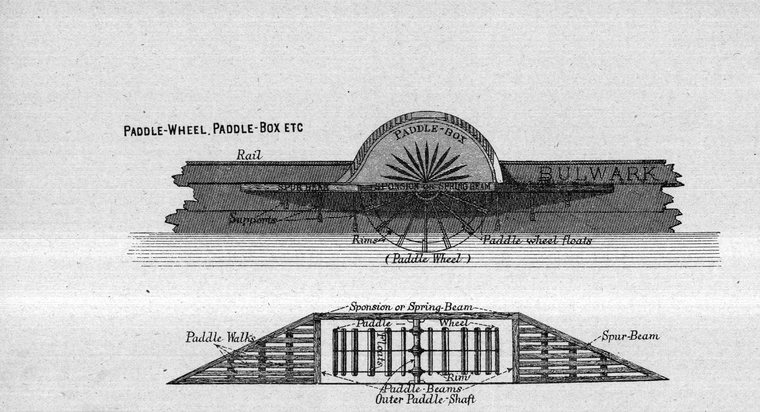
Paddle-wheel, paddle-box, etc.

Pet CockEngineering

A small cock placed in the barrel of a pump to ascertain if the pump is throwing water.

Pillow BlockEngineering

A shaft-bearing that is complete in itself and secured to the rest of the structure by bolts.

PistonEngineering

The circular disc in the bore of a steam cylinder which receives and transmits the pressure of the steam.

Piston DisplacementEngineering

The volume swept through by the piston in a single stroke, and is the area of the piston face multiplied by the stroke.

Piston HeadEngineering

The principal piece composing a piston.

Piston RingsEngineering

Small metal rings closely fitted at the circumference of the piston between the flange and follower, and held out by springs against the bore of the cylinder to prevent leakage.

Piston RodEngineering

The rod which is attached at one end to the piston, passes out through the stuffing box in head, and is attached at the other end to the cross-head. In the trunk styles of engine the free end of the rod takes hold directly of the crank pin.

← page 438The A–Z indexpage 444 →