Heating SurfaceEngineering
That surface of a boiler which is exposed to the hot gases on one side and has water on the other.
Page 438 of Patterson’s Illustrated Nautical Encyclopedia · 22 entries
That surface of a boiler which is exposed to the hot gases on one side and has water on the other.
(See Brace.)
Terms to distinguish types of engines, or cylinders. It is more common in these days to use the terms non-condensing and condensing, respectively, instead.
The smallest cylinder of a compound or triple expansion engine.
The bolts which secure the bed-plate to the foundation.
That force which will raise 33,000 pounds one foot in one minute. A conventional unit used in expressing the power developed by an engine. It is the result obtained by multiplying together the area of piston, in square inches, the mean unbalanced pressure of steam acting thereon during the stroke, and the speed of piston expressed in feet per minute, and dividing the product by the constant number 33,000. The mean unbalanced pressure can only be obtained from the indicator diagram.
A receptacle above the delivery valves of the air pump which receives the water of condensation from the condenser, from which it is supplied to the boilers as feed water.
The body of metal about a shaft hole.
(See Scale.)
An instrument for registering the pressure in a cylinder at all parts of the stroke.
The closed curve or figure traced by the pencil of the indicator.
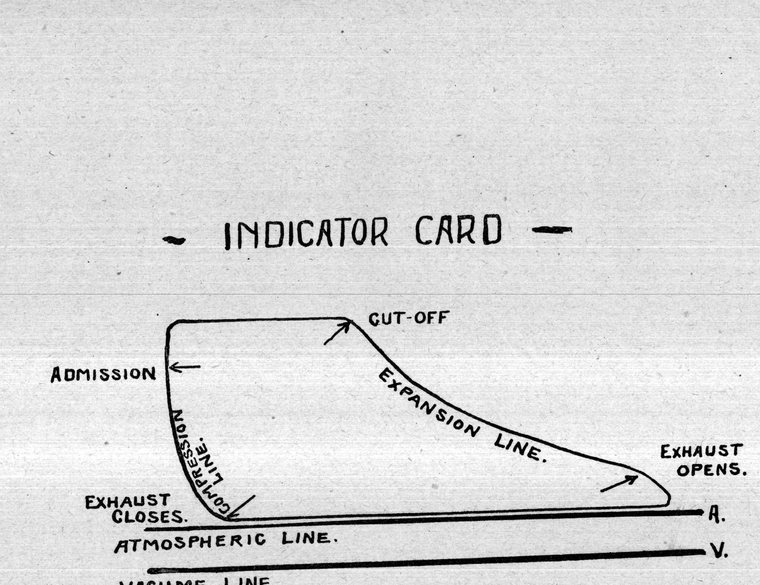
The pressure of the steam as it enters the cylinder.
The cold water supplied to the condenser for condensing the exhaust steam.
Those leading the injection water from overboard into the condenser.
An instrument for feeding water into a boiler in which the steam acts upon the water direct.
That between the high and low-pressure cylinders of a triple expansion engine.
A small bolt screwed through the flange of a bonnet or cover against the other part, to aid in breaking the joint. Called also Forcing Bolt.
The covering of a cylinder, boiler or pipe. (See Steam Jacket.)
An instrument consisting of a screw and nut used for moving heavy weights.
A taper piece of rectangular cross-section, two opposite sides of which are flat and parallel; a wedge.
A valve in the bottom of a vessel through which water flows to the pumps, etc. The valve is a truncated cone and opens downwards against the pressure of the water outside.
The covering of a cylinder or pipe which prevents radiation of heat.