Professors of MathematicsNaval
The Corps of Professors of Mathematics in the U. S. Navy consists of three with the relative rank of captain, four with the relative rank of commander, and five with the relative rank of lieutenant.
Page 494 of Patterson’s Illustrated Nautical Encyclopedia · 22 entries
The Corps of Professors of Mathematics in the U. S. Navy consists of three with the relative rank of captain, four with the relative rank of commander, and five with the relative rank of lieutenant.
A mass of metal discharged from a gun by the explosion of a charge of gunpowder or some high explosive, or by compressed air.
The projectiles used in the U. S. Navy for breech-loading cannon are armor-piercing shells, which are distinguished from the ordinary explosive shell by having thicker walls, not provided with a fuze, and having a smaller bursting charge. The bursting of these shells is insured by the heat generated by the blow.
The ordinary shell is of moderately thick walls, has a large bursting charge, and is furnished with a percussion fuze to cause the shell to explode on striking. These latter shells are for use against stone forts and earthworks, and vessels other than ironclads.
Shrapnel is furnished with a time fuze, has a small bursting charge, and is for use against boats and exposed masses of men on shore.
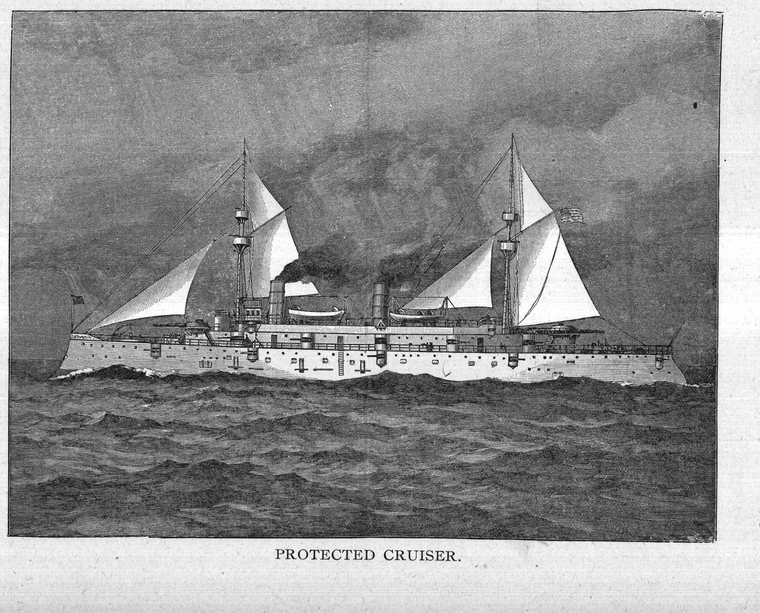
A modern man-o'-war built with not less than a four-inch steel protective deck. (See Partially Protected Cruiser.
To furnish; to serve out.
A field where guns are tested.
A written or printed form showing the various stations assigned to the officers and men for going into action.
A petty officer who assists the navigating officer of the ship in the care of the sounding leads, the lights, bunting, etc., who has charge of the wheel, reeds and hoists signals, and stands a regular watch, day and night, whether at sea or at anchor. His duty is to observe signals made to the ship from the shore or other vessels, the approach of small boats or boats containing officers, and report same to the officer of the deck.
The mess-rooms and sleeping-rooms set apart for the officers are known as Officers' Quarters. Assembling the crew at their stations for exercise, for battle, or inspection. Beat to Quarters: To order the boatswain or his mates to wind the call for assembling.
A division of one-fourth part of the ship's company.
There are various kinds. One kind is cotton wick saturated with mealed powder, spirits and gum. It will burn about 15 feet per minute. (See Slow Match.)
That part of a primer which contains the powder.
An old-fashioned wooden instrument, in the shape of a wedge, which was used for elevating guns before the introduction of elevating screws.
Chocking Quoins. Shapes of wood to chock the wheels of an old-fashioned gun carriage and prevent the same from running in or out.
To fire into a vessel in the direction of her length--in her fore-and-aft line
(See Marine Rams.)
A shot fired when the gun has an angle approaching 45 deg., which would give the utmost range. An angle of 45 deg. is considered to give a range about ten times greater than the point-blank. Also a shot fired without regard to aiming at the object struck.
The distance from the muzzle of the gun to the point struck by the projectile.
(See Relative Rank.)
(See Guns.)
(See Classification.)
(See Uniform.)
The daily allowance of food served out on Government vessels to seamen and marines. Officers are entitled to one ration, which may be stopped, and in lieu thereof 30 cents per day credited to their accounts. Petty officers may also stop their rations, and draw commutation therefor at the rate of 30 cents per day. At the discretion of the commanding officer permission to stop one or more rations may be given to a seamen's, firemen's, or marines' mess, and the commutation paid to said mess by the paymaster. This is done to enable the mess to purchase such small stores and fresh vegetables for the mess as are not furnished in the ration list. Rations are not allowed except to the members of a vessel in commission.