Naval ReserveNaval
A body of men recruited as an auxiliary naval force to be employed in time of emergency. State naval reserves are on about the same footing as the militia.
Page 486 of Patterson’s Illustrated Nautical Encyclopedia · 34 entries
(See Explosives.)
No! No! (See Hail.)
Names appropriated to any science.
(See Commissioned Officer.)
The watch officer in charge of the deck and the general management of the ship. When at sea, the officer of the deck directs the movements of the vessel, and follows the course laid down by the navigating officer. When entering or leaving port, the executive officer takes charge of the deck and handles the vessel. When at quarters, the navigating officer assumes charge of the deck, and the watch officer relieved takes command of his division. When in port, the officer of the deck observes that the routine of the ship is carried on, that the boats leave and return to the ship at proper times, and keeps the rough-log, entering therein an account of all happenings and work going on during his watch, makes a memorandum of the names of liberty parties leaving and returning to the ship, etc. (See Watch Officer.)
A term embracing cannon, mortars, howitzers, and machine-guns.
The first watch officer of a man-o'-war is also the ordnance officer. Formerly the navigating officer was the ordnance officer.
When vessels are laid up--out of commission--they are said to be in ordinary.
(See Charge.)
A rating next below that of seaman, and next above that of landsman.
Formation; the state of being organized.
(See Uniform.)
A rifled gun named after its inventor.
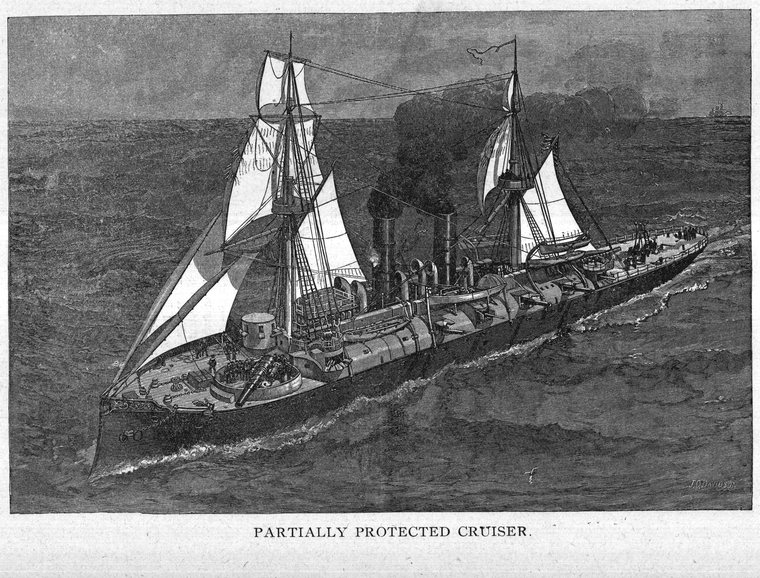
A modern man-o'-war built with not less than a 2-inch steel deck, forming an arch and curving from a point a short distance below the water-line on either side, the highest point of the curve being over the midship line, or keel, of the vessel, and in contact with the first deck above the water-line. The idea is that a projectile striking and penetrating the vessel in the vicinity of the water-line will naturally be deflected by the curve of the steel deck, and thus be prevented from doing injury to any vital part in the ship's interior.
Grenades fired from a mortar.
An appointed officer who acts as clerk to the paymaster, keeping the latter's books and exercising care over the paymaster's stores, consisting of provisions, clothing, etc.
The paymaster's corps of the U. S. Navy consists of one paymaster-general with the relative rank of commodore; pay directors with the relative rank of captain; pay inspectors with the relative rank of commander; paymasters with the relative rank of lieutenant-commander; paymasters with the relative rank of lieutenant; passed assistant paymasters with the relative rank of lieutenant, junior grade, and assistant paymasters with the relative rank of ensign.
The ship carrying the Commodore or Rear Admiral.
(See Uniform.)
A gun that can be revolved horizontally and fired on either side of the ship.
The rod connected with the cylinder, carriage and slide.
A term applied to members of the fourth, or lowest, class at the Naval Academy.
The tray on which the breech plug travels in and out.
In a direct line with the object at which the gun is aimed. Point-blank Range. The distance at which a projectile, fired at point-blank, will hit the object at which it is aimed.
In gunnery, an opening in the side of a man-o-war through which a gun is fired.
The powders explained following are in use in the U. S. Navy.
Brown Prismatic. A slow-burning powder, brown in color, in shape hexagonal prism, having a hole in the centre through which it is strung when putting the charge together, and through which also the circulation of the flame is accelerated throughout the mass. This powder is used for service charges for the modern breech-loading rifles.
Black Prismatic. A quick-burning powder used in small quantities as a primer for brown prismatic powder. (See Charges.)
Cannon Powder. A black grain powder, used for service and saluting charges for the old smooth-bore guns.
Mealed Powder. The only use for this powder in the service is for filling primers. As its name implies, it is very fine.
Musket Powder. This is a black, fine-grain powder and is used for filling smallarm cartridges and shell.