Transporting AxlesNaval
Axles employed in moving from one part of the deck to another gun which is mounted on a pivot carriage.
Page 513 of Patterson’s Illustrated Nautical Encyclopedia · 12 entries
Axles employed in moving from one part of the deck to another gun which is mounted on a pivot carriage.
The wheels used in connection with transporting axles.
The latch that holds the tray to the face of the breech of the gun.
A mount that allows the gun to circle around the top on a small track.
A vessel used in carrying troops, horses, and field artillery. (See Transport.)
Suspended hostilities. When such suspension is desired, it is indicated by the display of a white flag, and the person approaching the enemy's lines carrying a flag of truce is always given safe conduct in going and returning.
An old-fashioned carriage, which is manipulated by side tackles, etc.
The two round projections on the sides of a piece of ordnance by which it rests upon the carriage and affords means of elevating and depressing the piece by its oscillations in the grooves on the upper edges of the cheeks of the carriage.
Gauge. An instrument by which the diameter of the trunnions is measured.
Ledge. The small shelf to the trunnion of a heavy piece of ordnance.
Level. The spirit-level by which the trunnion ledge is placed in a horizontal position.
Plate. The plate which covers the upper part of the side-pieces and goes under the trunnion.
Ring. The ring upon a gun just forward of the trunnions--now obsolete.
Rule. The rule employed in measuring the distance from the base ring to the trunnions.
Square. The instrument made use of in ascertaining whether or not the axis of trunnions is perpendicular to the axis of the bore.
Under this head come division-tub, fire-tub, grog-tub, and match-tub.
Division Tub. A large flat bucket for holding fresh water, and placed about decks during action.
Fire Tub. A wood tub containing water and fitted with a grating. In order to provide against explosion of the new charges by fire on account of possible sparks contained in the cartridge boxes, each empty one is placed inverted on the grating for a moment as it is passed below from the deck--old ordnance.
Grog Tub. The tub in which the allowance of grog was contained, before the spirit ration was abolished, and from which it was served out to the crew.
Match Tub. A bucket for containing slow-matches.
The circular inclosure in which heavy guns are mounted.
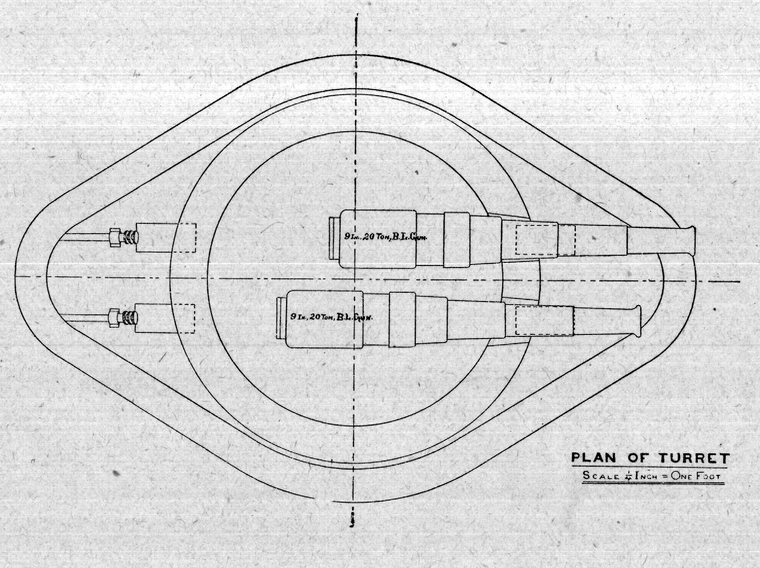
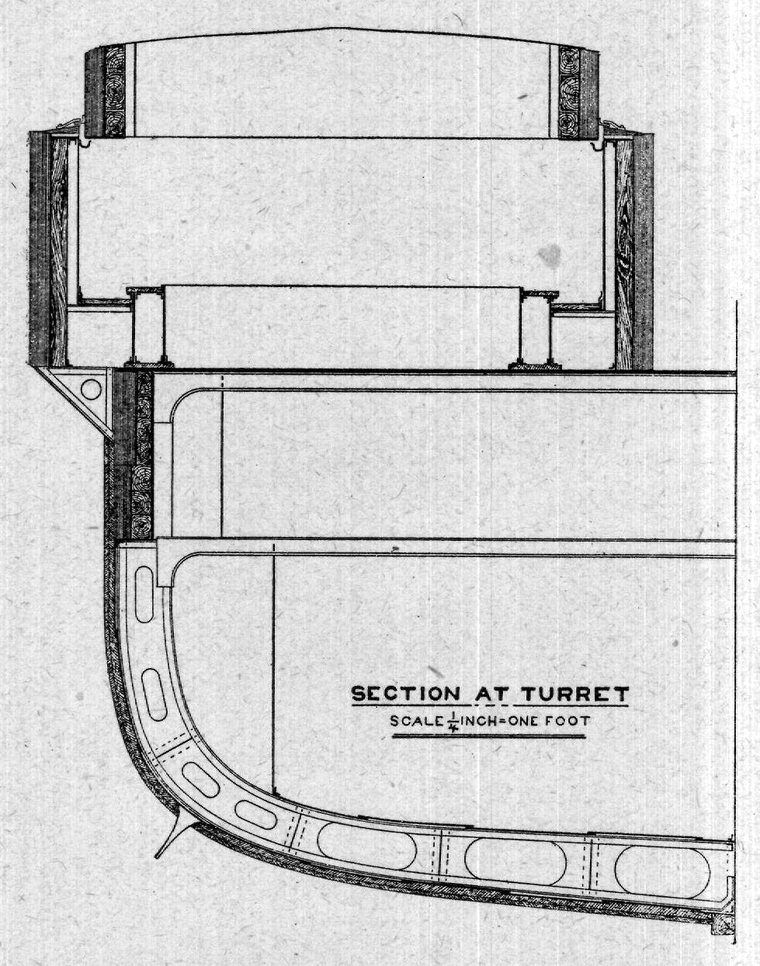
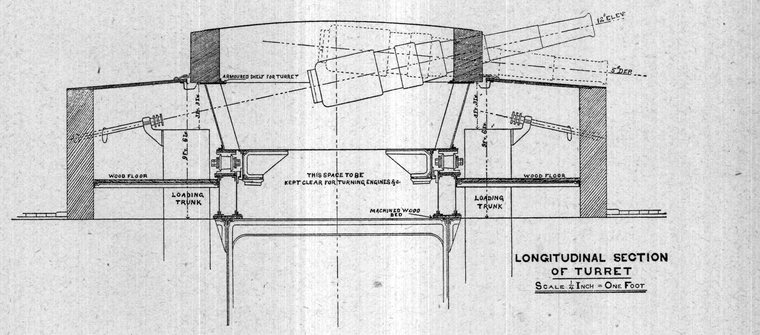
A vessel not provided with protective armor to hull and guns. This class of vessel is designed chiefly to prey upon an enemy's commerce, and is not considered as a regular fighting ship.
The following particulars relate to the uniform worn by officers in the U. S. Navy:
SLEEVE ORNAMENTS. The sleeve ornaments on the special full-dress coat of the admiral, vice-admiral, and rear admirals are as follows:
Admiral: Three stripes of gold embroidered white-oak leaves, the strips 1 inch wide and a half an inch apart.
Vice-Admiral: Two strips of oak leaves, similarly placed.
Rear Admirals: One strip of 2-inch gold lace, 1 1/2-inches from the edge of the sleeve, with one strip of 1/2-inch gold lace one-quarter of an inch above it.
The regular sleeve ornaments are:
Admiral: One strip of 2-inch gold lace, with three strips of 1/2-inch gold lace, one-quarter of an inch apart.
Vice-Admiral: One strip of 2-inch gold lace, with two strips of 1/2-inch lace above.
Rear Admirals: One strip of 2-inch gold lace, with one strip of 1/2-inch lace above.
Commodores: One strip of 2-inch gold lace.
Captains: Four strips of 1/2-inch gold lace, set one-quarter of an inch apart.
Commanders: Three strips of 1/2-inch gold lace, set one-quarter of an inch apart.
Lieutenant-Commanders: Two strips of 1/2-inch gold lace with one strip of 1/4-inch gold lace between, each a quarter of an inch apart.
Lieutenants: Two strips of 1/2-inch gold lace, one-quarter of an inch apart.
Lietuenants (junior grade): One strip of 1/2-inch gold lace, with one strip of 1/4-inch gold lace one-quarter of an inch above it.
Ensigns: One strip of 1/2-inch gold lace.
Naval Cadets who have completed the four years' course at the Naval Academy: One strip of 1/4-inch gold lace to be wound with dark blue silk at intervales of 2 inches, the width of the silk wrapping to be 1/2 inch.
All staff officers except chaplains wear the same lace on the cuff as is prescribed for line officers with whom they have relative rank, with bands of colored cloth around the sleeve, between the strips of gold lace, as follows:
Medical officers: Dark maroon velvet.
Pay officers: White cloth.
Engineer officers: Red cloth.
Naval constructors: Dark violet cloth.
Professors of mathematics: Olive green cloth.
Civil engineers: Light blue velvet.
All line officers (including mates, boatswains and gunners) wear a star of five rays, embroidered in gold, one inch in diameter, on the outer side of each sleeve.
GOLD LACE ON COLLARS AND TROUSERS. On the special full-dress coat the collar to have one strip of gold embroidered white-oak leaves for the admiral and vice-admiral, and a strip of navy gold lace 1 inch wide around the top and down the front for rear admirals, commodores, captains and commanders, and a strip 1/2 inch wide for lieutenant-commanders, lieutenants and ensigns. For all commissioned officers, except chaplains, the trousers to have a strip of gold lace down their outer seam, of the same width as prescribed for the collar of the special full-dress coat.
DEVICES. The following devices are worn on epaulets and shoulder-straps:
Admiral: Four silver stars of five rays each, placed at equal distances, with a gold foul anchor 1 1/8 inches long under each of the outer stars.
Vice-Admiral: Three similar stars, placed at equal distances, with a gold foul anchor 1 1/8 inches long under the central star.
Rear Admirals: Two similar stars, one near each end of the frog, with a silver foul anchor seven-eighths of an inch long in the centre.
Commodores: One similar star, placed in the centre, with a silver foul anchor at each end of the frog.
Captains: A silver spread eagle in the centre, with a silver foul anchor at each end.
Commanders: A silver oak leaf at each end, with a silver foul anchor in the centre.
Lieutenant-Commanders: A gold oak leaf at each end, with a silver foul anchor in the centre.
Lieutenants: Two silver bars at each end, with a silver foul anchor in the centre.
Lieutenants, junior grade: One silver bar at each end, with a silver foul anchor in the centre.
Ensigns: A silver foul anchor in the centre.
Naval Cadets who have completed the four years' course at the Naval Academy:
A gold foul anchor in the centre of the pad of the shoulder knot.
Staff officers wear on the frog of the epaulet and in the centre of shoulder strap the same rank devices as are prescribed for line officers with whom they have relative rank, substituting the proper corps device for the foul anchor.
Corps Devices: The following corps devices distinguish officers of one branch of the service from another:
Medical corps: A spread oak leaf embroidered in dead gold, with an acorn embroidered in silver upon it.
Pay corps: A silver oak sprig.
Engineer corps: Four silver oak leaves.
Construction corps: A gold sprig of two live-oak leaves and an acorn.
Professors: One silver oak leaf and an acorn.
Civil Engineers: The letters C E in silver.
Secretaries: The letter S in silver.
Warrant Officer's Devices: These devices are worn on the frock and service coats of warrant officers and pay clerks.
Boatswains: After twenty years' service as such, two foul anchors, crossed, embroidered in silver. Under twenty years' service as such, two foul anchors, crossed, embroidered in gold.
Gunners: After twenty years' service as such, a flaming spherical shell, embroidered in silver. Under twenty years' service as such, a flaming spherical shell, embroidered in gold.
Carpenters: After twenty years' service as such a chevron, point down, embroidered in silver. Under twenty years' service as such, a chevron, point down, embroidered in gold.
Sailmakers: After twenty years' service as such, a diamond, embroidered in silver. Under twenty years' service as such, a diamond, embroidered in gold.
Mates: After twenty years' service as such, a binocular glass, with the axes at right angles to the edge of the collar, eye-pieces up, embroidered in silver. Under twenty years' service as such, a binocular glass placed as above, embroidered in gold.
Pay clerks: The corps device of the Pay Corps, embroidered in gold.
CAP ORNAMENTS: For all commissioned officers and naval cadets who have completed the four years' course at the Naval Academy, the device is a silver shield, emblazoned paleways, of thirteen pieces, with a chief strewn with stars surmounted by a silver spread eagle, the whole being placed upon two crossed foul anchors embroidered in gold.
For warrant officers, mates, and pay clerks, two gold foul anchors crossed.
SWORD. The sword for all officers is a cut and thrust blade, not less than 26 nor more than 32 inches long; half-basket hilt; grip white; scabbards of black leather; mountings of yellow gilt; and all as per pattern.
Chaplains wear the dress commonly worn by clergymen, consisting of a single-breasted coat, with standing collar, waistcoat, and trousers of black or dark navy-blue cloth, and black, low-crowned soft felt hat.
PETTY OFFICERS' RATING BADGES. All petty officers wear on the outer garment a rating badge, consisting of a spread eagle placed above a class chevron. (See Navy Pay Table for information concerning class.) In the interior angle of the chevron, under the eagle, the specialty mark of the wearer is placed. The badge is worn on the outside of the right or left sleeve half way between the shoulder and elbow. Petty officers of the starboard watch wear the badge on the right arm, those of the port watch on the left arm. On blue clothing the eagle and special mark are worked in white; on white clothing in blue, and the chevron is always made of scarlet cloth, each stripe raised by padding.
For petty officers, enlisted in their ratings by reason of holding three consecutive good conduct badges, the chevron is made of gold lace, instead of scarlet cloth.
The chevron is, for--
The master-at-arms: Three stripes and an arch of three stripes.
Other petty officers, first class: Three stripes and a lozenge.
Petty officers, second class: Three stripes.
Petty officers, third class: Two stripes.
The specialty marks are worked so as to be entirely included in a circle one inch in diameter.
The specialty marks are as follows:
{A five-pointed star.}
Master-at-arms
Ship's corporal
{Two crossed anchors.}
Chief boatswain's mate
Boatswain's mates
Captains of tops
Captains of afterguard
Coxswains
{Ship's wheel.}
Chief quartermasters
Quartermasters
{Two crossed cannon.}
Chief gunner's mates
Gunner's mates
Armorer
Quarter gunners
{Flaming spherical shell.}
Seaman gunner
{Two crossed keys.}
Yeomen
Captain of hold
{Staff surmounted with wings, and two intertwining snakes about staff.}
Apothecary
{Two crossed pens.}
Ship's writer
{Open book.}
Schoolmaster
Printer
{Lyre.}
Bandmaster
Chief musician
{Disc with hole in centre.}
Ship's cook
{Propeller wheel.}
Machinists
Boilermakers
Water-tenders
Oilers
{Crossed broad-axes.}
Carpenter's mate
Painter
{Two crossed mauls.}
Blacksmith
{Cringle.}
Sailmaker's mate
{Figure eight knot.}
Apprentice mark
Petty Officers' and Seamen's Class Marks. Petty officers of the second and third classes, enlisted men of the seaman first, second, and third classes, except bandsmen, wear around the collar of the overshirt and white jumper three strips of white tape three-sixteenths of an inch wide and three-sixteenths of an inch apart, the outer stripe one-quarter of an inch from the edge; the stripes extend down in front to bottom of opening. In each corner of the collar there is worked, in white, a star three-quarters of an inch in diameter.
Petty officers of the second and third classes and enlisted men of the seaman first class, except bandsman, wear around the cuffs of the overshirt and white jumper three stripes of white tape three-sixteenths of an inch wide, one-quarter of an inch apart, the middle of the middle stripe to be in the centre line of the cuff.
Enlisted men of the seaman second class, except bandsmen, wear around the cuffs of the overshirt and white jumper two stripes of white tape three-sixteenths of an inch wide, one-quarter of an inch apart, the middle line of the space between the stripes come over the middle of the cuff.
Enlisted men of the seaman third class wear around the cuffs of the overshirt and white jumper one stripe of white tape three-sixteenths of an inch wide, placed over the middle line of the cuff.
The apprentice mark, worked in white on blue clothes and in blue on white clothes, is worn by all enlisted men who belong to, or have passed through, the ratings of apprentice in the navy. On the overshirt and jumper it is worn on the breast, two inches below the neck opening. On coats of all descriptions it is worn on the outside of the same sleeve as the rating-badge, half way between the elbow and wrist.
The watch-mark is worn by all enlisted men except petty officers and messmen.
It consists of a strip of tape three-eights of an inch wide, white on blue shirts and blue on white shirts; placed on the shoulder-seam of the sleeve, and extending entirely around the arm. For 1st and 2d class firemen and coal-heavers, the tape is red on both blue and white shirts, and of the same width and disposition as above. The men of the starboard watch wear the mark on the right sleeve; those of the port watch wear it on the left sleeve.