BearingsSea Terms
The widest part of a vessel below the covering board or deck line. (See Part II.)
Page 52 of Patterson’s Illustrated Nautical Encyclopedia · 23 entries
The widest part of a vessel below the covering board or deck line. (See Part II.)
(See Quarters.)
When sailing close hauled a vessel is said to be beating to windward. (See Eating to Windward.)
Making progress against the direction of the wind when sailing close hauled.
A head wind, necessitating a vessel to tack.
A current of air intercepted in its course toward a vessel is said to becalm her. When the foresails intercepts a wind which would otherwise blow into the jib it is said that the former becalms the jib. (See Blanket.)
When there is no wind, a vessel is said to be becalmed.
A small piece of rope in the shape of an eye or grommet into and across which a toggle is slipped as a fastening. Also an eye of rope on the gunwale of a boat for the oar to work in.
A rope-becket secured to the gunwale in which the oar works.
This term applies to many things; pieces of wood placed under the quarters of casks so as to keep the bilge clear of the floor; a vessel makes a bed or cradle for herself when she settles in the mud; extra pieces of timber placed on decks like a platform, for raising the guns above the port sills when the latter are too high for the battery; a bed is made for the bowsprit, where it rests upon the stem and apron.
A term applied to muscular effort. "More beef" has reference to more strength.
Pieces of oak bolted to the outer sides of the bowsprit and through a hole in which the fore topmast-stays (double) reeve before they are set up on the bows.
The bearing of any object from the vessel contained between the ship's beam and that point of the compass towards which the vessel heads.
Expressive of that portion of the crew who live in the forecastle.
A vessel is said to be before the wind when the latter is blowing after the ship--when the wind is following after the vessel.
An order to cease pulling or hauling; to make a rope fast to a belaying pin or other object.
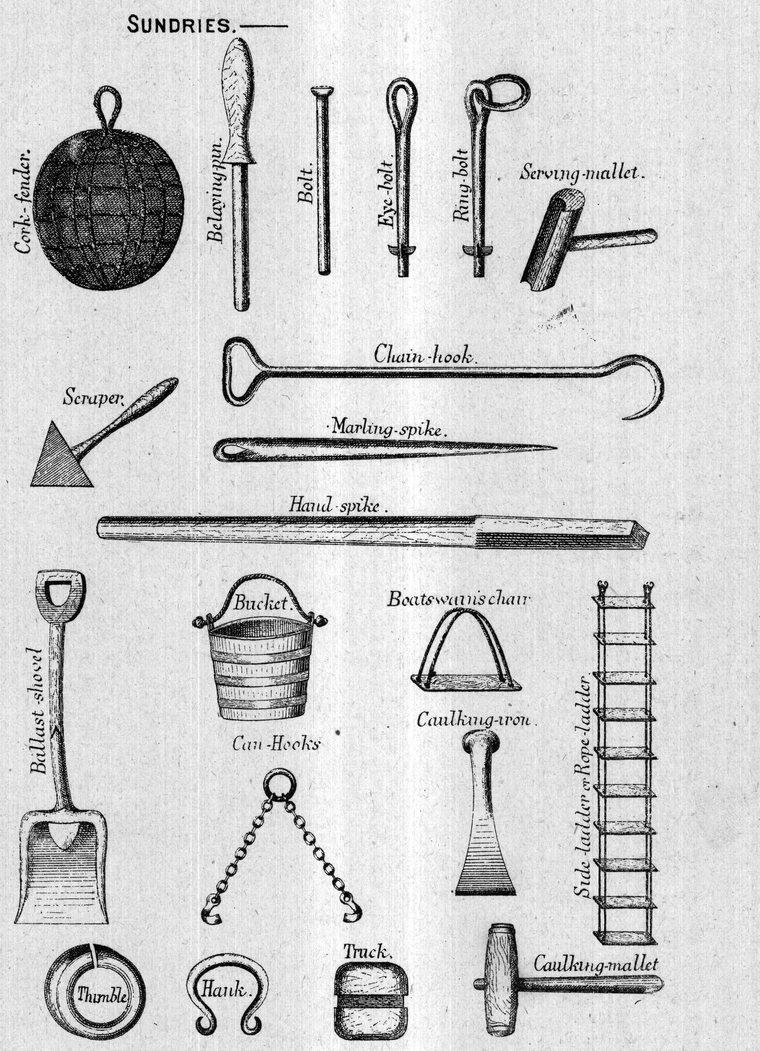
Wooden or iron shapes found in the pin-rails, and used for securing ropes to.
A buoy, on top of which is suspended a deep-toned bell, which rings when the buoy rocks from the action of the waves. It is specially valuable to vessels in its vicinity during foggy weather.
The handles to the wires in the wheel-house of a steamer connecting the engine-room bells. Sometimes vessels are provided with engine-room connections in various parts of the decks, and these are called deck pulls.
An old name for the cross-staff.
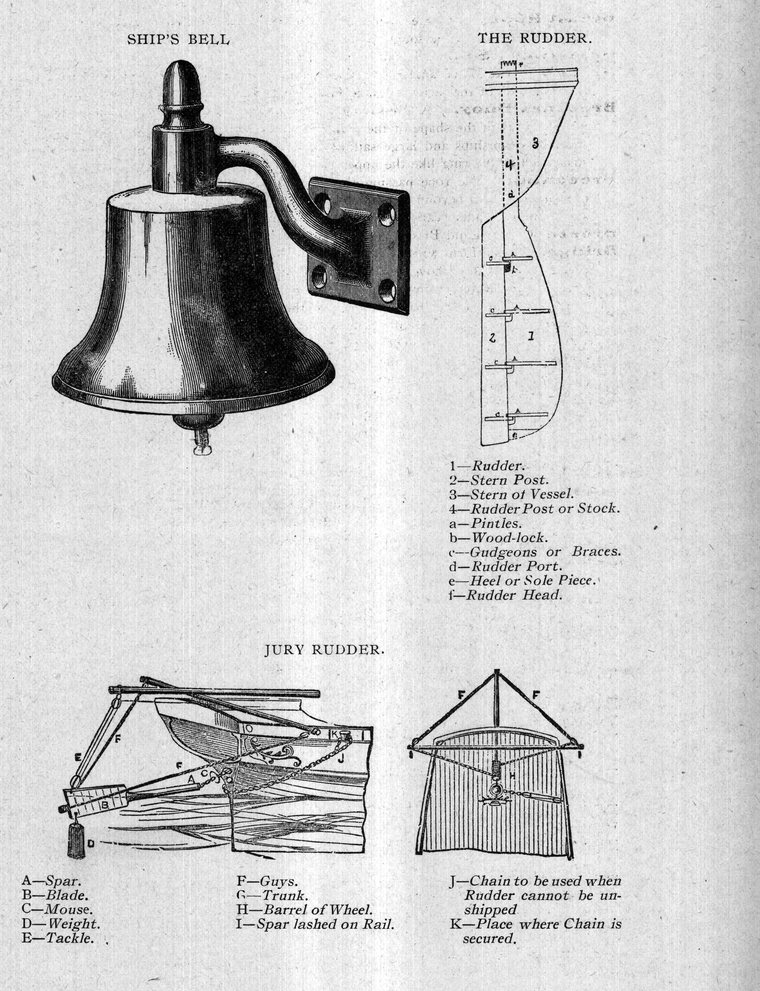
(See Ship's Bells.)
A sail is said to belly when it is swelled out by the wind.
(See Tide Bench Marks.)