BendSea Terms
To fasten; to secure one rope to another rope, spar, etc.
Page 54 of Patterson’s Illustrated Nautical Encyclopedia · 28 entries
To fasten; to secure one rope to another rope, spar, etc.
To shackle the anchor chain to the anchor.
To secure a sail to a yard, or to a boom and gaff.
The thickest planks on the vessel's outboard side, and to which the knees, beams, etc., are bolted; also the ribs of a vessel. (See Wales.) The midship bend is that at the broadest part of the ship. (See Dead Flat, Part II.)
(See Neaped.)
Ropes seized to the weather futtock staves and set up to the lee channels for the purpose of steadying the mast when the vessel was rolling heavily (obsolete).
Schooners of three masts which were built at Bermuda by the English during the war with this country in 1812.
Bunks on board of vessels are known as berths; a position on board ship; the place of a vessel when at anchor or alongside a dock. (See Wide Berth.)
Making a vessel fast alongside of a dock. (See Docking a Ship.)
The largest of the two bower anchors. (See Bowers.)
The space between two decks.
That part of the vessel around the water line.
A Calcutta lighter used for discharging cargo.
A small holystone. It is also called a prayer book and a testament. Sailors kneel to use it in scrubbing the decks.
Pieces of timber bolted to the hounds of a mast for the trestle trees to rest upon.
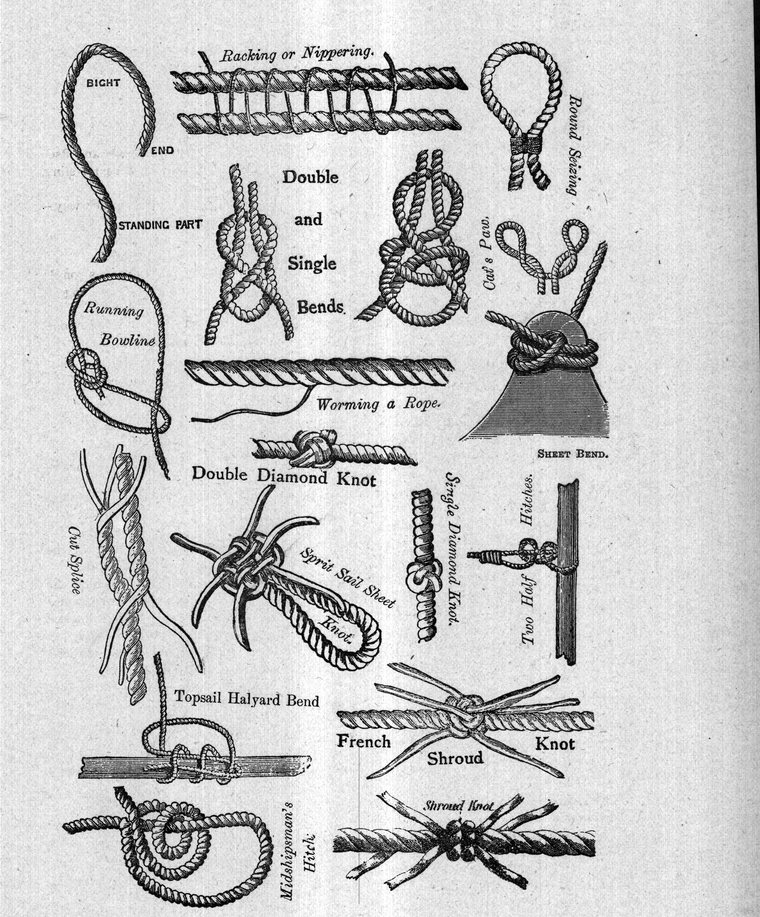
A curve or indentation in the coast is called a bight. When a curve or bend exists in a rope it is called the bight of the rope. Any part of a rope except the ends may be called the bight.
That part of the bottom of a vessel that is next to the keel. In reference to a cask, bilge refers to the greatest circumference in the direction that the hoops run.
Same as Limber Boards.
Fore-and-aft timbers bolted outside along the bilges of a vessel to prevent excessive rolling.
Fore-and-aft timbers bolted inside along the bilges for the purpose of strengthening the frame.
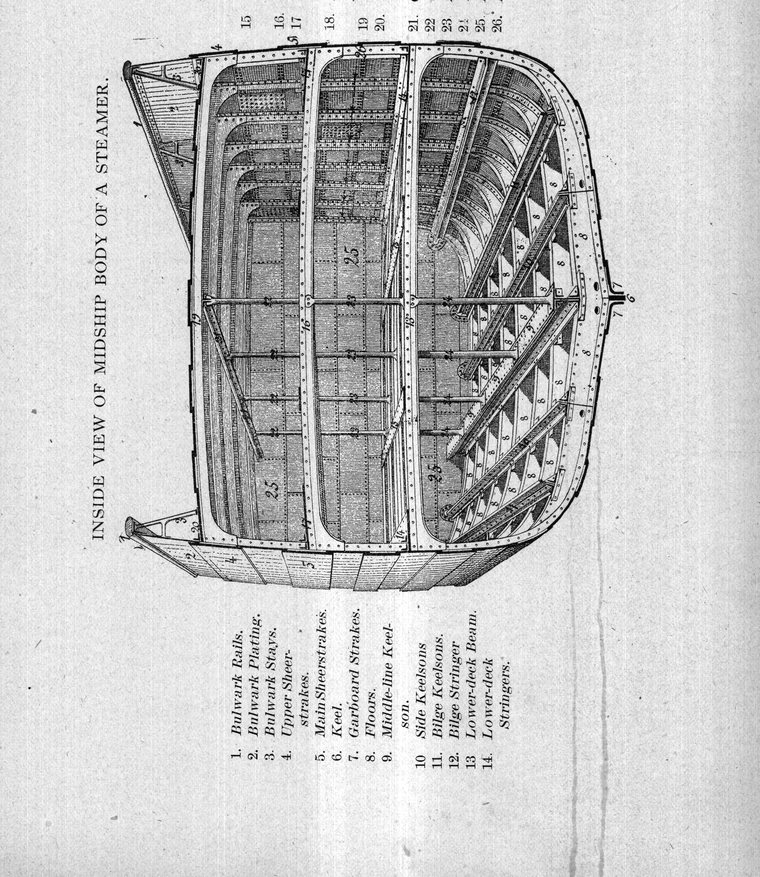
A thick plank used on the same principle as the bilge keel and keelson--a modification of the latter.
A block placed under a vessel's bilge to steady her while on a dry dock.
Water which has collected in the vessel's bilge either from the natural oozing leaks through the planking of the bottom, as in the case of a wooden ship, or from deck leaks, etc., in reference to iron vessels.
Timbers belonging to the launching ways, and on which the cradle rests, the latter supporting the body of the vessel.
Said of a vessel when the bilge is broken in by the bottom of the ship coming in contact with a rock, the shore, etc.
The apex of the fluke of an anchor. The term applied to the end of a knee or compass timber. (See Fire, Watch, Quarter and Station Bills.)
The extra planking or the covering of iron, copper, or brass on the rail abaft the cat-head for the fluke to rest on when the anchor is catted.
A written agreement (practically a note) in which the debtor agrees to pay his creditor on a date specified the sum of money which the bill calls for. This bill is drawn in sets of three owing to the risk involved in mailing. Upon presentation of one of these bills, the other two become void.