ThwartsSea Terms
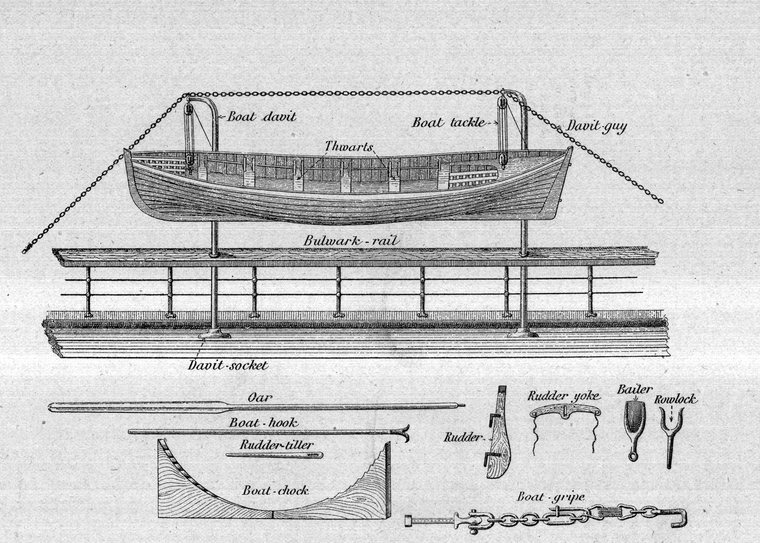
The seats extending across a boat and on which the rowers sit.
Page 250 of Patterson’s Illustrated Nautical Encyclopedia · 21 entries
The seats extending across a boat and on which the rowers sit.
Same as athwartships.
(See Tide Table.)
The flow, and elevation, and depression of the water. What is known as tiding up or down a river is to allow a favorable tide to carry the vessel in the desired direction when, by reason of a calm, her sails are useless. As soon as the tide turns against the vessel the anchor is dropped until the next tide, when it is hove up and the former operations repeated. (See High Tide.)
Permanent marks placed upon the stone facing of a basin, dry-dock, upon a sea wall, etc., and which record the height of the marks above mean low water.
The horizontal movement of the water in a channel which does not change with the tide but continues to flow on sometimes two or three hours after the tide has turned.
What is known as the tide day is the interval between two successive arrivals of the tide wave at the same point. This interval is not regular, and the shortening and lengthening of the tide day is known as the lagging and priming of the tides.
It being of the utmost importance that the time of high water for harbors should be capable of ready solution, a standard for calculation is determined or based upon certain positions of the sun and moon, this standard being the time of high water at the full and change of the moon at a given point, and reckoned from apparent noon. This is known as the establishment of the port.
A narrow opening through which the tide runs with great velocity.
An instrument for ascertaining the rise and fall of the tide.
A pole marked in feet and inches and driven in the sand in shallow water, employed for ascertaining the rise and fall of the tide.
The difference between the height of high and low water.
The agitation of the surface water caused by the tide passing swiftly over a shoal.
A vessel is tide-rode when she rides to her anchor by the force of the tide independent of the wind.
Yearly tide tables are published by the U. S. Coast Survey Office which give the computed times of high water for the most important ports of the United States, and constants to apply as directed to these times to obtain the hour of high water at neighboring places.
In the open sea high water and low water succeed each other 6 hours and 12 minutes apart, and this is known as a tide; but in channels where the stream continues to flow up for 3 hours after it is high water it is said to make a tide and half-tide, and if it continues to flow up for only 1 hour and 30 minutes it is said to make a tide and quarter-tide.
An immensely broad wave which more or less follows the movements of the sun and moon.
The part of a river or channel in which the tide ebbs and flows.
The single rope which is bent to a topsail yard in hoisting the spar, and which passes either through the sheave-hole in the mast or through a tie-block at the topmast head.
(See Tie.)