ValligueSea Terms
A small coasting boat of Asia Minor.
Page 257 of Patterson’s Illustrated Nautical Encyclopedia · 28 entries
A small coasting boat of Asia Minor.
Ropes for steadying a gaff, secured to the outer end of the spar and leading to the rail on each side.
Certain parts of the oceans where the winds are very inconstant.
A chart on Mercator's projection on which the variation of the compass is represented by curved lines. (See engraving.)
An abbreviation of avast, as 'vast heaving.
To pay out chain or rope. When the wind changes against the sun (i. e., contrary to the way the hands of a watch revolve)--for example, when the wind changes from east to north it is said to veer. On board ship the wind hauls forward and veers aft.
To slack and haul alternately upon a rope.
A general term for all classes of square and fore-and-aft rigged vehicles of navigation.
A large messenger once used in weighing anchor by the capstan.
A large single block used with a viol.
A French off shore fishing boat. It has a well to keep the fish alive in until the vessel reaches port.
A journey by water. Outward voyage, the passage of the vessel between her loading port and the place of her destination. Homeward voyage, the passage back. Out and home, the round voyage.
(See Viol.)
A man is said to have his wack when he is provided with his share or portion of food out of the forecastle mess tub.
That part of the deck contained between the forecastle and quarterdeck.
(See Sheet Anchor.)
Green hands; decrepit seamen.
The agitation of the water left astern of the vessel's course. The track over which the ship has passed.
Strong planks running fore-and-aft on a vessel's sides.
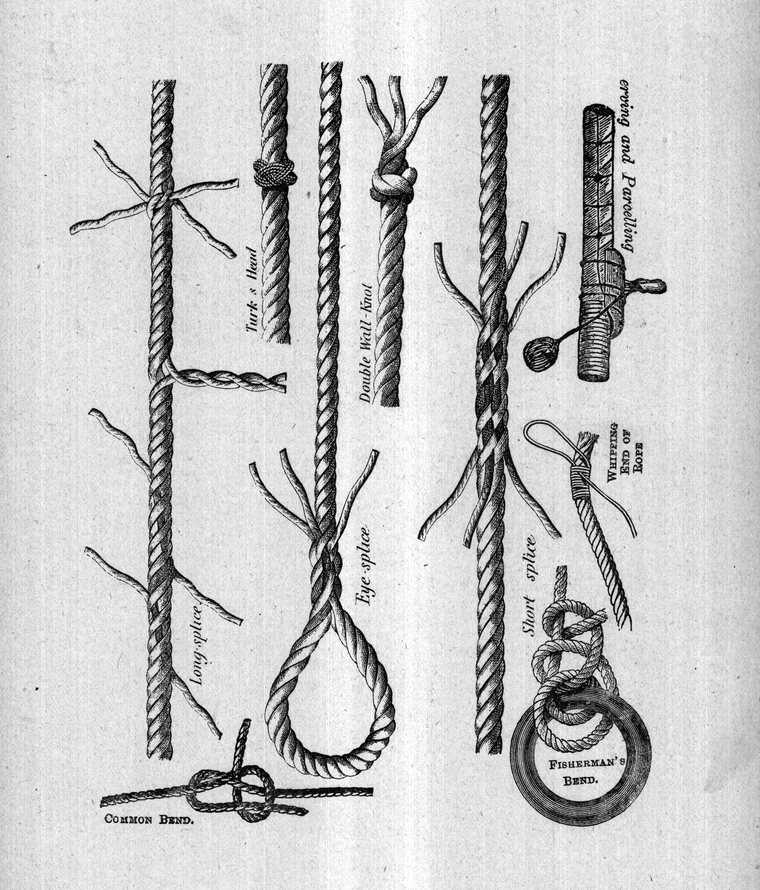
A knot worked in the end of a rope. (See engraving.)
Opposed to flaring out or tumbling home. Perpendicular sides.
The compartment in a man-o'-war or yacht in which the officers live.
(See Wear.)
To change the position of a vessel by kedging, or by hauling her along by means of a hawser attached to some object. A warp is a light hawser.
Lengths of thin plank fastened to and projecting above the gunwale of boats and small low-sided vessels to keep the spray out and increase the freeboard. A boat's row-locks are cut in the wash boards. These boards are also known as wash strakes.
(See Wash Boards.)
Cotton yarn used for cleaning purposes on shipboard.
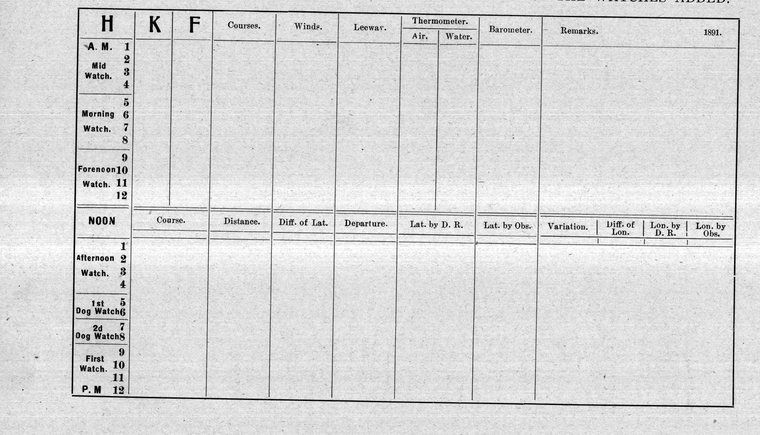
There are seven watches on board ship during the 24 hours. They are named as follows: From midnight until 4 a. m., mid-watch; from 4 a. m. to 8 a. m., morning-watch; from 8 a. m. till noon, forenoon-watch; from noon till 4 p. m., afternoon-watch; from 4 p. m. till 6 p. m., first dog-watch; from 6 p. m. till 8 p. m., second dog-watch; from 8 p. m. till midnight, first watch. On a merchant ship the crew are mustered aft at 8 p. m. on the day of sailing, the men divided into the captain's and mate's watch, and the first watch set at that time, the captain's watch, remaining on deck while the other goes below. The captain always takes the first watch out and the mate the first watch home. The stewards and cooks are known as "idlers," and they stand no watch. The captain's watch is called the "starboard," and the mate's the "port" watch. If there is an uneven number of men in the forecastle, the odd man goes into the captain's watch by courtesy. Provided the vessel carries a second mate, the captain's watch is kept by him, so that the captain has no regular deck duty, but goes and comes as he pleases. The officer on watch is known as the "officer of the deck," and, while left in possession, his orders must be obeyed to the letter. He has full powers to alter the course of the ship to avoid danger, to make, or alter, or take in sail, etc. On an ocean passenger steamer one of the waiters is always on watch in the saloon, being stationed by the steward the same as the anchorwatch is set by the mate, so that they stand a certain number of hours each and then call their relief. The saloon-watch should report to the officer of the deck when each bell is struck. A floating buoy is said to watch. (See Anchor Watch.)