Boat the OarsSea Terms
To arrange the oars fore and aft in a boat along the thwarts so as to have them ready for the order "up oars".
Page 60 of Patterson’s Illustrated Nautical Encyclopedia · 29 entries
To arrange the oars fore and aft in a boat along the thwarts so as to have them ready for the order "up oars".
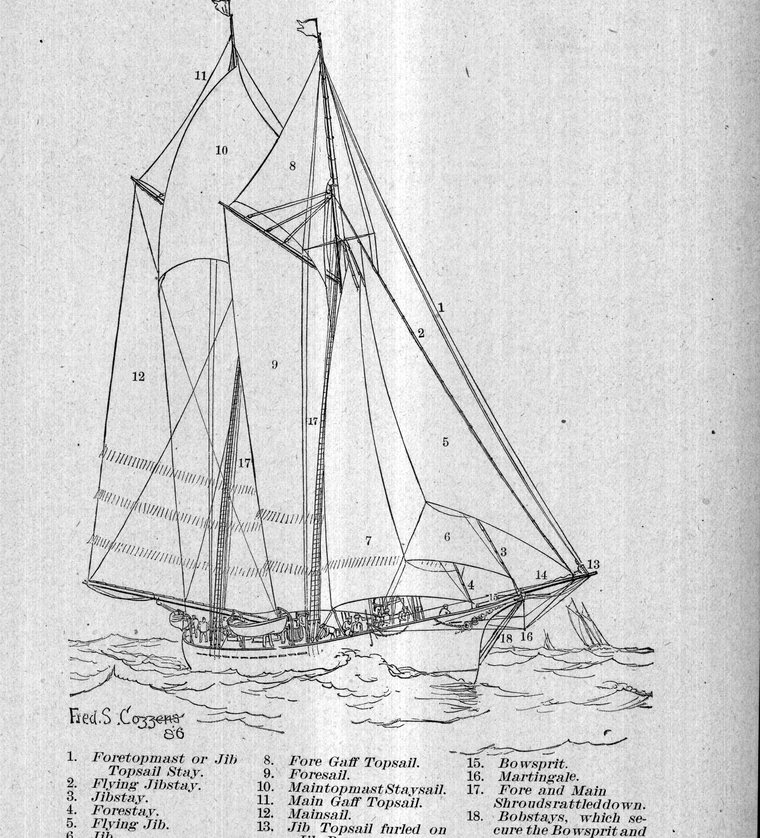
The chains or ropes leading from the underneath outboard end of the bowsprit to the stem where they are secured, and by which the bowsprit is held down and prevented from jumping. (See Bowsprit Shrouds.)
(See Deck.)
A broad bow.
A steep coast; a shore that may be closely approached by a vessel.
A small boat.
(See Knight Heads.)
A small sailboat of the Philippines and Moluccas.
Pieces of soft wood, sometimes covered with canvas, which are placed upon the trestle-trees, and on which the eyes of the rigging rest, so as to prevent chafing.
A roll of canvas is called a bolt, and contains thirty-nine yards, whatever may be its width. Bars of metal used for various purposes in the construction of a vessel, possessing different names according to their shape, such as eye-bolt, etc.
The rope that goes around the edges of sails, and to which the latter is sewed.
A vessel is said to carry a bone in her mouth when she is coming along rapidly so as to curl the water about the stem into froth.
A dug out made from the bongo tree.
The piece of canvas secured to the foot of a head sail by a lacing, and which is taken off in heavy weather.
A wooden hood which covers a small after-hatchway which is used for obtaining access to the interior of the vessel without removing the main hatches.
A spar used for extending the foot of a fore-and-aft sail or a studding sail--pronounced stun' sail.
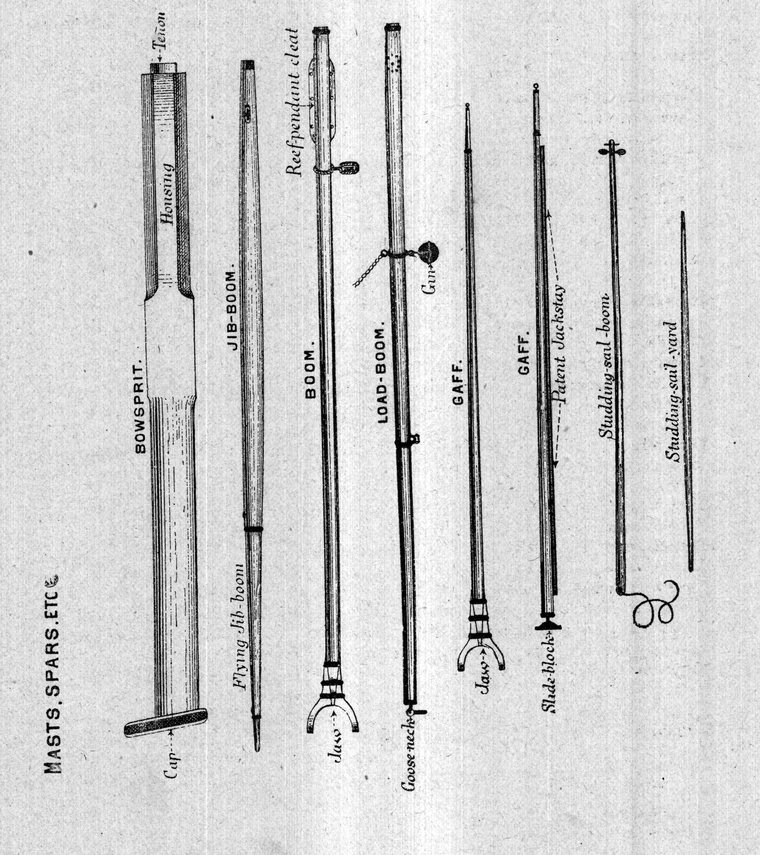
A rope leading from the end of the stun-sail boom through a tail block in the main rigging.
A fore-and-aft foresail having its foot spread by a boom.
(See Boom Pendant.)
An iron half-circle which is secured to the iron band of a boom for the sheet traveler (the iron ring on the end of the boom sheet block) to traverse on.
Iron rings or collars at the extremity of the yard arms and through which the stun-sail-booms travel. (See Pacific Irons.)
A light tackle used for rigging out and in the stun-sail booms.
A fore-and-aft mainsail, having its foot spread by a boom.
A double purchase used to guy out booms when the vessel is running so that they will not come aboard. Also known as boom-guys and lazy-guys.
Whips which lead from the after end of a boom through a block at the lower mast head, thence down on deck, and are employed for topping up the boom and taking the strain off the sail when the latter is set, and the strain off the peak halliards when the gaff is lowered and the sail tied up. (See Quarter Lifts.)
Scraping off the marine growth from a vessel's bottom, and giving the latter a coating of some mixture to prevent worming.
Forcing a vessel through ice.
The situation of a square-rigged vessel when sailing right before the wind--the wind dead-aft or nearly so.
Charts of currents calculated by the drift of bottles thrown overboard, tightly corked and containing the date, together with the ship's latitude and longitude. When these bottles are picked up by ships from the beach the data offorded by their contents is utilized for approximating the direction and force of the current in which they have been borne.