Flying JibSea Terms
One of the head-sails which sets outside the jib on the jib-boom. (See Jib.)
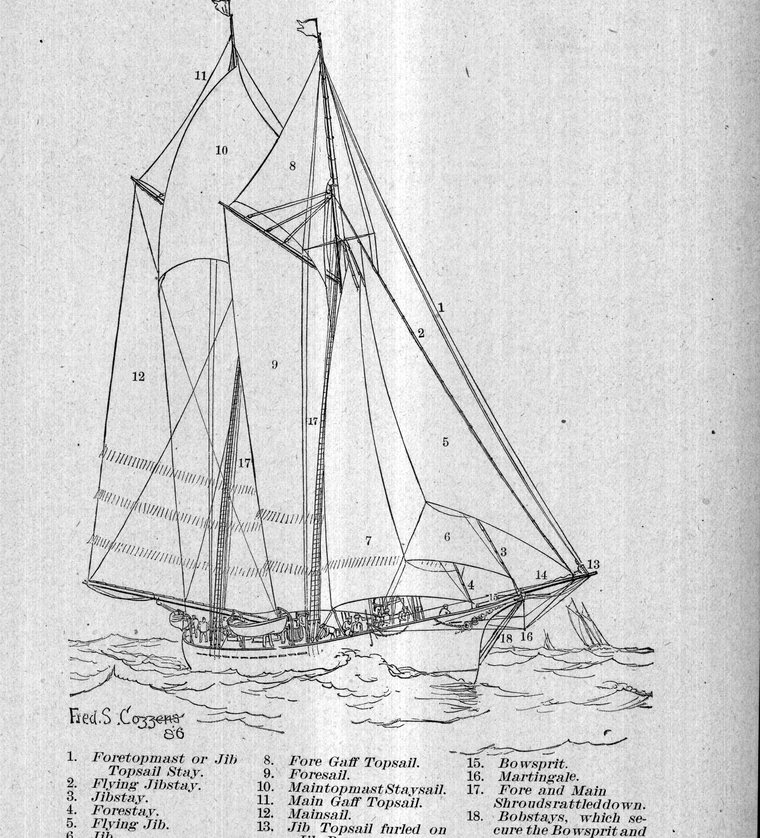
Page 114 of Patterson’s Illustrated Nautical Encyclopedia · 23 entries
One of the head-sails which sets outside the jib on the jib-boom. (See Jib.)
The light spar that rests on the jib-boom, and is rigged out ahead of the latter. (See Jib-Boom.)
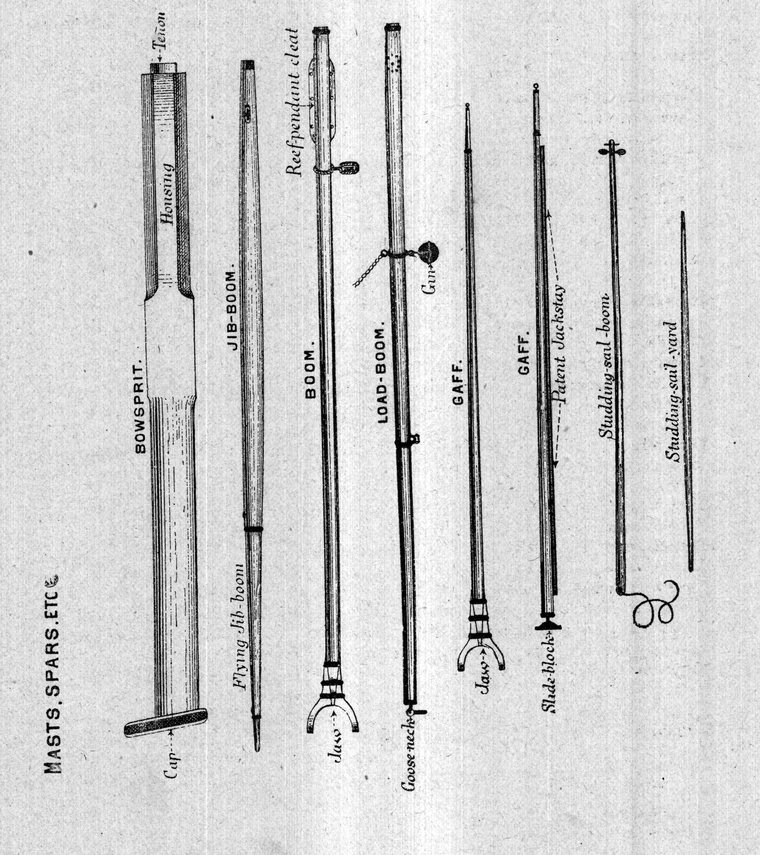
(See Jib-Boom Guys.)
(See Jib Netting.)
A stay forward, the foremast on which the flying jib is set.
Skysails, moonsails, and sky-scrapers, the two latter being obsolete.
Said of a vessel when she is crank for want of ballast or cargo.
A sailing canoe of the Ladrone Islands.
(See Set Flying.)
This is the start now generally adopted by all yacht clubs in this country, and means that upon the firing of a preparatory gun the yachts are supposed to be under way and ready to manoeuvre for position, and ready to cross the line upon the firing of the second or starting gun.
A moist vapor of greater or less density floating near the surface of the land or water; a fine mist.
A heavy fog cloud lying on the horizon.
A bell on a light-ship, shoal, etc., rung in foggy weather to warn vessels.
Buoys placed on shoals, having an automatic whistle attached, which gives forth a warning noise, the vertical rise and fall communicated from the motion of the waves generating the necessary power to supply the bellows of the whistle.
A term applied to the risen moon on account of its influence as a dissipator of fog, especially when at its full.
An instrument blown by steam, by caloric engine or by bellows, from a light-house, etc., during foggy weather to warn mariners. A small fog horn blown by mouth is used on sailing vessels to warn approaching ships.
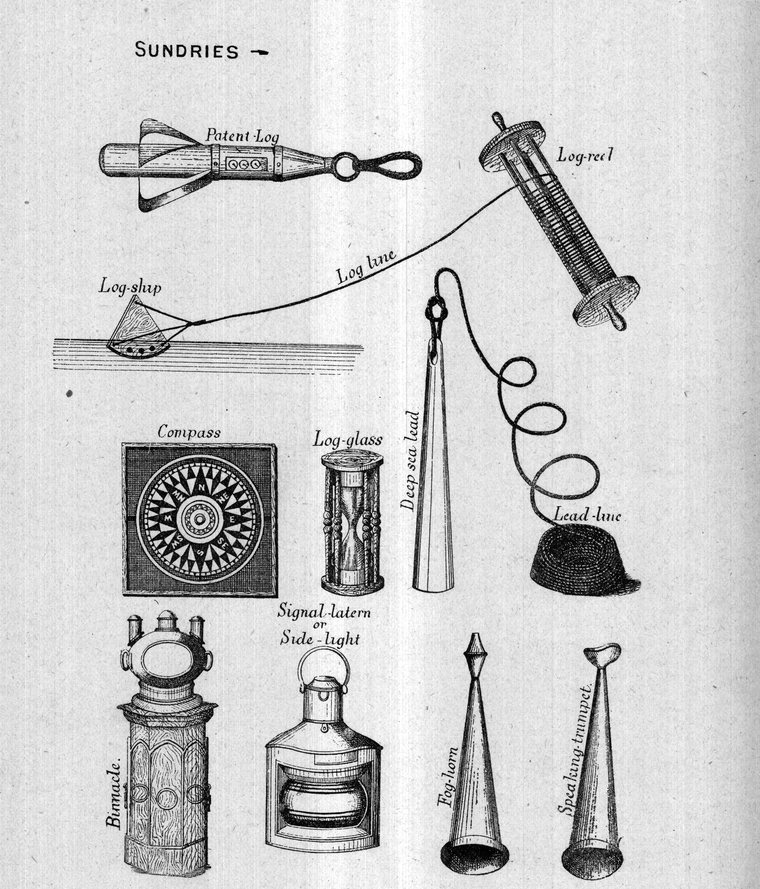
When under way at sea a steamship blows a prolonged blast on the steam whistle every two minutes; a sailing vessel on the starboard tack blows one blast on the fog horn every two minutes, but if on the port tack two blasts, and if the wind is abaft the beam three blasts. All vessels at anchor ring the bell every minute. All vessels navigating bays, rivers and harbors during a fog are obliged to sound their respective signals incessantly. A steamer may signify to another the way she is putting her helm by the following: one blast to mean, I am putting my helm to port; two blasts, I am putting my helm to starboard.
(See Siren.)
A steamer's whistle blown as a warning during fogs.
A sea setting after the vessel; a sea running toward the same point of the compass that the vessel is heading.
A wind blowing towards the same point of the compass that the vessel is heading.
The lower edge of a sail; that part of a mast near the deck. (See Fore Foot.)
A small portable thwartship piece of wood fitting into notches on top of the flooring in a boat, and against which the rower braces his feet.