ScoffSea Terms
Food. To scoff is to eat.
Page 218 of Patterson’s Illustrated Nautical Encyclopedia · 52 entries
Food. To scoff is to eat.
The groove cut in the sides of blocks for the strop to fit in.
A piece of wood or hide placed over the turnings in of rigging to prevent chafe.
A tub-shaped vessel used in shallow waters for the transportation of merchandise, etc. Some scows are sloop-rigged, and others schooner-rigged. A large, open, flat bottom boat.
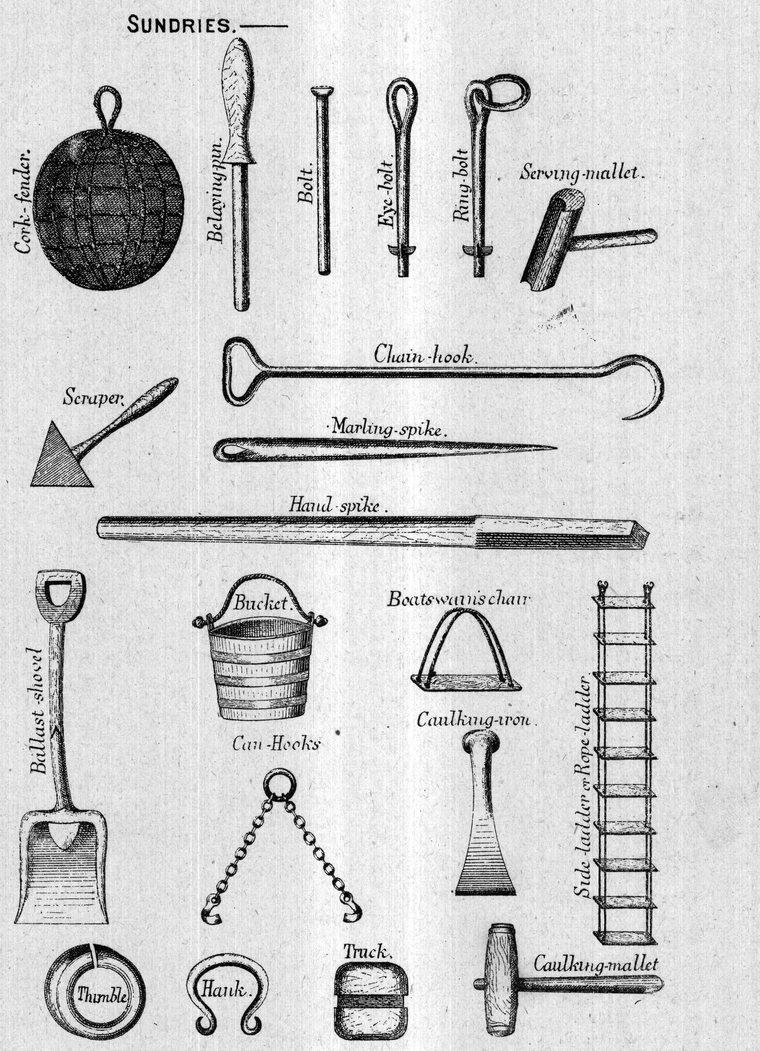
A small iron instrument used for scraping masts and other wood and iron work.
(See Dock.)
A piece of timber bolted to the knee of the head, and which takes the place of a figure-head. (See Head.)
Clouds of mist driving along close to the water. To drive before a gale.
To scull a boat is to propel her through the water by working an oar from side to side over the stern. It was this principle which suggested the idea of a screw propeller for steam vessels. A pair of sculls refers to two short, light oars such as are used in pleasure row-boats.
The narrow lengths of board covering the scupper holes which hang on hinges, opening outwards to the pressure of water on the decks.
Holes cut through the bulwarks next to the plankshear to allow water to run overboard from the decks.
A small hole in a vessel's deck, used as a hatchway. To scuttle a ship is to chop or bore holes in her bottom so as to make her sink.
A cask with a hole cut in its bilge, and kept on deck to hold water for daily use.
A wave. Under this head are classed: smooth sea, moderate sea, heavy sea, head sea, long sea, short sea, ugly sea, following sea, beam sea, bow sea, quartering sea.
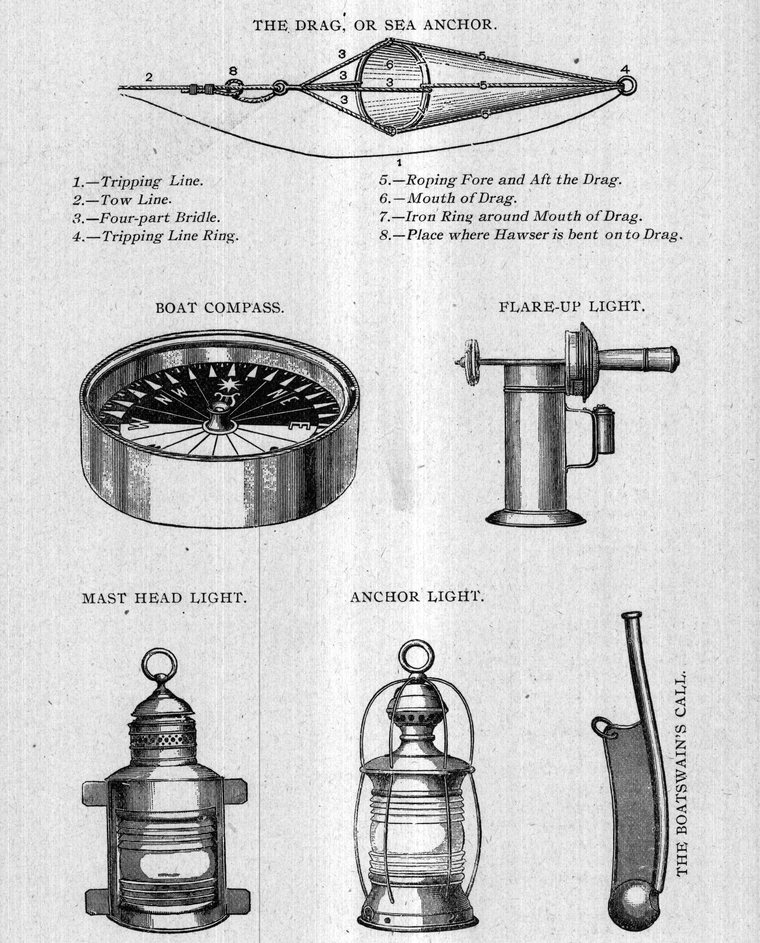
A drag is also known as a sea anchor. (See Drag.)
A vessel that rides the seas easily, and is capable of weathering storms, is said to be a good sea-boat.
(See Land Breeze.)
A kind of faucet connected to a pipe which leads from the outside of the vessel to the bath tubs for the purpose of filling them with sea water. (See Flood Cock.)
A name given to an old sailor.
A worthless sort of seaman, commonly given to inciting the crew and making them dissatisfied with things in general on shipboard. One who argues against instead of obeying at once certain orders that may be given by the officers.
A dish of fish and vegetables in layers between crusts. A small mess (i.e., few men) will have a double-decker pie, and a large mess will have a three, and sometimes a four-decker.
(See Quelling Oil.)
A sailor who goes on long voyages; one who cruises to various parts of the world.
The spaces between the planks of a vessel's decks and sides.
A powerful electric reflector light which can be thrown completely around the horizon, bringing into view any object within its rays.
Timber that has been treated chemically to protect it against rot. Some wooden vessels were protected against rot by having their timbers pickled in hot brine.
(See Dock.)
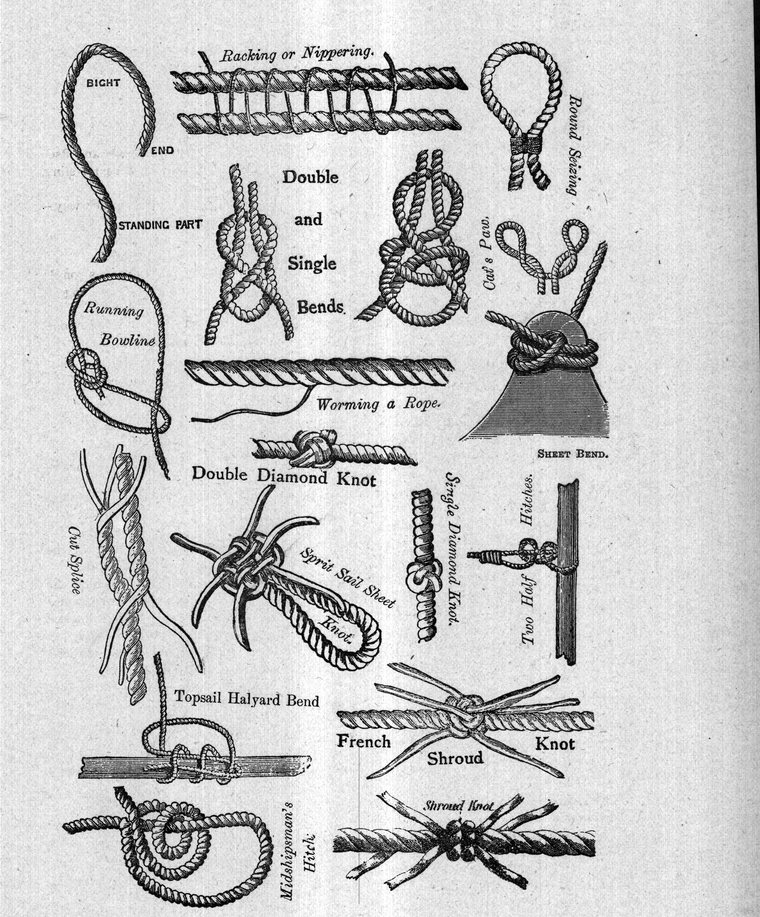
To seize a rope to another or to any object is to bind it with small stuff.
Seizings are named according to their position and use. There are throat, round, flat and eye seizings. (See under respective heads.)
Rope yarn or spun yarn marled together and used as a strop.
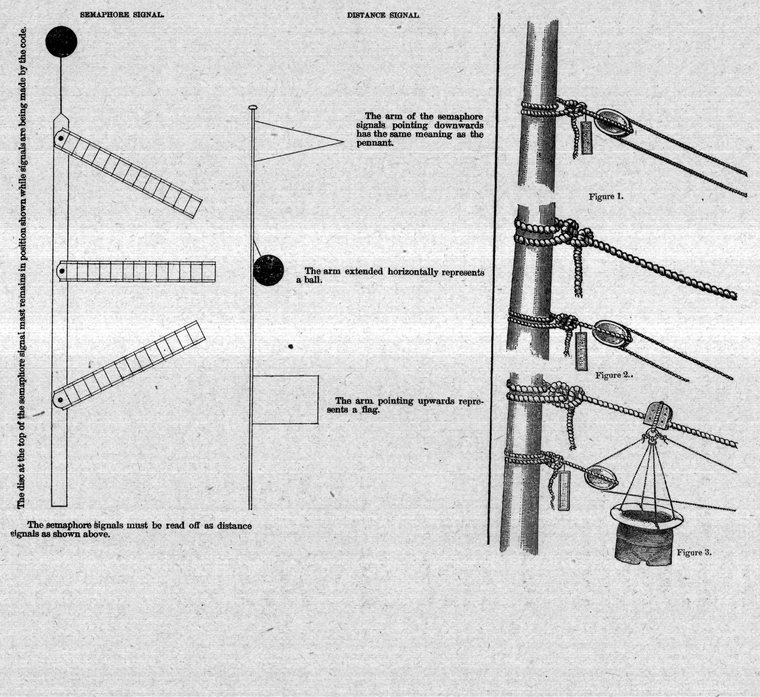
An upright post on which arms are hinged, their elevation or depression from the horizontal forming certain signals. (See engravings.)
A ship sends when she pitches into the trough of the sea suddenly and with violence.
The power, direction and velocity of the waves.
Rope yarns or spun varn braided. There are several kinds of sennit, known as flat, French, round and square, taking the name of the figure braided. French sennit is a flat figure, but made more open than the common-flat sennit, and is also woven of several more strands.
The act of covering a rope by winding small stuff, such as spun yarn, around it. (See Worming, Parcelling.)
The covering of a rope that has been served.
A small piece of flat board attached to a handle and used in place of a serving mallet when putting a service on small rope.
A mallet having a groove cut lengthwise in its head, and used for serving large rope.
Spun yarn is in general use for serving, but rope yarn, round-line, etc., is sometimes employed.
A sail not confined, but set from the deck like the jib of a cutter, a sprit or club-topsail, etc.
The direction in which the tide is flowing-not the direction from which it is coming.
To put to sea.
To give the helmsman the compass course to steer.
To muster the crew aft at 8 p. m., on the day of leaving port, and divide the ship's company into two watches, named starboard and port watches respectively. The starboard watch, which is the captain's watch, always stands the first watch out, and the port watch, which is the mate's watch, stands the first watch on the home voyage. If the vessel carries a second mate, he always stands the captain's watch.
A lateen rigged vessel of the Mediterranean. It is distinguished by a long and sharp prow.
To raise her from the keel blocks by wedging.
To tauten the shrouds and stays by the aid of purchases.
To lower. To settle a yard on the cap is to lower it so that the parrel rests on the cap.
(See Lay the Land.)
(See Sued.)
An iron horse-shoe shape which closes across the end with a movable bolt. It either secures with a thread (screw shackle) in one of the eyes of the shackle, or is provided with a pin which is either slipped through the hole in the outside end of the bolt, or by a wooden pin passing through the shackle-eye and bolt. This latter is used on chain cables, so that the bolt may be knocked out readily and the chain slipped.
A sail devised some years ago to take the place of a spinnaker, but which proved anything but satisfactory to yachtsmen. The idea was to make a square-headed spinnaker by setting the shadow on a gaff which was secured to the mast by a goose-neck under the hounds. The foot of this sail was spread by the swinging boom the same as the spinnaker. When the shadow gaff was not in use it hung down and was secured to the mast. The head of the shadow traveled on the gaff by the aid of hoops, and was hauled out and in by means of an out-haul and head brails respectively.
Shake out a Reef. To let a reef out of a sail by untying the reef-points, coming up with the reef tackle and casting adrift the reef earings.