RigSea Terms
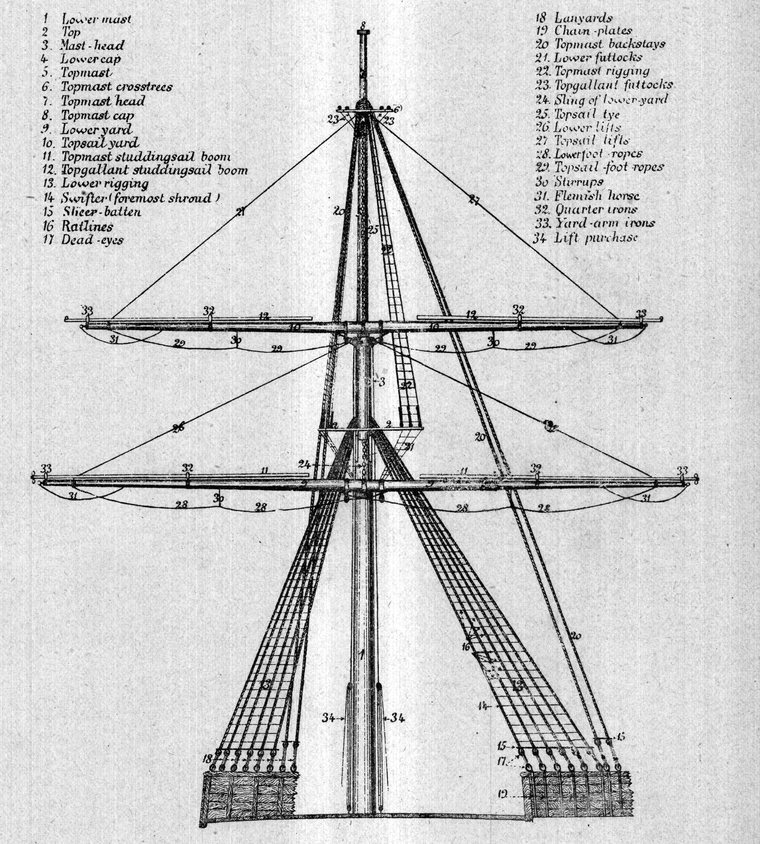
To rig a vessel is to send the shrouds and stays over the masthead and set them up, send up masts and cross the yards, etc. The word used in describing various kinds of vessels, as brig rig, schooner rig, ship rig, etc.
Page 210 of Patterson’s Illustrated Nautical Encyclopedia · 30 entries
To rig a vessel is to send the shrouds and stays over the masthead and set them up, send up masts and cross the yards, etc. The word used in describing various kinds of vessels, as brig rig, schooner rig, ship rig, etc.
A term applied collectively to all the ropes of a vessel. (See Fore Rigging. Main Rigging, Mizzen Riggings, Standing Rigging and Running Rigging.)
(See Running Bowsprit.)
A room in which rigging is cut and made.
Watch tackle purchases used for setting up rigging.
A mat seized to standing rigging to take chafe.
An iron instrument on the principle of a carpenter's clamp, and used for pressing the two parts of a heavy rope together so that it may be seized to one another.
To put the helm amidships is to right it. When the deck of a vessel returns to a horizontal position after a roll, or after being listed by the wind acting upon the sails, the vessel is said to right herself.
Rope that is laid up with the sun; i. e., twisted from right to left.
The edge of the top.
The round iron at the upper end of an anchor shank.
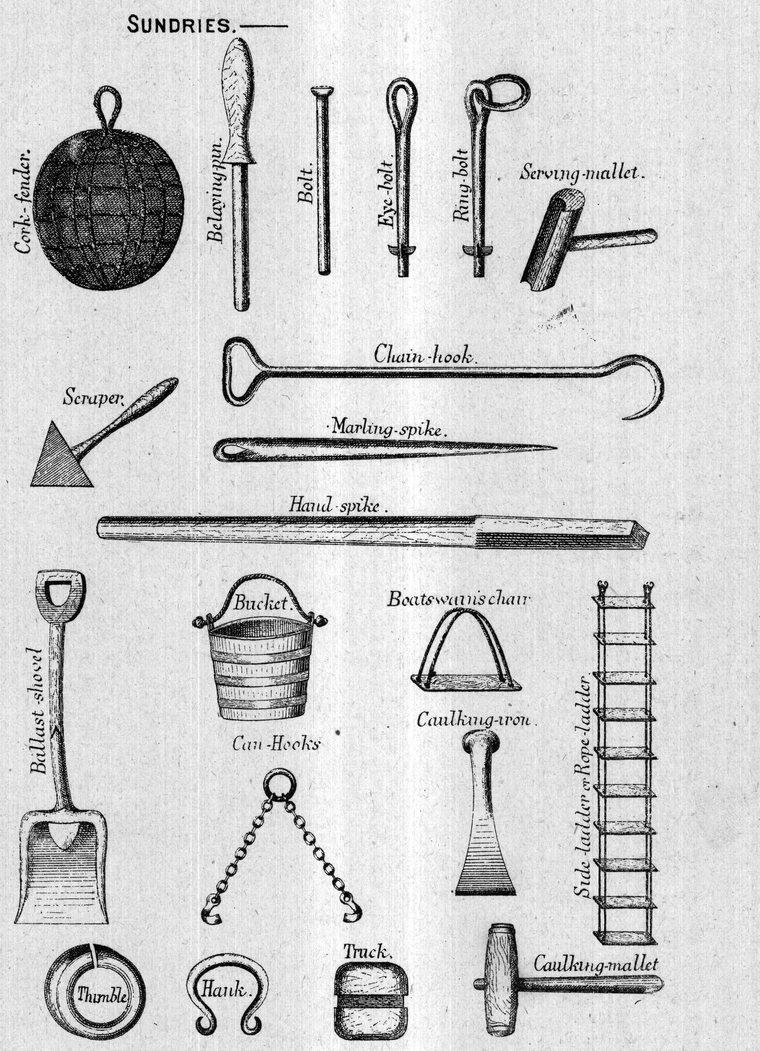
A bolt having a ring through its eye.
The rope by which the end of the cable is lifted from the hawsehole to the anchor ring in bending the chain.
A jib-headed sail, the foot of which sets on an additional boom rigged out on the end of the after-boom. Its head hoists to the gaff, and the sail itself might be called a spanker-stunsail. It is rarely carried, and is only set in light airs.
A tool used by caulkers for getting oakum out of a seam, or by sheathers in tearing the old metal off of a ship's bottom.
One who robs vessels in port by sneaking alongside in a small boat and carrying off anything handy to pass over the side.
The curve on the foot of a square-sail. The roach of a fore-and-aft sail can be on any one or its sides.
Same as Roadstead.
An anchorage more or less exposed.
Small pieces of Manilla or spun yarn used to secure the luff of a fore-and-aft sail to the mast hoops or stay-hanks, and the head of a square-sail to its yard. Also to secure the head of a fore-and-aft sail to a gaff fitted with a jack stay. Manilla spun yarn is preferable, as it is not tarred and will not stain the sail.
A pirate's flag.
(See Gaff.)
The rocking motion of a ship from side to side. (See Angle of Safety.)
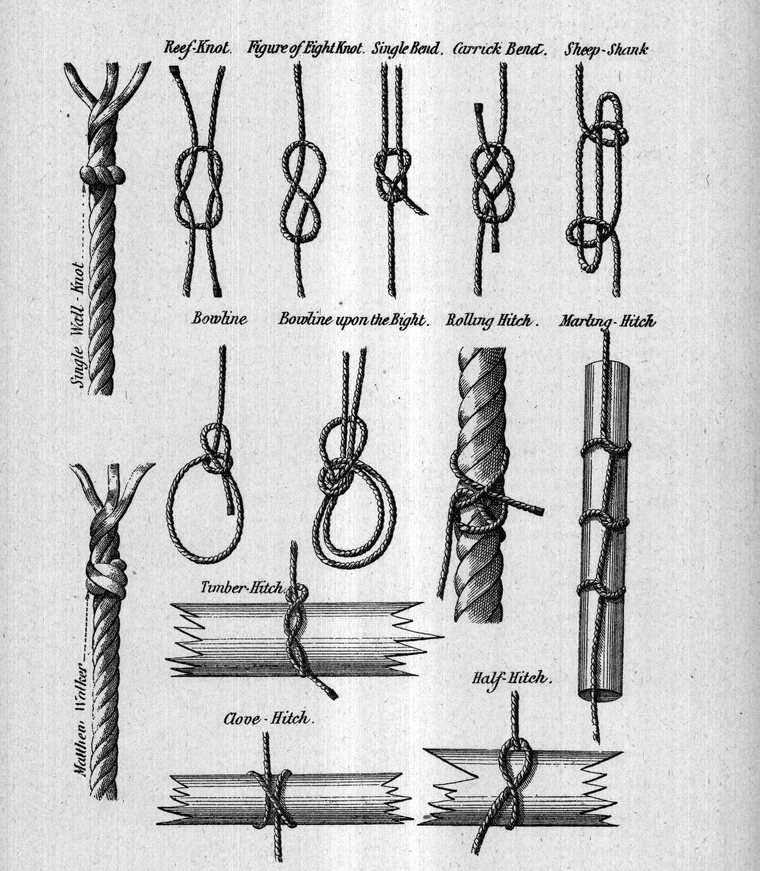
A kind of a three-part heaving-line bend. (See engraving.)
A rope used for steadying light yards, on the same principle as a rolling tackle.
Tackles used during a heavy sea for the purpose of steadying the yards.
(See Rowlocks.)
Old pieces of rope and junk in general.
(See Right and Left-Handed Rope, Hawser-Laid Rope.)
An untwisted strand of rope used for rough seizings, etc.