Shifting BoardsSea Terms
Portable wooden bulkheads used to separate cargo.
Page 224 of Patterson’s Illustrated Nautical Encyclopedia · 9 entries
Portable wooden bulkheads used to separate cargo.
(See Ballast.)
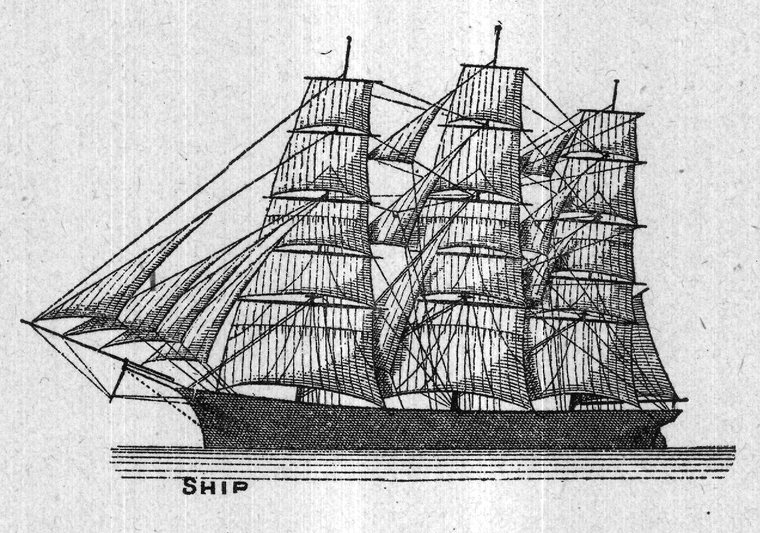
A vessel having three masts and square-rigged on all. Some large ships carry an additional mast stepped way-aft, which is known as a jigger-mast. The term Ship is often used in a general sense in speaking of vessels.
To ship a man is to engage him for duty on board a vessel.
To ship goods is to send them on board a vessel for transportation.
To ship a sea is to have the top of a wave fall on the vessel's deck.
To ship anything is to put it in place, as to ship the capstan-bars, to ship the tiller, etc.
One who transacts the ship's custom house business, negotiates for cargoes, buys and sells vessels on commission, etc.
A man who deals in naval stores, rope, chain paint, etc.
A watchman who looks after a vessel having no crew on board.
A man serving on board the same ship.
(See Out Oars.)
The principal feature to be overcome is the impossibility of having all wastes from fixtures, including basins, baths, sinks and water-closets, discharge overboard by gravity; the fixtures being in the majority of cases below the water-line, combined with which is the fact that the supply of water is below the floor, being carried in tanks placed below the floor, and as near to the keel as possible; consequently pumping becomes necessary, both to obtain a supply and to dispose of it after it has served its purpose. The supply for basins, baths and sinks is usually obtained by placing pumps at or near the fixtures, though sometimes in steam vessels it is obtained by air pressure on the tanks, causing the water to run at fixtures without the use of pumps. The waste usually goes to a wastetank, either connected to a pump placed under galley sink in sailing vessels, or in steam vessels sometimes by a connection to the steam syphon, by which means the contents of tank is forced overboard. The waste of galley sink, on account of the large amount of grease contained in it, is not usually drained into the waste-tank, but is pumped directly overboard, the pump under sink having valves not affected by hot water, and being so connected by stop cocks that either the sink or the waste-tank may be pumped out. Hot water to fixtures may be obtained from boiler in galley, connected to range, or by steam injected into fixture when water is drawn. The old-style water-closet, which had simply a valve in the outlet to prevent the sea from swashing up through the funnel-pipe, and which to discharge was necessarily placed well above water-line, being supplied by tank placed overhead and filled from deck above, cannot be used where the floor of cabin or toilet-room is below the level of water outside of vessel, the pump being in this case also necessary. The best pump water-closet, by the arrangement of its valves, takes water direct from the sea to flush it, without the use of any receiver, tank or cutoff of any description being necessary, allowing it to be placed at any point either above or below water-line, while the soil is discharged below the water. There being no danger of the vessel being flooded, while at the same time the working of the pump being so easy and simple that children may use it. The action of the pump being double, the up-stroke of lever flushing bowl and sucking soil out of bowl, while the down-stroke of lever forces soil into sea, and recharging pump with clean water.