TierSea Terms
A row of barrels or casks in a vessel's hold. (See Cable Tier.)
Page 251 of Patterson’s Illustrated Nautical Encyclopedia · 19 entries
A row of barrels or casks in a vessel's hold. (See Cable Tier.)
A name given to any light repast served on board East India ships, such as luncheon.
The bar of iron or wood which fits into the forward side of the rudder head, and by turning which the rudder is moved around at different angles to the keel.
That end of the tiller which is farthest from the rudder.
Ropes or chains which lead from the tiller to the barrel of the steering wheel.
A small arrow on top of the tiller box, connected with the barrel of the wheel, and which indicates the position of the tiller by its angle with the keel of the vessel.
The ends of the timbers projecting above the deck, and used for belaying hawsers, etc.
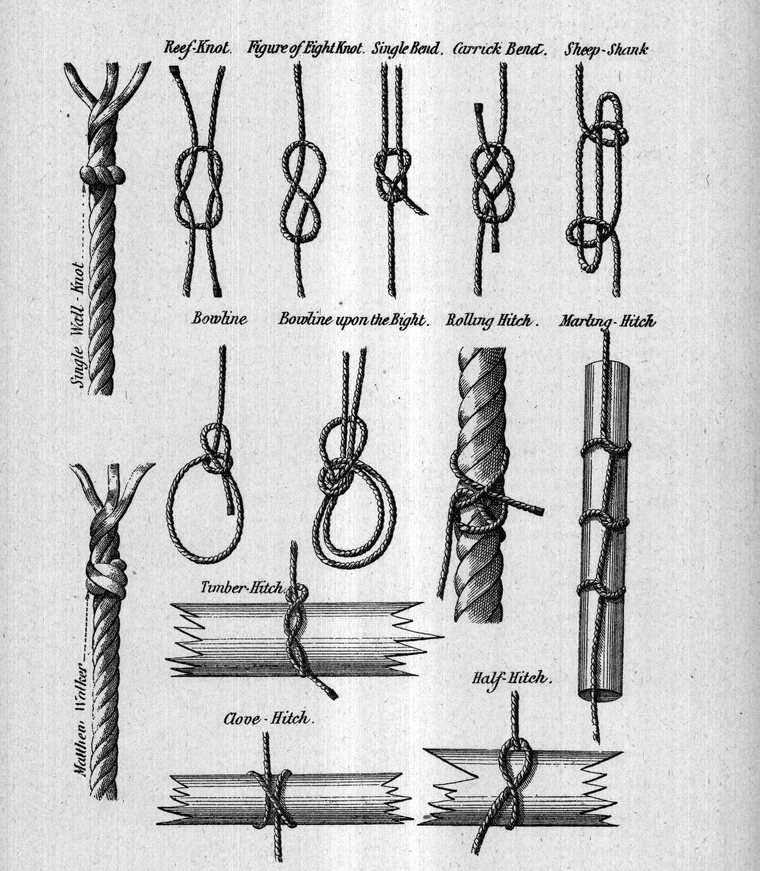
This hitch is made by passing the end of a rope round a spar or timber head, then led up under and over the standing part, and passing a couple of turns round its own part. (See engraving.)
A small port in the bows of vessels carrying timber used to run the cargo out and in horizontally.
Long, curved pieces of wood extending up from the keel on each side. They are known as the ribs of the vessel. The frame of a vessel is composed of the keel, stem, stern-post and ribs.
The process of figures by which the advantage gained by a larger vessel over a smaller one is reduced to an equality, or an approximation thereto. In other words, the larger vessel may go over the course in less time than the smaller vessel, yet if the time allowance to be subtracted from the latter's time reduces it to less than the time consumed by the larger vessel the smaller one wins the race.
A rope stretched from one point to another for the purpose of preventing gear from fouling.
A Holland fishing boat.
To be compelled to stand without moving, the toes of the shoes against one of the deck seams.
Same as toeing a seam.
A pin of wood or metal employed for connecting two ropes. The pin slips through and across an eye called a becket, formed in the other rope. Bowlines are fastened to their bridles in this manner, and the method is also employed for securing ring-buoys so that they may be let go quickly in the event of a man going overboard. (See Becket.)
The wooden bung or plug placed in the mouth of a cannon to exclude dampness and dust.
The block of wood that is secured between the jaws of a gaff, and which slides that spar up and down the mast when the throat halliards are handed. This tongue works on a pin driven through the jaws from side to side, so that it can play fore-and-aft from the perpendicular to accommodate the angle assumed by the gaff when being raised.
The carrying capacity of a ship expressed in tons.
A ton of bulk is equal to 40 cubic feet.
A ton of weight is equal to 2,240 pounds.
The gross tonnage of a vessel is the cubical measurement or contents below decks.
The net tonnage of a vessel is the gross tonnage, minus the statutory deductions.