StrutEngineering
A support for the outer end of a twin-screw propeller shaft.
Page 452 of Patterson’s Illustrated Nautical Encyclopedia · 21 entries
A support for the outer end of a twin-screw propeller shaft.
A closed vessel in which steam, separated from water, is brought in contact with heated plates or pipes.
Steam which has an excess of heat. This excess may be parted with and cause no condensation. If the corresponding temperature for any pressure be increased by say 10 degrees, that 10 degrees is the amount of superheating, and may be lost again with condensation.
A continuation of the piston rod through the piston and opposite cylinder head.
A small finished bolt with thread cut only part way from point to head.
A rotating or vibrating piece applied to move periodically another part.
An instrument for indicating at all times the position of a moving part, and particularly to indicate the speed of the propeller shaft.
The pipe is made in two or more lengths, the higher one smaller in diameter than the one below it, into which it can be lowered.
That valve in the steam pipe next to engine by which the flow of steam to the engine is controlled.
The distance from the centre of shaft-hole in a crank to the centre of the pin; and the distance from the centre of shaft-hole in an eccentric to the centre of the eccentric.
The pressure on the hull produced by the screw revolving in the water.
(See Bearing.)
Collars turned on the thrust shaft and in the thrust bearing.
That piece of shaft laying in the thrust bearing which transmits the thrust of the screw to the vessel.
Small welded pipe used in boiler construction for the passage of products of combustion.
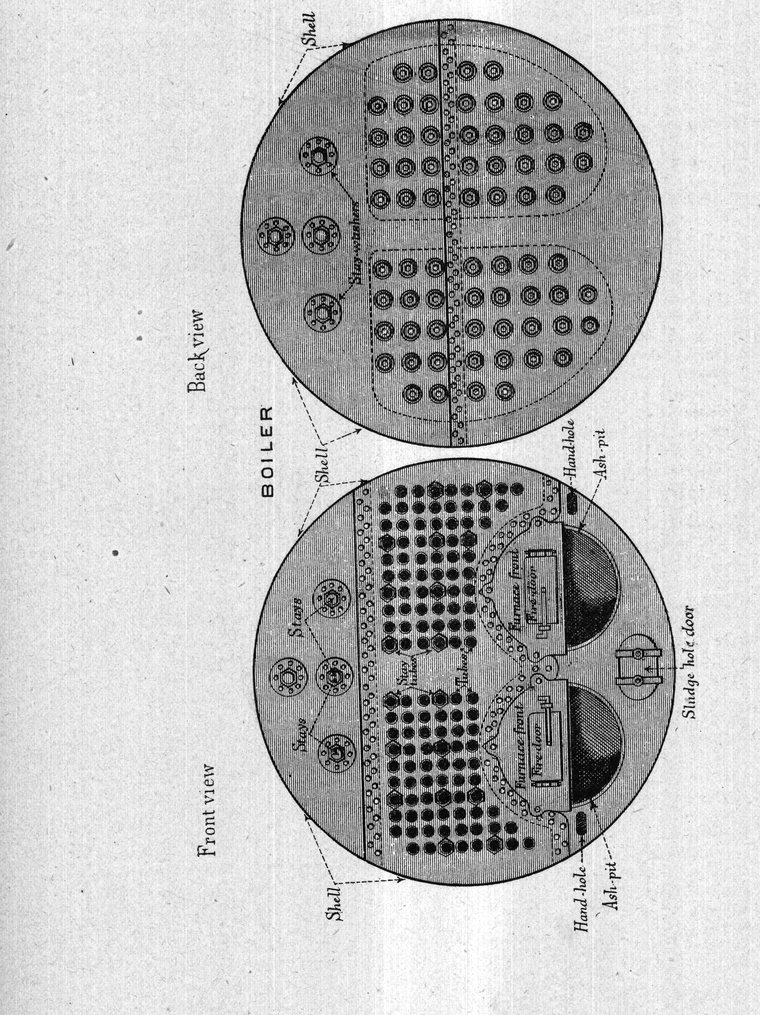
A tool used to expand the end of a boiler tube against the inside of the hole in the tube sheet, making the joint steam tight.
The plate into which the ends of the boiler tubes are fitted and secured.
The two screws fitted to one vessel, each driven by a separate engine. One is right hand, the other left.
The heat required to raise the temperature of one pound of water from 39 deg. to 40 deg. F. It is called a Thermal Unit, and is equal to 772 foot pounds.
The force to raise a pound one foot, and is called a Foot Pound.
The smoke passage between the smoke box and chimney.
Vacuum Space containing no matter. As used in steam engineering the term is applied to the partial vacuum obtained by abstracting, in a closed vessel, the heat of vaporization from steam, reducing that given volume of steam to an approximately equal weight of water of much less volume. Vacuum is measured by the height of a column of mercury sustained in the long leg of a bent tube, the long leg being connected with the enclosed space in "condenser," the other open to the atmosphere. The sustaining force is the difference between the pressure of the atmosphere and the slight pressure in the "condenser." In case of perfect vacuum this slight pressure would be zero.