Vacuum GaugeEngineering
An instrument attached to the condenser to register the height in inches of the column of mercury that would be sustained by the partial vacuum within. It may be the primary mercury column or a spring gauge adjusted by one.
Page 454 of Patterson’s Illustrated Nautical Encyclopedia · 29 entries
An instrument attached to the condenser to register the height in inches of the column of mercury that would be sustained by the partial vacuum within. It may be the primary mercury column or a spring gauge adjusted by one.
An appliance for controlling the flow of liquids and gases through a pipe or aperture.
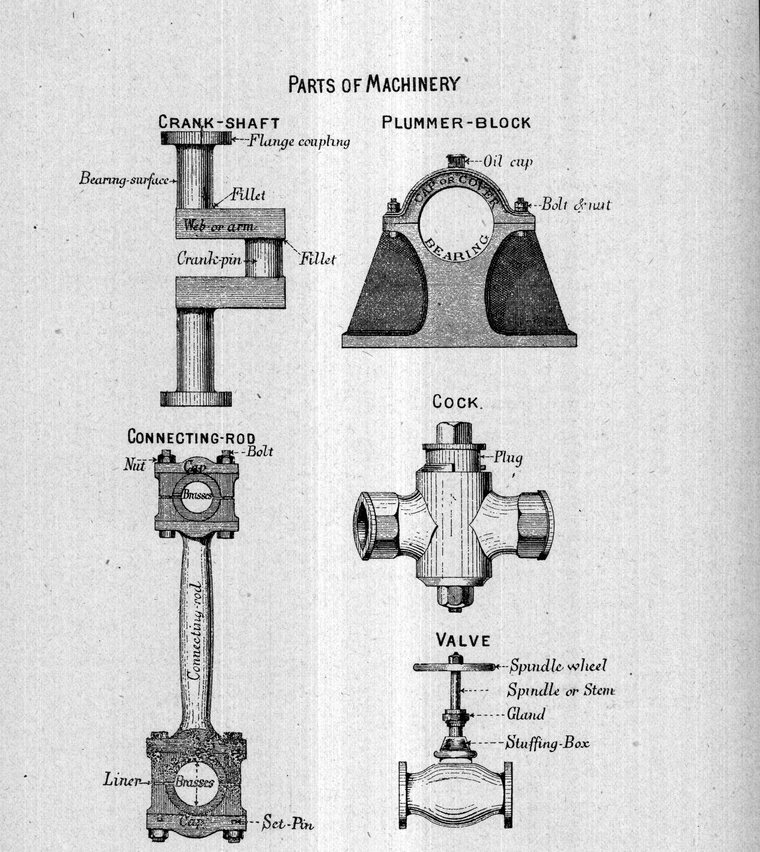
The casting which encloses the valve.
The combination of parts by which an engine valve is operated.
(See Seat.)
The rod entering the steam chest and connected to the valve which it moves.
Oil is said to have viscosity when it possesses good body.
(See Beam.)
(See Engine.)
A small plate about a bolt and next to the nut. Its use is to distribute the strain which the nut resists over a greater area than the nut possesses.
Spun but unwoven cotton refuse used as wiping stuff about the engine.
A bridge wall built into a boiler at the back of the furnace, forming part of the interior shell and inclosing water space.
A small vertical cylinder, usually of composition, attached to a boiler at the water line, to which the gauge cocks and glass water gauge are attached.
(See Gauge Glass.)
(See Leg.)
The part of a boiler which is designed to contain water.
The water resulting from condensing steam.
The reduction of pressure which steam undergoes by its passage through contracted areas, and by which its efficiency is reduced.
That about an engine from which the starting and reversing gear is reached and handled.
In its pure state it is metallic iron without combination with any other element, and is produced from cast iron by refining and puddling.
Naught. The term is applied to the point on a scale from which the graduation are made.
Absolute zero. The line of no pressure on an indicator diagram, and from which absolute pressures are measured.
(See Naval Academy.)
An engagement between two or more vessels.
Clear Ship for Action. To make preparation for battle by removing everything liable to obstruct the working of the guns, also such material as hatch-railings, etc., that would naturally be shattered and scattered by the enemy's shot.
The highest ranking officer in the navy.
An officer of the rank of lieutenant, attached to the admiral's staff. This officer is also known as flag lieutenant.
An instrument so constructed as to permit the observer to look over intervening objects, and by the employment of which guns may be pointed, or trained, from the deck below.
Explosives and projectiles designed to be fired from ordnance. (See Powder; Explosive; Charges; Table of U.S. Naval Breech-loading Guns.)
(See Naval Apprentice.)