Ratline StuffSea Terms
A small tarred line used to rattle rigging. It is generally 18 threads.
Page 206 of Patterson’s Illustrated Nautical Encyclopedia · 23 entries
A small tarred line used to rattle rigging. It is generally 18 threads.
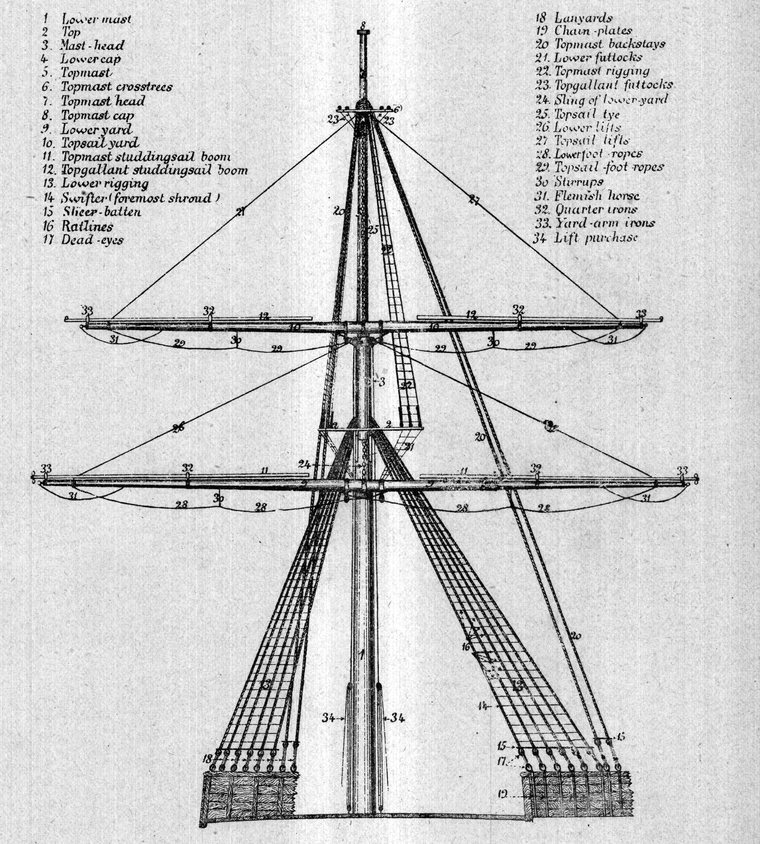
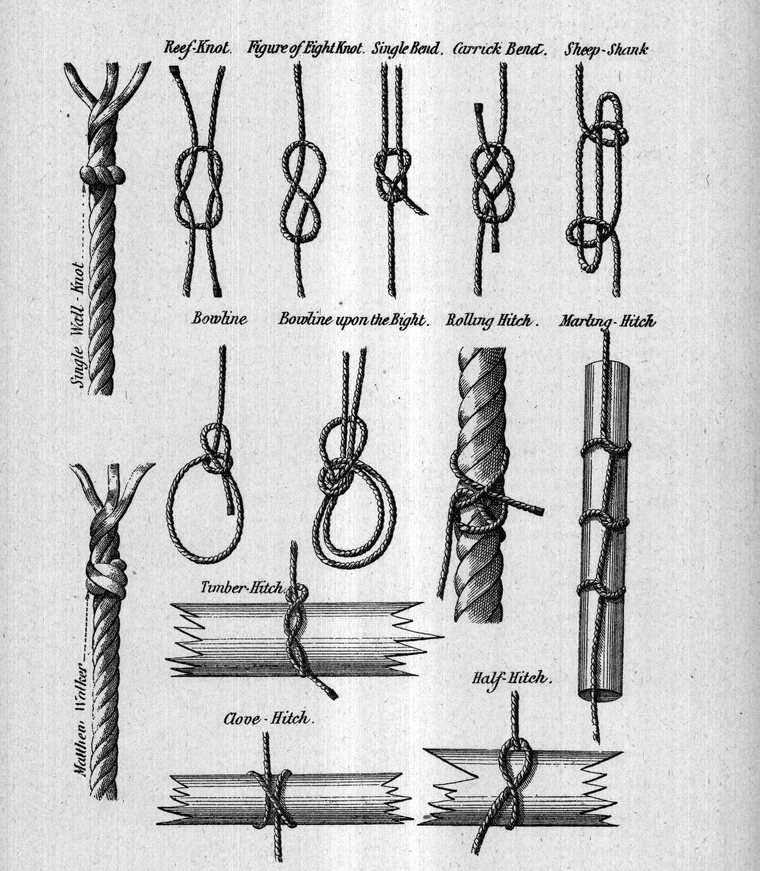
Short lengths of ratline stuff seized and clove-hitched 14 inches apart across the shrouds, parallel with the sheer pole, and which act as the rounds of a ladder for the crew in ascending or descending from aloft. All the ratlines extend from the swifter (the forward shroud) to the one next to the aftermost shroud, but every fifth ratline is seized to this after shroud, and is called both a catch ratline and a sheer ratline.
To seize and clove-hitch the ratlines across the rigging.
(See Canvas.)
A ship of war after being cut down so as to reduce her to the next inferior rate.
(See Head Reach.)
(See Fore Reach and Head Reach.)
An order to the crew to be prepared for tacking ship.
A mixture of white lead and red lead used for various purposes. Some shipmasters fill up the deck seams with this preparation after caulking, instead of using pitch or marine glue. This putty does not become soft and stick to the feet when the ship is in warm latitudes. (See White Lead Putty.)
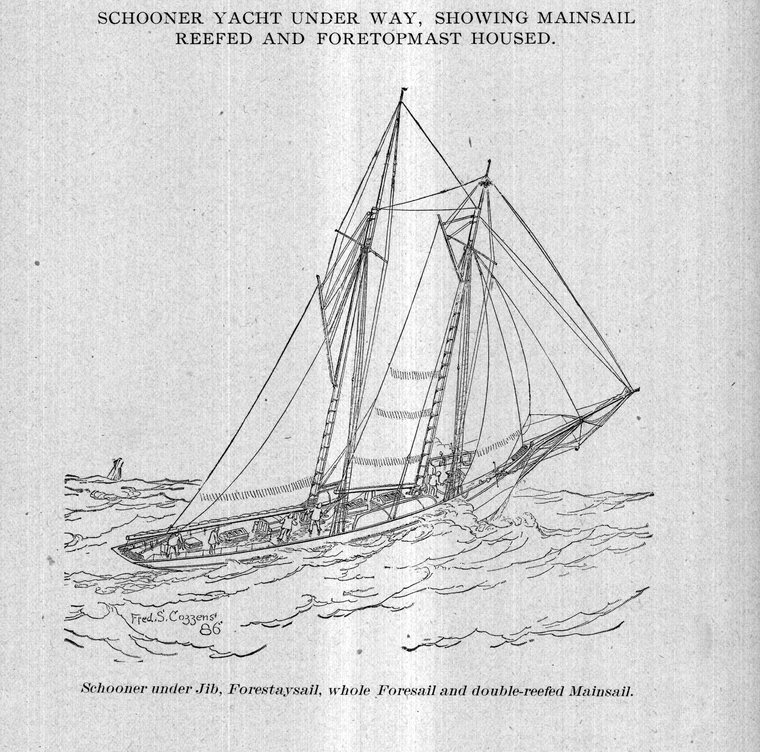
To contract a sail is to reef it. Square sails are taken in upon the head, but fore-and-aft sails upon the foot. Close reef means to reduce the sail to the last row of reef points. To shake out a reef is to open out the sail to the value of a breadth contained between two reef bands.
A band of canvas sewed across the sail in order to support the strain placed upon it by the reef points. A reef band has ear-rings at each end.
Galvanized iron rings (called thimbles) spliced in the bolt rope on the leaches of square sails, and on the leach and luff of fore-and-aft sails at the end of the reef bands, and used for confining the ends of the reef bands to the yard or boom.
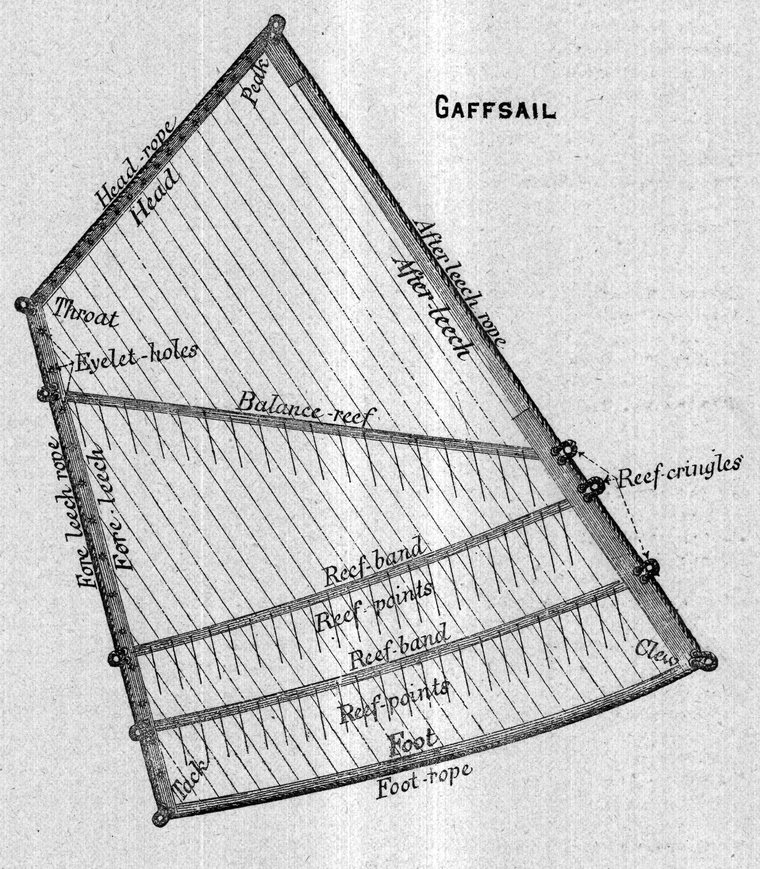
On a square sail a reef earing is a small line used to secure the reef cringle to the yard-arm. On a fore-and-aft vessel reef earings are short platted lengths of rope passed through the reef cringle and around the boom several times, so as to keep the leach of the sail secure to that spar after the reef points are tied and the sail again hoisted.
A familiar term by which a midshipman is designated.
(See Flat Knot.)
A rope made fast in the reef cringle on the leach, and to which the reef tackle is hooked.
The short cordage on the reef bands used to tie up the sail in reefing. Reef points are often referred to as nettles.
The tackle which holds the middle of the leach of a squaresail up to the yard in reefing. On a fore-and-aft vessel the reef tackle hauls the reef earing on the leach of the sail out along the boom.
(See Running Bowsprit.)
An iron used by caulkers to widen the seams of a wooden vessel before driving in the oakum.
To reeve a rope is to pass the end of it through a block, dead-eye, bull's eye, or any aperture.
Races between sailing yachts and rowing boats.
A marine document issued to a vessel by the customs officials, permitting such vessel to engage in trade with a foreign country, to be employed in the fisheries, and to engage in domestic trade. In other words, a register does not limit a vessel's occupation. The register identifies the vessel in the following particulars; nationality, official number, ownership, vessel's name, home port, name of master, year of building, place of building, name of the measurer, number of decks, number of masts, rig of vessel, dimensions and tonnage. Vessels of the United States engaged in trade with a foreign country (except upon the northern inland frontier of the United States) must be under register. The register continues in force indefinitely unless the rig of the vessel, or the tonnage of same, or the ownership changes, in which case a new register must be obtained.